How to Design a Spraying Line for Chemical Milling Maskant of Aircraft Components
1. What is the difference between maskant spraying and conventional painting?
Many people associate a "spray line" with paint spraying. However, the application of chemical milling maskant for aircraft components is entirely different from ordinary coating.
Chemical milling is a critical weight-reduction process in aerospace manufacturing. It removes excess metal via etchant to precisely thin structural parts such as aircraft skins and wing panels. The maskant serves as a temporary protective layer applied to areas that must remain unetched. It must be fully impermeable under strong alkaline conditions (NaOH solution at 70–85°C for aluminum parts) or strong acidic environments (HF/HNO₃ mixed solution for titanium parts)[1].
This maskant has conflicting performance requirements: it must have sufficient adhesion to resist peeling and blistering in etchant, yet be peelable as an intact film after chemical milling without residue. Ordinary coatings cannot achieve such "controllable adhesion". Aerospace-grade maskant is typically neoprene-based, offering excellent resistance to NaOH systems for aluminum workpieces[2].
In terms of application process, maskant has much higher viscosity than conventional coatings and requires multi-layer cross spraying. Each layer is applied at a 90° angle to the previous one with 50% overlap, building up to a total thickness of 0.2–0.4 mm. Per industry standard HB/Z 412-2013 Chemical Milling Process for Titanium Alloy Parts, maskant shall be applied no fewer than three times. The next coat can only be applied after the previous layer is surface-dry[3]. This means the production line cannot finish spraying in one pass; parts need to go through the spraying station multiple times or recirculate within the spray booth.
Based on our experience with aerospace manufacturers, maskant application quality directly determines the success of chemical milling. Even a single pinhole leak can ruin an entire workpiece, resulting in losses of hundreds of thousands of RMB. Therefore, the production line design must center on the core goal of "multi-layer cross spraying with zero defects".
2. How is the production line zoned and laid out?
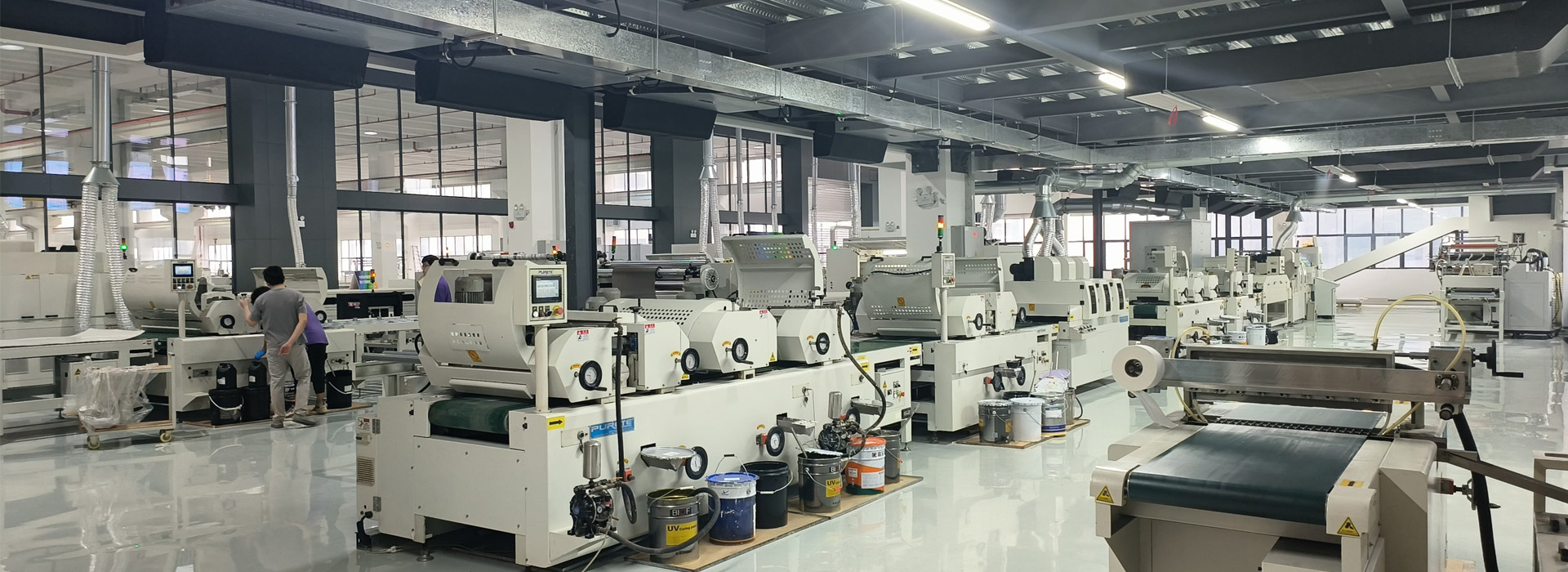
Focused on the multi-layer cross spraying process, reciprocating spray machines are adopted in this production line design, with PURETE reciprocating spray machines as the example. The whole line is divided into five functional zones from feeding to discharging. The functions of each section are as follows:
| Zone | Core Function |
|---|
| Conveying Zone | Degreasing & cleaning, surface activation, oxide layer removal |
| Turning Mechanism | 180° workpiece turnover to enable coating on both sides |
| Conveying Section | Isolation between two process stages |
| Main Spraying Zone | Multi-layer cross spraying of chemical milling maskant |
| Conveying Zone | Unloading |
3. How to set the spraying process parameters for chemical milling maskant?
The spraying parameters of maskant differ greatly from conventional coatings and shall be configured separately from four dimensions: viscosity, spray gun selection, spraying distance and film thickness control.
Viscosity control: The viscosity of chemical milling maskant is generally 40–50 seconds (Ford Cup #4)[4]. Excessively high viscosity leads to poor atomization and uneven film thickness; while too low viscosity results in insufficient film thickness after solvent evaporation. As maskant contains a large amount of solid fillers such as talcum powder and silica, sedimentation will occur after long-term standing. Therefore, the glue supply system must be equipped with an agitator to maintain homogeneity.
Spray gun selection: Maskant features high viscosity and high solid content, and ordinary air spray guns deliver poor atomization. Production lines commonly adopt airless spray with nozzle orifice of 1.5–2.5 mm and spraying pressure of 15–25 MPa. Airless spray produces coarse atomized particles and high coverage, suitable for multi-layer build-up of high-viscosity maskant.
Cross spraying method: This is the core operating specification for maskant application. The first coat is sprayed horizontally (0°), the second coat is applied vertically at a 90° rotation, and so on. A 50% overlap coverage is required between each layer to ensure no missing areas. Per standard HB/Z 412-2013, adjacent maskant layers shall be applied in mutually perpendicular directions[3]. On automated lines, this is realized by PLC-controlled reciprocating direction switching of the spray gun.
Film thickness control: The wet film thickness of each layer is approximately 0.08–0.12 mm. After 3 to 4 layers, the total dry film thickness is controlled at 0.2–0.4 mm. Film thickness of every workpiece is inspected by an eddy current thickness gauge. Thin areas below 0.2 mm may be penetrated by the etchant during chemical milling; thickness over 0.4 mm will cause difficult stripping and greatly raise the cleaning cost of residual maskant after milling.

4. Environmental and Safety Considerations for Chemical Milling Maskant Spraying Line
Chemical milling maskant contains large amounts of organic solvents (xylene, tetrachloroethylene, etc.) and is flammable. Therefore, the environmental and safety design of its spraying line is more stringent than that of conventional coating lines.
VOCs Emission Control: A large volume of solvents evaporates during maskant spraying, resulting in high VOCs concentration. The spray booth is equipped with a closed negative-pressure system (-30 to -50 Pa). Exhaust gas containing solvents is treated by activated carbon adsorption + catalytic oxidation (RCO) or zeolite rotor + regenerative thermal oxidation (RTO), to ensure the emission concentration complies with GB 16297 Integrated Emission Standard of Air Pollutants.
Explosion-proof Requirements: The flash point of maskant solvents is generally 20–35°C, making the spraying area Zone 1 hazardous location. All electrical equipment (lights, motors, sensors) shall adopt Ex d or Ex de explosion-proof rating, with grounding resistance ≤ 4 Ω. The concentration of flammable gas inside the spray booth shall be monitored in real time with two-stage alarms: the first alarm at 25% LEL triggers increased exhaust air volume; the second alarm at 50% LEL triggers line shutdown and emergency exhaust.
Waste Maskant Disposal: Stripped waste maskant after chemical milling is classified as hazardous waste (HW12 dye and coating waste), which must be disposed of by qualified contractors. According to actual data from an aerospace manufacturer, the consumption of chemical milling maskant per aircraft set is approximately 120–180 kg, and the stripped waste maskant accounts for about 60–70% of consumption. For a workshop with an annual output of 50 aircraft sets, the annual waste maskant generation is around 4–6 tons.

5. FAQ
Q: Can chemical milling maskant and conventional paint share the same production line?
A: Not recommended. Maskant has a much higher viscosity than ordinary coatings (40–50s via Ford Cup #4 versus typically 15–25s for paints), requiring airless spray equipment with entirely different nozzle sizes and pressure settings. Moreover, its cross-spraying method and multi-layer progressive drying process differ substantially from the single-coat film formation of conventional painting. Shared-line operation will cause difficult cleaning and cross-contamination.
Q: What is the progress of domestic chemical milling maskant development?
A: The dominant product in aerospace manufacturing is AC850 from US-based AC Products, which has long monopolized the global market. For domestic substitution, Shuzhou Surface Technology’s YN-AC850 has been applied in mass production at Changhe Aircraft, AVIC Chengdu Aircraft, AVIC Xi’an Aircraft and other manufacturers, with performance indicators comparable to AC850[1]. The global chemical milling maskant market reached approximately USD 495 million in 2025, of which the aerospace & defense sector accounts for 80.2%. It is projected to grow to USD 711 million by 2032 at a CAGR of 5.3%[2]. Domestic substitution is a clear trend, yet gaps remain in high-end formulations and certification systems.
Q: What are the key points for daily maintenance of this line?
A:
- Check belt tension weekly; re-tension if slack exceeds 2%.
- Apply lithium-based grease to roller bearings every month.
- Clean spray guns in the spraying zone after each use to avoid nozzle clogging from cured maskant.
- Calibrate the encoder zero point of the servo motor on the turning mechanism quarterly.
References
[1] Domestic YN-AC850 Chemical Milling Maskant, Shuzhou Surface Technology, Sohu Official Account, 2025-11-22
[2] Peelable Chemical Milling Maskants Market Report, Precedence Research, 2026-06-20
[3] HB/Z 412-2013, Chemical Milling Process for Titanium Alloy Parts, Aviation Industry Standard of China
[4] Technical Specification for Acid & Alkali Resistant Peelable Paint / Coatings, Turun Coatings