How to Apply Direct Printing of Wood Grain Patterns to Large Rubber Finger-Jointed Wood Panels?
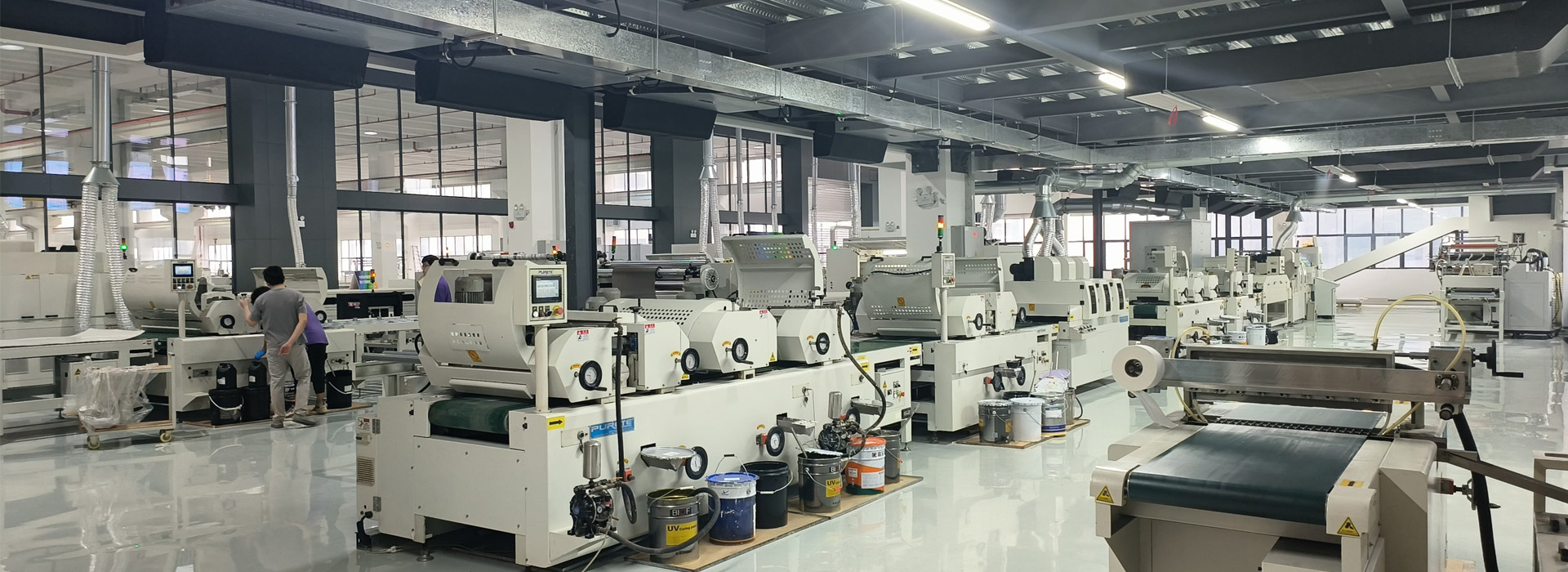
In the finishing industry, there are several methods for applying patterns to substrates, including direct printing, transfer printing, digital printing, and surface lamination. Among these, direct printing, transfer printing, and digital printing require the use of paint, while surface lamination uses adhesive and decorative materials to bond the pattern to the substrate. This article uses a practical case study of direct printing on rubber finger-jointed wood to explain the direct printing process. The case study presented here is from a real client of PURETE
1. What is the difference between direct printing on rubberwood finger-jointed boards and conventional veneer application?
Direct printing on rubberwood finger-jointed boards uses a multi-color printing press to print wood-grain patterns directly onto the surface of the solid wood substrate, producing a more realistic finish. Conventional veneering, by contrast, bonds decorative paper or wood veneer to the board surface with adhesive.
The most fundamental difference between the two lies in the bonding mechanism: direct printing is a penetration-type bond, whereas veneering is a glue-lamination-type bond. In terms of durability, directly printed products are far less prone to the blistering, delamination, and edge lifting commonly seen with veneer.
However, direct printing places higher demands on substrate flatness. Rubberwood finger-jointed boards have finger-joint seams on the surface — if these are not adequately treated before printing, the printed grain may show broken lines or color mismatch.
According to industry practice data, the yield rate of direct printing on rubberwood finger-jointed boards is 15–20% higher than that of natural wood veneer lamination, because the batch-to-batch color variation of veneer is eliminated. The grain consistency of each roll of transfer paper is also far superior to that of natural wood veneer. (Source: 2026 Rubberwood Paint-Free Board Industry Report)
2. Why does direct printing on rubberwood finger-jointed boards require 9 process steps?
The 9 steps are not arbitrarily stacked — each one solves a different surface problem.
Step 1 – Sanding the blank board. Removes saw marks and burrs, providing a flat starting point for the subsequent processes.
Steps 2–3 – Two rounds of heavy putty filling. With only one goal: to fill and level the finger-joint seams. Rubberwood finger-jointed boards are made by tooth-joining multiple short pieces of lumber; the joints naturally have gaps and height differences. If they are not filled level, the printed grain will be broken later.
Step 4 – Forward/reverse roll sanding base coat. The key transitional layer.
Step 5 – Tinting base coat. Determines the final "base color" of the wood grain.
Step 6 – Grain printing. The core process, in which the wood-grain pattern is printed directly onto the board surface.
Steps 7–8 – Two rounds of color correction. Making the final color more vivid and saturated.
Step 9 – One more forward/reverse roll sanding base coat, after which a clear topcoat can be applied.
There is a curing stage between each process step. Across the entire line, the time required for one board to go from feeding to finished product depends on the configuration of the drying ovens at each stage.
3. What are the common quality issues in direct printing on rubberwood finger-jointed boards?
Based on frontline experience at the case customer's factory, the most common quality issues in the direct printing process are broken grain lines and color variation.
Broken grain lines are usually caused by two factors: first, the putty fails to fill the finger-joint seams level, so the printing roller "floats" over the gaps and the ink cannot transfer evenly; second, the base coat sanding is not smooth enough, leaving height differences on the surface. The solution is to strictly follow Steps 2–3 (double putty filling) and Step 4 (forward/reverse roll sanding base coat) without skipping any step.
Color variation comes in two forms. Batch-to-batch variation stems from an unstable tinting base coat formula or differences between ink batches for grain printing, and requires color-board comparison before each batch goes into production. Within-board variation occurs because of uneven board density — different sections of rubberwood finger-jointed board have different wood densities, absorb different amounts of ink, and therefore produce printed colors of varying depth. Controlling the moisture content within the 8–12% range can effectively reduce this type of problem. (Source: Hangmei Rubberwood Paint-Free Board Process Report, August 2026)
In addition, insufficient drying can also cause problems in subsequent processes. If the grain is printed before the tinting base coat is fully dried, the ink will bleed into the base layer and the grain will turn blurry; if color correction is applied before the printed grain is fully dried, the two layers will blend together and the final effect will look gray.
4. What products is direct printing on rubberwood finger-jointed boards best suited for?
Based on the case customer's product line, the main application of direct printing on rubberwood finger-jointed boards is large-panel furniture panels.
Solid wood tabletops / tea tables: Rubberwood finger-jointed boards are used as the substrate, with walnut, oak, rosewood and other wood grains printed directly onto the surface, finished with a matte or semi-matte treatment. The finished product visually resembles natural solid wood tabletops.
Cabinet door panels: High demand in the whole-house customization sector. Direct-printed panels can be used directly as cabinet doors without additional veneering, saving an entire process step. Based on the case, this is the typical cabinet door panel product.
Wall cladding / decorative panels: Large-format direct-printed panels are ideal for wall decoration, offering continuous grain and strong visual cohesion.
Display cases / commercial space panels: For commercial projects with high requirements for batch consistency, direct printing offers a clear advantage over natural wood veneer.