I.What problems does battery housing coating solve?
The battery housing of new energy vehicles is no ordinary "metal box". An aluminum alloy battery lower enclosure must withstand vibration and impact from road conditions, maintain structural integrity under extreme temperatures ranging from -40℃ to 85℃, and prevent corrosion caused by electrolyte leakage as well as high-voltage short circuits and fire hazards. The coating serves as both the first and last line of defense for battery housings.
In accordance with standard GB/T 31467.3, battery packs must pass stringent tests including extrusion, drop and vibration. Coating quality directly determines the test pass rate. Insufficient breakdown voltage of the insulating coating will lead to high-voltage electric leakage, while weak anti-corrosion coating will accelerate salt spray corrosion and further result in structural failure.
The core challenge lies in the large surface area of the battery housing (a single base plate can reach 1500×2300mm), complex geometries (numerous weld seams, inner cavities and blind holes), and multi-functional coating requirements (insulation, anti-corrosion, adhesion, and welding assistance).
II. What Coatings Are Applied to Battery Housings? Three Typical Application Scenarios
Scenario 1: Insulating Coating (Inside Battery Trays)
This represents one of the core roll coating applications for battery housings. The interior of battery trays requires insulating coating to avoid short circuits between high-voltage cells and metal enclosures.
Typical process flow:
Alkaline degreasing of aluminum alloy surface → Chrome-free passivation (zirconium/titanium based) → Multi-stage pure water rinsing (conductivity <30μS/cm) → Cathodic epoxy electrocoating (film thickness: 20–25μm, voltage:150–250V, bath temperature:28–32℃, pH:5.8–6.5) → Curing (workpiece temperature:160–170℃, 20–25min).
According to the technical solution from Maanshan Sibr Metal Technology, the coating system combining cathodic epoxy electrocoating and chrome-free passivation achieves a breakdown voltage ≥2kV, neutral salt spray resistance ≥800h, and adhesion performance passing MEK rub test (≥50 rubs without substrate exposure).
Source: Emerging Applications of Electrocoating for New Energy Battery Trays, Furniture Hardware & Medical Devices, Sibr Metal.
Role of reciprocating single roll coater in this scenario:
Before or after electrocoating, apply functional coatings on designated areas (e.g., welded zones, assembly contact surfaces). Typical applications include flux coating for subsequent brazing, or insulating sealant coating for bonding sealing strips.Scenario 2: Flux Coating for Liquid Cooling Plates
This is a key application scenario for PURETE reciprocating single roll coaters. Liquid cooling plates of power batteries require welding, and flux must be applied precisely and uniformly onto welding areas prior to brazing.
Flux functions to remove oxides on the base metal and filler metal surfaces, protect welded zones, and improve the wettability of brazing filler metals. The uniformity of flux coating directly determines welding quality: insufficient flux leaves residual oxides and causes cold solder joints, while excessive flux leads to flux residue and pipeline corrosion.
Roll coating delivers distinct advantages in this process. The coating roller enables precise control over flux application weight and coverage area. Reciprocating motion covers the entire surface of liquid cooling plates, and the servo system ensures consistent coating results for every cycle.
Scenario 2: Flux Coating for Liquid Cooling Plates
This is a key application scenario for PURETE reciprocating single roll coaters. Liquid cooling plates of power batteries require welding, and flux must be applied precisely and uniformly onto welding areas prior to brazing.
Flux functions to remove oxides on the base metal and filler metal surfaces, protect welded zones, and improve the wettability of brazing filler metals. The uniformity of flux coating directly determines welding quality: insufficient flux leaves residual oxides and causes cold solder joints, while excessive flux leads to flux residue and pipeline corrosion.
Roll coating delivers distinct advantages in this process. The coating roller enables precise control over flux application weight and coverage area. Reciprocating motion covers the entire surface of liquid cooling plates, and the servo system ensures consistent coating results for every cycle.

Scenario 3: Anti-Corrosion Coating for Energy Storage Pack Enclosures
Energy storage system (BESS) pack enclosures operate long-term in outdoor or enclosed environments, where they must withstand vibration, impact and electrochemical corrosion. According to the selection guide from Herewinpower, aluminum alloy pack enclosures are recommended to use fluorocarbon resin coatings to mitigate electrochemical corrosion risks caused by internal condensation, achieving a 2000-hour neutral salt spray test result.
Source: LFP Battery Housing Selection Guide, Herewinpower.
Roll coating enables uniform application of anti-corrosion primer, building a sound adhesion foundation for subsequent powder topcoat or fluorocarbon coatings.
III. Overview of Coating Performance Requirements
| Performance Indicator | Required Value | Test Standard | Applicable Coating Type |
|---|
| Insulation Resistance | ≥50 GΩ | DC 1000V, 5s | Insulating Powder Coating |
| Dielectric Strength | 30–70 kV/mm | IEC 60243-1 | Insulating Coating |
| Salt Spray Resistance | ≥800h, no corrosion | ISO 9227 | Anti-corrosion / Insulating Coating |
| Thermal Shock Resistance | 100 cycles from -40°C to 85°C, no cracking | — | Insulating Coating |
| Electrolyte Corrosion Resistance | 50 days continuous corrosion, no electrical breakdown | — | Battery Pack Housing Coating |
| Flame Retardancy Class | V-0 | UL 94 | Internal & External Coatings for Battery Housings |
| Adhesion | Grade 0 (Cross-cut Test) | ISO 2409 | All Coatings |
| MEK Rub Test | ≥50 rubs, no substrate exposure | — | Electro-cured Coating |
IV. What Does a Reciprocating Single Roll Coater Look Like?
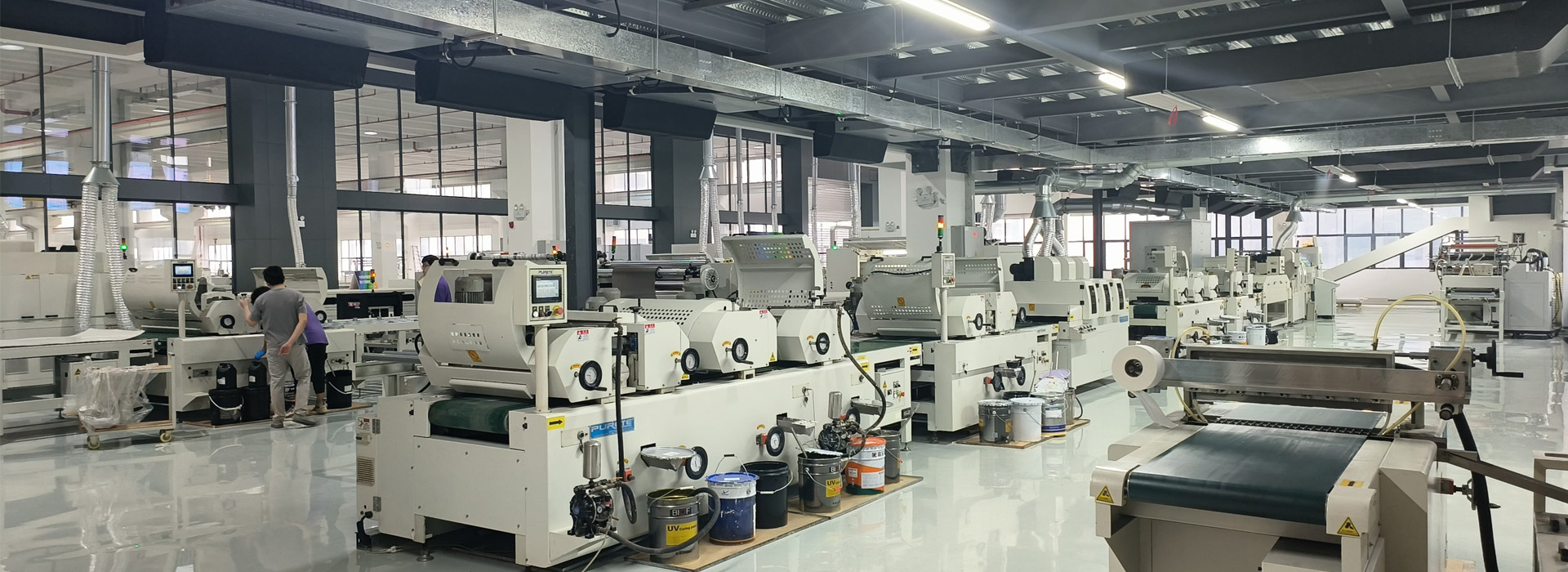
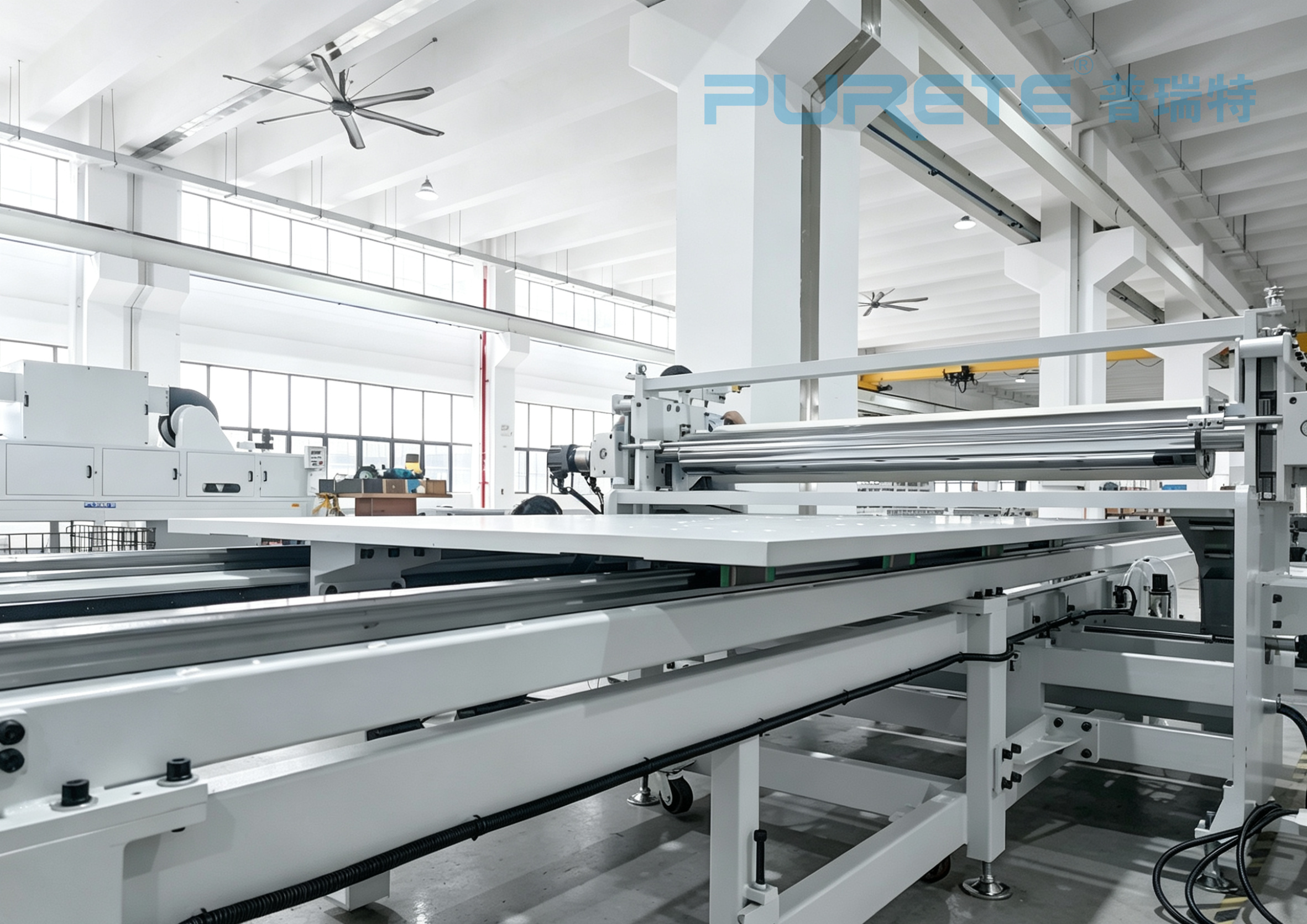
Take the PURETE reciprocating single roll coater as an example. The complete machine consists of two independent modules: the coating assembly and the conveying platform.
Coating AssemblyThe single roll coating head adopts full servo control and features two motion axes. For vertical movement, servo motors paired with RV reducers and ball screws deliver precise lifting. During non-working strokes, an air cylinder enables rapid floating lift to avoid unnecessary contact between the roll surface and workpieces. The coating roll itself is driven by a servo motor and planetary reducer, with an encoder wheel to control the coating load.
Conveying PlatformDriven by a servo system, the platform achieves reciprocating horizontal movement via rack-and-pinion and linear guides, with a designed linear speed of 30 m/min. The platform is equipped with a pneumatic lifting and unloading system. Each lifting unit is fitted with corrugated vacuum suction cups to ensure no workpiece displacement during lifting, which is critical to prevent coating scratches during transfer.
Auxiliary SystemsElectric agitation for the paint tank; oil-free detection sensors mounted on the coating head to prevent dry coating due to material shortage; pneumatic oil dams to define coating boundaries. Position sensors are installed for both vertical lifting and horizontal reciprocating motion for safety protection.
V. FAQ
Q: What size battery housings are compatible with the reciprocating single roll coater?
A: The coating working range is 1500 × 2300 mm, covering most new energy vehicle battery lower trays (typical dimensions approx. 1200 × 2000 mm to 1600 × 2400 mm) and liquid cooling plates (typical dimensions approx. 800 × 1200 mm to 1500 × 2000 mm). With a coating depth of 50 mm, the machine can process workpieces with shallow grooves and reinforcing ribs. Longer conveying platforms are available as custom options for oversized workpieces.
Q: Can roll coating apply coatings to the inner cavities and weld seams of battery housings?
A: The limitation of single roll coating is that it only coats flat surfaces and shallow concave surfaces. Roll coating cannot reach complex 3D features such as inner cavities, deep holes and weld seams of battery housings; these areas typically require electrocoating or spray coating. Therefore, roll coating is commonly deployed in production lines as a dedicated process for selected zones (e.g., large base flat surfaces, liquid cooling plate surfaces), working in combination with electrocoating or spray coating.
Q: How is coating thickness controlled? What is the achievable precision?
A: Film thickness is governed by three parameters: ① the gap between the coating roll and metering roll (directly defining the coating load); ② the pressure between the coating roll and conveying platform (affecting transfer efficiency); ③ roll speed ratio (adjusting shear force and coating weight). With coordinated control of these three parameters, film thickness tolerance can be kept within ±5 μm. According to industry reports, the high-precision adaptive roll gap control system from Jiangsu Snoway Electromechanical can limit transverse thickness deviation to within ±3%.
Source: 2026 China Conventional Two-Roll Coating Machine Industry Development Report, Boyan Consulting.
Q: Can the machine integrate into automated production lines? How to interface with robotic loading & unloading?
A: Yes. For robotic handling, the robot places workpieces onto the conveying platform. Lifting suction cups secure the workpiece. Once coating is finished, the robot picks up the finished part. The whole process operates without manual intervention.
Q: Are additional treatments required after roll coating on battery housings?
A: It depends on the coating function. For flux coating, workpieces go straight to the brazing process after roll coating. For insulating or anti-corrosion primer, the coated parts normally enter a drying/curing oven (160–170°C for 20–25 min). If a topcoat is required afterwards, the roll-applied primer acts as an adhesion layer, and the topcoat can be applied via spray coating or powder coating.