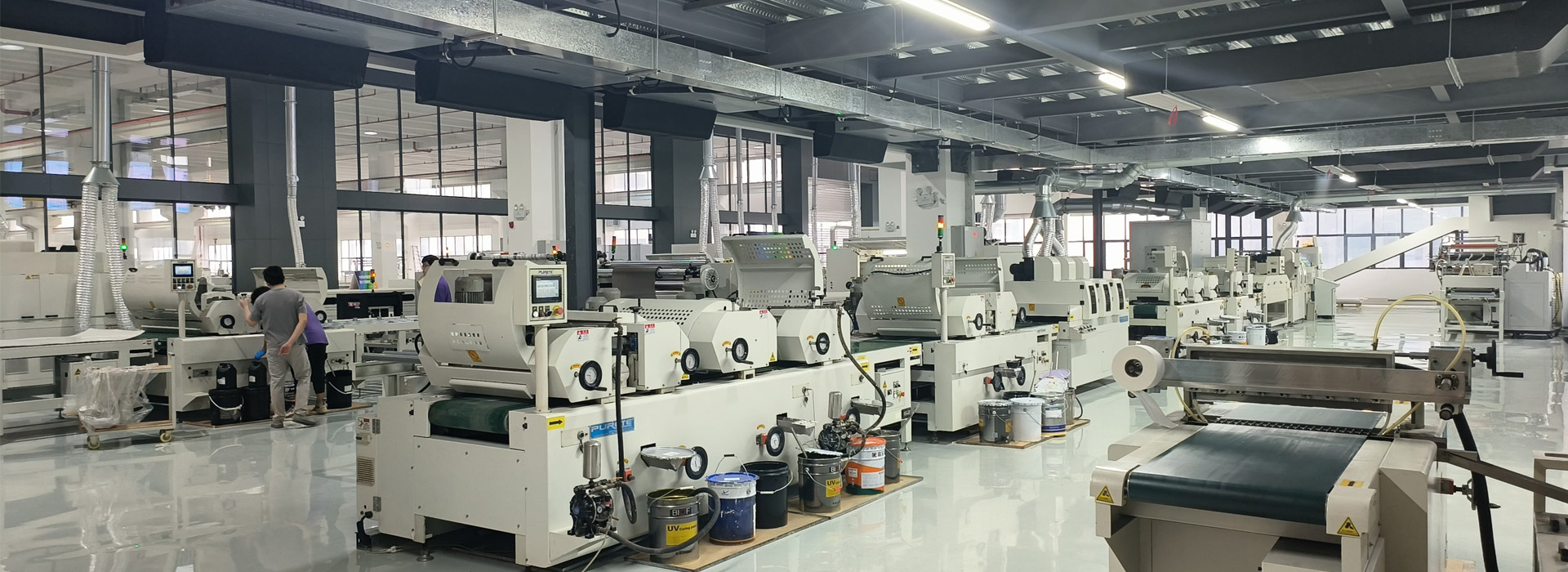
Information on local agents in Portugal:
Country/Region: Portugal (Paredes and Lordelo, Porto District)
Year established: 2016
Number of employees: 11–50, with a technical team of 12 (all with over 20 years’ industry experience)
Core business: Distributor of industrial equipment for the timber and cork sectors + systems integrator, specialising in high-end automated production lines and technical services
The client’s current issue
1. Product Quality Issues
Poor adhesion and delaminationCalcium silicate board features dense surface, low water absorption and tendency to chalk. Conventional laminating lines suffer from insufficient adhesive force, leading to edge warping, peeling and blistering, which gets worse in humid European climates.
Wrinkles and deviation caused by uneven & warped boards,Minor warpage and wavy edges commonly exist on calcium silicate boards. Ordinary equipment has low tolerance to board deformation, resulting in material deviation, uneven tension, surface orange peel, air bubbles and wrinkles. The qualified rate stays low with high rework costs.
Inconsistent finishing on wide panels.For mainstream wide panels (1220–1530mm) popular in Europe, traditional equipment fails to guarantee stable performance across full width. Uneven glue thickness, inconsistent gloss on both ends and glue marks often occur, causing rejection of high-end orders.
Inadequate water, weather and temperature resistancePortugal and other European regions have high humidity and large temperature differences. Lamination with conventional cold glue tends to come unglued in damp conditions and shift under high temperature, failing to meet EU standards including CE and EN 13986.
2. Production Efficiency & Cost Issues
Time-consuming model changeoverThe company handles diversified customized orders with various finishes and sizes. Old devices require 1.5 to 3 hours for product switchover, relying heavily on skilled operators. Long lead times make it hard to satisfy delivery requirements.
High labor dependency & labor costsManual work is widely used for board feeding, positioning, deviation correction and edge trimming. Skilled workers are hard to recruit and expensive in Europe. Manual operation also leads to unstable product quality.
Excessive glue consumption & strict environmental requirementsTraditional processes consume large amounts of glue and generate more waste. Solvent-based adhesives produce high VOC emissions, which cannot comply with EU environmental regulations.
3. Equipment Adaptability & Maintenance Issues
Rapid wear caused by high hardness and dustCalcium silicate boards are hard and produce plenty of dust during processing. Dust easily sticks to glue rollers and impairs lamination quality. Conveying rollers, pressure rollers, bearings and belts wear out quickly, resulting in frequent downtime and maintenance.
High price, long delivery and slow after-sales service of European local equipmentLocal European machinery is costly, with a delivery cycle of 6–12 months. Spare parts are expensive and technical support responds slowly. Besides, mature solutions dedicated to calcium silicate board are scarce.
Low automation and poor line integrationOrdinary laminating lines cannot connect smoothly with upstream sanding and coating equipment. They lack automatic deviation correction, positioning and edge trimming functions, and fail to support digital management required by modern European factories.
4. Market & Order Challenges
Stringent requirements for high-end projectsProjects such as hotels, hospitals and metro facilities demand flawless surfaces with no bubbles or wrinkles, excellent flatness, yellowing resistance and moisture resistance, which traditional equipment cannot achieve steadily.
Strict EU environmental regulationsProducts must pass CE, REACH and meet non-asbestos, low-VOC and high-grade environmental standards like ENF. Outdated processes cannot fulfill these mandatory certification requirements.
Fierce market competitionHomogenization is serious in the industry. As a machinery distributor, Lignotec needs to deliver solutions with high finished product quality and stable operation to gain competitive advantages.
We have drawn up the following configuration requirements based on the client’s needs:
1. Direction of operation: reverse;
2. Base material: magnesium oxide board;
3. Workpiece dimensions (specifications): 40 mm thick, length 700–1200 mm, width 700–1200 mm;
4. Film material: PVC;
5-Configuration standards: All equipment to be certified as required: CE certification; Variable frequency drives and low-voltage electrical components: Schneider; PLC, servo motors and HMI: Siemens;
6-All integrated motor/gear units: Siemens;
7-Lifting mechanism: Siemens servo motors, ball screws;
8-Power cut-off upon door opening;
9- Safety features: Anti-pinch design; colour-coded warning on components (in areas accessible to hands): yellow;
10- Standard components (bearings/guide rails/pneumatic): Imported brands or fully imported brands selected for core components;
11- Quality of exterior finish: Avoid colour discrepancies and paint flaking; ensure smooth sanding, precise door gap alignment, anti-warping measures and anti-corrosion treatment;

Comparison of Advantages
| No. | Comparison Items | PURETE Equipment | Ordinary Competitors' Equipment |
|---|
| 1 | Running Direction | Custom reverse operation to match production layout | Mostly fixed forward direction, unable to adjust as required |
| 2 | Applicable Base Material | Optimized for magnesium oxide board, stable lamination effect | General design, poor adaptability to magnesium oxide board, easy to cause bonding failure |
| 3 | Workpiece Size | Fits boards: Thickness 40 mm, Length 700–1200 mm, Width 700–1200 mm; good tolerance to size variation | Limited size range, unstable operation for thick and large-size workpieces |
| 4 | Cladding Film | Perfectly compatible with PVC film, uniform laminating without wrinkles or bubbles | Prone to PVC film deviation, air bubbles and poor surface finish |
| 5 | Certification & Electrical Parts | Full CE certification for EU market accessVFD & low-voltage components: Schneider | Incomplete or no CE certification, risks for EU exportMixed low-end domestic or generic electrical parts, high failure rate |
| 6 | Motor & Gear Unit | Adopt Siemens integrated motor-gear units, stable running and long service life | Use common domestic or low-cost combined units, large noise and easy wear |
| 7 | Lifting Structure | Driven by Siemens servo motors + ball screws, high positioning accuracy, no offset after long-term use | Ordinary motors + common screw/chain drive, low precision, loose positioning easily |
| 8 | Power Safety | Equipped with power cut-off function when door is opened for operation safety | Most models remove this function, existing potential safety hazards |
| 9 | Safety Protection | Professional anti-pinch structureYellow warning color on all hand-accessible parts, fully compliant with EU safety norms | Simplified safety design, no anti-pinch protection and standard warning marks |
| 10 | Standard Core Components | Bearings, guide rails and pneumatic parts: all imported brands, wear-resistant and low maintenance cost | Mainly domestic standard parts, quick to wear out and require frequent replacement |
| 11 | Exterior & Overall Workmanship | Strict anti-corrosion & anti-warping treatmentSmooth surface, no color difference or paint peelingPrecise door gap matching | Poor anti-corrosion treatment, easy to rust and paint flakingRough surface, inaccurate gaps and frame deformation after long operation |