

5-Axis vs Robotic Spray Painting System: Key Differences
 June 30, 2026
 Hits:466second
Introduction
Factories today face increasing pressure to improve coating consistency, reduce labor dependency, and support flexible production across complex product geometries. The decision between a 5-axis vs robotic spray painting system is not simply about automation level—it directly impacts production layout, process stability, and long-term operating cost.
From an engineering perspective, these two solutions belong to different automation architectures. A 5-axis spray painting system is a CNC-based multi-axis motion system using gantry-style coordinated axes. A robotic spray painting system is based on an industrial articulated robot arm using joint kinematics.
In modern implementations, both systems are also equipped with 3D vision recognition systems and AI-based automatic programming capabilities. The system scans the product geometry, extracts dimensional data, and automatically generates optimized spray trajectories. Therefore, the key difference is not automation level or intelligence, but motion architecture and trajectory execution method.
This article explains both systems in an industrial context to help manufacturers, such as those in the furniture manufacturing industry and wood panel finishing industry, select the most suitable solution for their production line, based on real-world PURETE industrial coating solutions.
Quick Answer
| Feature | 5-axis spray painting system | robotic spray painting system |
|---|---|---|
| System type | CNC-based multi-axis automation system | 6-axis industrial robotic system |
| Motion architecture | Gantry + linear axis coordination | Articulated joint kinematics |
| Intelligence layer | 3D vision + auto path generation | 3D vision + AI adaptive programming |
| Trajectory control | CNC interpolation path | Robot kinematic motion planning |
| Flexibility | Medium (structured parts) | High (complex geometries) |
| Application focus | Standardized panel production | High-mix complex production |
What Is a 5-Axis Spray Painting System?
A 5-axis spray painting system is a CNC-based automated coating system that uses coordinated multi-axis motion to control spray gun positioning. Modern systems are integrated with 3D vision scanning and automatic programming systems, enabling automatic generation of spray trajectories based on captured geometry.
The system is typically integrated into a spray coating system used for structured, repeatable production environments.
The spray coating process is generated through vision-based path planning and executed through CNC interpolation control.
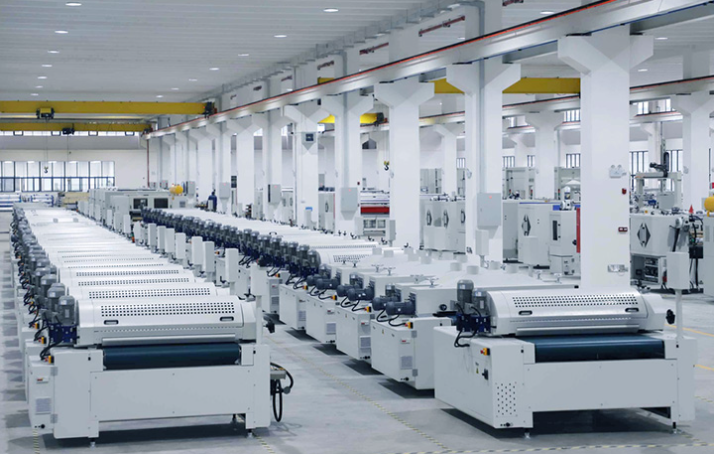
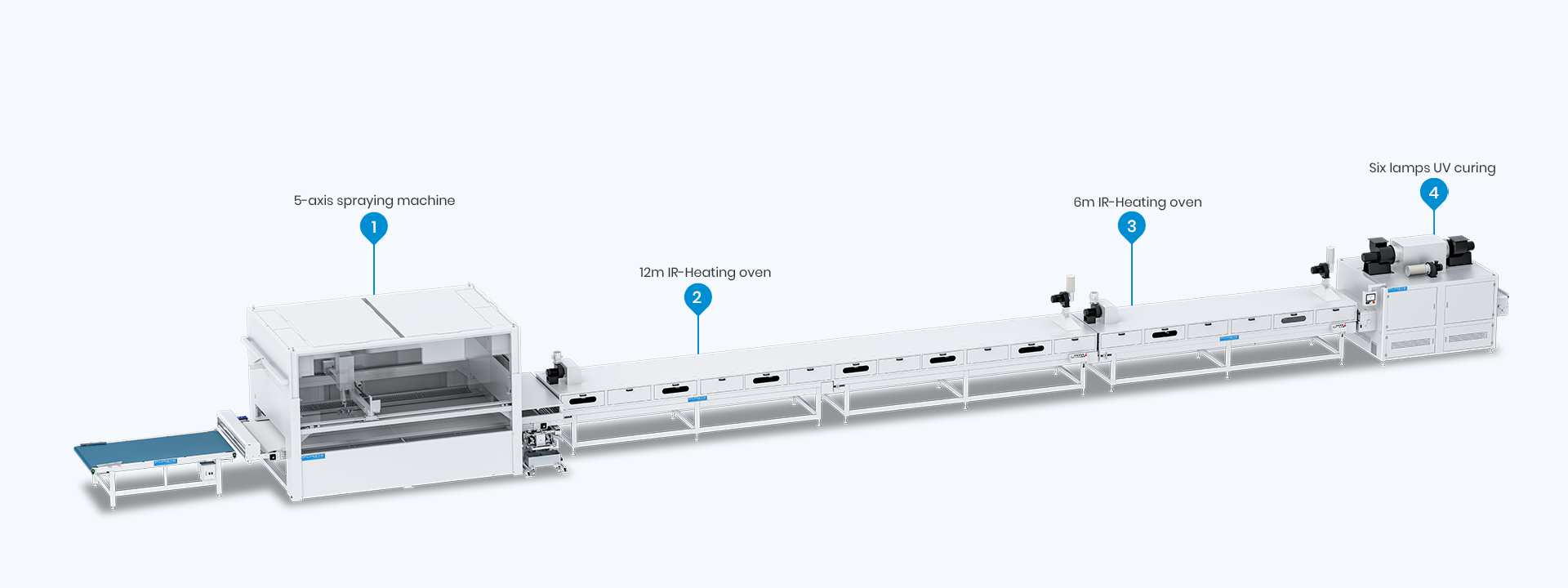 PURETE Belt-Type Numerical Control Intelligent Spray Coating Line (Five-Axis)
What Is a Robotic Spray Painting System?
A robotic spray painting system uses an industrial 6-axis robot arm to perform automated coating operations. It is part of modern spray painting automation systems, integrated with conveyors, loading systems, and curing units.
Unlike CNC-based systems, robotic systems rely on joint kinematics, allowing higher flexibility in motion paths and adaptation to complex geometries.
In advanced configurations, the system uses 3D vision scanning and AI-based automatic path generation, enabling real-time trajectory planning.
The robotic painting process is adaptive rather than strictly pre-programmed.
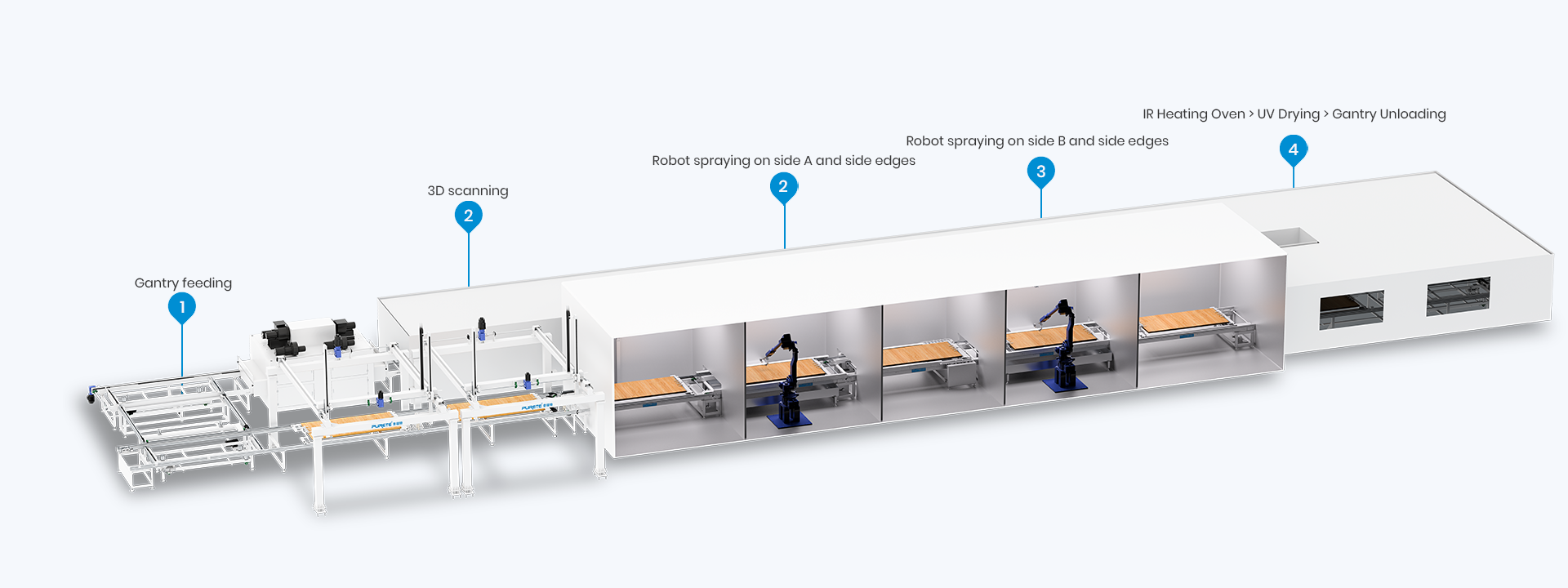 PURETE Robotic Automatic Spraying Production Line
Key Differences Between 5-axis and Robotic Spraying
Motion and Control Capabilities
A 5-axis spray painting system is based on CNC gantry architecture, where linear axes (X/Y/Z) and rotational axes are synchronized through interpolation control. The motion is deterministic and follows pre-generated trajectories, ensuring high repeatability in structured production environments.
A robotic spray painting system uses a 6-axis articulated arm controlled through inverse kinematics. The system calculates joint angles in real time to achieve spatial positioning, allowing greater freedom in orientation and reach. This makes it more suitable for complex geometries and multi-angle surface coverage.
Product Adaptability
5-axis systems are optimized for standardized and repeatable workpieces such as flat panels, MDF boards, and regular furniture components. The motion path is highly efficient when product geometry remains consistent.
Robotic systems can adapt to irregular shapes, curved surfaces, and mixed product batches. With integrated 3D vision input, the robot can adjust spraying angles and distances based on real-time geometry recognition, making it suitable for high-mix production environments.
Production Efficiency
In stable production environments, 5-axis systems achieve higher throughput due to fixed motion paths and synchronized conveyor timing. Cycle time remains consistent, which is critical for large-scale panel manufacturing.
Robotic systems prioritize flexibility over fixed cycle time. While individual cycle time may vary, overall efficiency improves in environments with frequent product changeovers because no mechanical reconfiguration is required.
Investment and Operating Costs
5-axis systems typically require lower initial investment and have simpler mechanical structures, resulting in reduced maintenance complexity and lower long-term operating cost.
Robotic systems involve higher upfront investment due to robot arms, vision systems, and control software. However, they provide higher long-term flexibility and better adaptability to product diversification.
Typical Applications for 5-Axis Systems
A 5-axis spray painting system is used in MDF panel coating, flat wood board finishing, and standardized furniture components.
These applications rely on stable spray coating processes with minimal variation.
Typical Applications for Robotic Systems
A robotic spray painting system is used in curved furniture components, complex plastic housings, and automotive interior parts.
These environments require a flexible industrial coating system.
Which Solution Is Best for Your Production Line?
Choosing between a 5-axis vs robotic spray painting system depends on production structure and product complexity. 5-axis systems suit stable production environments, while robotic systems are better for high-mix manufacturing.
In modern spray coating systems, both technologies are often combined for better efficiency and flexibility.
Conclusion
The 5-axis vs robotic spray painting system comparison reflects two different industrial automation philosophies: CNC-based deterministic motion versus robot-based adaptive motion. Each system delivers value through its own production logic rather than pure automation level.
From a practical manufacturing perspective, the selection is increasingly driven by production strategy rather than technical capability alone. Factories with stable, standardized workflows tend to benefit more from 5-axis systems, while those with diverse or frequently changing products require the flexibility of robotic systems.
In many advanced coating lines, a hybrid configuration is becoming more common, allowing both technologies to operate within different segments of the same production ecosystem to achieve better overall efficiency and adaptability.
FAQ
1. How do maintenance requirements differ between 5-axis and robotic systems?
5-axis systems require simpler mechanical maintenance, while robotic systems require calibration and software diagnostics.
2. Which system is better for furniture manufacturing?
5-axis systems are more efficient for standardized panels, while robotic systems are better for customized production.
3. How do 5-axis and robotic spray systems connect with other equipment?
Both integrate with conveyors, loading units, and curing ovens in a full spray painting automation system.
4. Can 5-axis systems handle high-mix production efficiently?
Not efficiently. They are optimized for repeatable production.
5. When should manufacturers choose robotic spraying?
When product complexity is high and flexibility is required.
What Is the Principle of Auto Coating Machine?

Advantages of Short-Cycle Presses in Panel Processing
Application of Soft-Touch (Excimer) Coating in Furniture and Decorative Materials
Which Industries Benefit Most from PUR Laminating?
What Is the Principle of Roller Coating Machine?
How Does PUR Laminating Compare to Solvent-Based Lamination in Terms of Cost?
Global Surface Finishing Market Analysis and Development Trends


