

A Guide to Automated Spray Coating Machines for Furniture Manufacturing
 March 04, 2026
 Hits:876second
In the high-stakes world of furniture manufacturing, the finishing line is often the bottleneck. As we move through 2026, the industry faces a "perfect storm": skilled labor is scarcer and more expensive, raw material costs (paints and solvents) are rising, and environmental regulations regarding VOCs are tighter than ever.
For manufacturers of custom cabinetry, flooring, doors, and architectural panels, the transition from manual spray booths to Automated Spray Coating Machines is no longer a luxury—it is a survival strategy. But with various technologies available—Reciprocating, Rotary, and Linear—how do you choose the right system for your factory?
This guide provides a deep dive into the mechanics, ROI, and application scenarios of modern automated spraying, helping you make an informed investment decision.
Why Upgrade? The Real ROI of Automated Spraying Systems
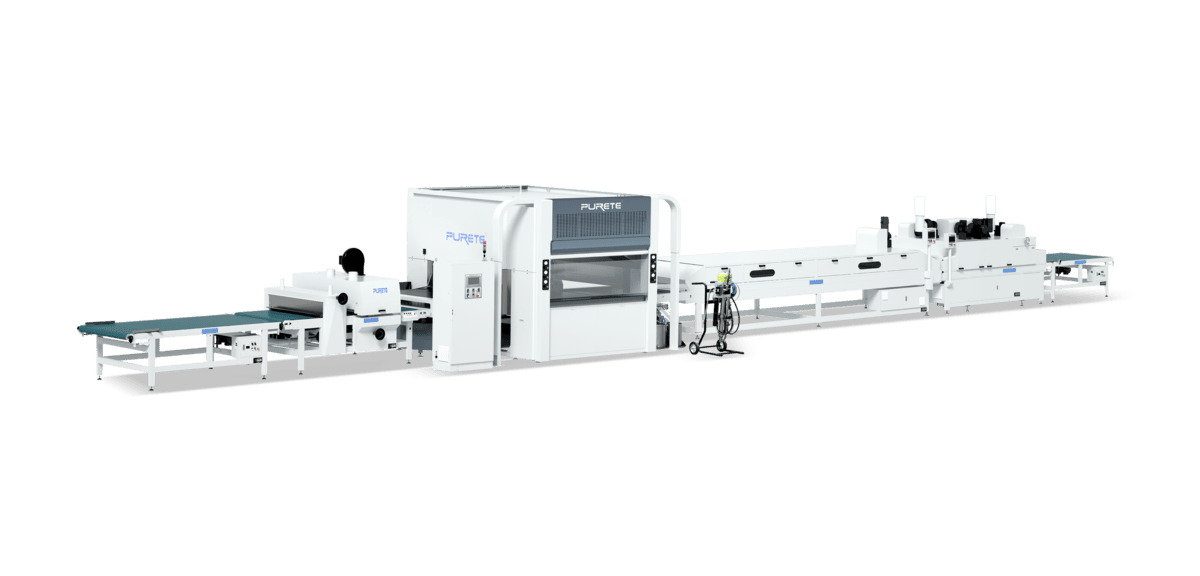
The hesitation to automate often stems from the initial capital expenditure (CapEx). However, when analyzing the Operational Expenditure (OpEx), automated spraying systems typically offer a return on investment (ROI) within 8 to 14 months.
Here is where the value lies:
1. Drastic Reduction in Material Waste (Transfer Efficiency)
Manual spraying has a low "Transfer Efficiency" (TE)—often as low as 40%. This means 60% of your expensive lacquer ends up in the filters or the air.
- The Automation Advantage: Modern automated machines, especially those equipped with 3D Scanning and Precise Gun Control, can achieve transfer efficiencies of over 75-85% for PU/Water-Based paints and up to 95% for UV coatings (via recycling).
- The Math: If a factory spends $50,000 monthly on paint, saving just 30% equates to $180,000 annually—often the cost of the machine itself.
2. Consistency and Quality Assurance
Human operators, no matter how skilled, fatigue over time. This leads to variations in film thickness, causing color differences and uneven curing.
- The Automation Advantage: A machine applies the exact same grammage (g/m²) at 8:00 AM and 5:00 PM. This consistency is crucial for large orders (e.g., hotel projects) where every door must match perfectly.
3. Process Control & Recipe Storage
Finding master painters is difficult. Automated lines shift your reliance from "craftsmanship" to "process management."
The Smart Feature: PURETE machines allow you to save "Recipes" (e.g., "White Primer - 120g/m² - Speed 4m/min"). An operator simply selects the recipe on the touchscreen, ensuring the machine runs perfectly without needing years of experience.
Types of Spraying Machines: Reciprocating vs. Rotary vs. Linear
Not all spraying machines are created equal. The geometry of your product dictates the machine you need.
1. Reciprocating Spraying Machines (The Versatile All-Rounder)
How it works: Spray guns are mounted on an arm that moves back and forth (reciprocates) across the conveyor belt as the product passes underneath.
- Best For: Flat panels with profiled edges, cabinet doors (Shaker style), furniture components, and high-mix, low-volume production.
- Pros: Highly flexible; easy to change colors; compatible with almost all paint types (PU, UV, Water-based, NC).
- Cons: Slightly slower than rotary systems for massive throughput.
2. Rotary Spraying Machines (The High-Speed Specialist)
How it works: Guns are mounted on a rotating carousel. As the carousel spins, it attacks the product from all 360-degree angles continuously.
- Best For: Complex 3D workpieces, doors with deep routing, and high-speed production lines requiring edge coverage.
- Pros: Excellent coverage of vertical edges and intricate details; higher production speeds.
- Cons: Generally more expensive; requires more setup time for gun positioning.
3. Linear (Profile) Spraying Machines
How it works: Fixed guns are positioned around a narrow conveyor to spray long, thin products.
- Best For: Moldings, skirting boards, window frames, and linear timber.
- Pros: Extremely fast; very little overspray; compact footprint.
- Cons: Cannot handle wide panels (like doors).
Critical Technologies That Define a "Smart" Machine
In 2026, a spraying machine is only as good as its software and sensors. When evaluating vendors like PURETE, look for these specific "Smart" features:
1. High-Precision 3D Scanning (The "Eyes")
Legacy machines sprayed the entire width of the belt, wasting paint on the empty gaps between boards.The Smart Solution: Sensors at the in-feed scan the shape, size, and position of every panel. The PLC (Programmable Logic Controller) calculates the trajectory and triggers the guns to fire only when they are directly over the wood. This is the single biggest factor in paint savings for PU and Water-Based coatings.
2. Paint Recycling Systems (For UV Coatings)
For UV coatings, waste is unnecessary.The Smart Solution: PURETE utilizes a Belt Cleaning and Recovery System. Instead of a disposable paper belt, the machine uses a durable conveyor belt. A scraper mechanism at the end of the machine collects the wet UV overspray, filters it, and pumps it back into the supply tank. This achieves near-zero waste for UV applications.
3. Quick-Change Circuits
For custom furniture manufacturers, changing colors (from white to grey to blue) is a daily headache.The Smart Solution: Look for machines with independent fluid circuits or automated flushing programs. PURETE offers configurations with multiple circuits (e.g., Circuit A for White, Circuit B for Clear, Circuit C for Colors), allowing color changes in 10-15 minutes with minimal solvent waste.
Application Scenarios: Matching the Machine to Your Product
To help you visualize the fit, here are common industry scenarios:
| Industry Segment | Typical Product | Recommended Configuration | Why? |
|---|---|---|---|
| Custom Cabinetry (Whole House Customization) | Kitchen doors, Wardrobe panels | Reciprocating Spraying Machine | Handles mixed sizes and frequent color changes efficiently. Excellent for "Shaker" style doors. |
| Interior Doors | Solid wood or Molded doors | Rotary Spraying Machine | The rotating angle ensures deep grooves and all four edges are coated evenly in one pass. |
| Flooring (SPC/LVT/Wood) | Floor planks | Roller Coating + Mini Spray | Roller coating does the flat surface; a small linear spray unit handles the bevels (V-grooves). |
| Architectural Decor | Wall panels, Cement fiber boards | Reciprocating (Wide Belt) | Can handle heavy, wide boards and apply heavy-duty coatings like fluorocarbon or real stone paint. |
| Moldings & Trim | Skirting, Picture frames | Linear Vacuum/Spray | High speed is the priority here; linear machines can run at 60m/min+. |
Common Spraying Defects & How Automation Solves Them
Manual spraying is prone to defects caused by human error. Automation solves these through physics and precision.
1. Orange Peel (Uneven Texture)
- Cause: Improper gun distance, inconsistent air pressure, or paint viscosity issues.
- Automation Fix: The machine maintains a strictly constant gun height and air pressure. When paired with an automatic paint mix room, viscosity is kept stable, resulting in a mirror-like flat finish.
2. Runs and Sags (Curtaining)
- Cause: Applying too much paint in one pass (heavy hand).
- Automation Fix: The PLC controls the flow rate (ml/min) and conveyor speed precisely. You can dial in exactly 120g/m², and the machine will never apply 130g/m², eliminating runs.
3. Blushing (Milky Haze)
- Cause: Moisture trapped in the film due to humidity or fast evaporation.
- Automation Fix: Automated lines are usually enclosed in positive-pressure rooms with controlled temperature and humidity, creating the perfect curing environment.
Explore PURETE's Automated Spraying Solutions
As a "Hidden Champion" in the surface finishing industry, PURETE (and our high-end brand HAUTE) offers a complete portfolio of spraying technologies designed for the global market.
Why do manufacturers in 81 countries choose PURETE?
- The "Minimal Waste" Philosophy: Our UV spraying lines feature industry-leading recycling rates (up to 95%), while our PU/WB lines maximize transfer efficiency via precise scanning.
- Intelligent Control: Equipped with Siemens/Schneider electronics and high-resolution scanning, our machines integrate seamlessly into Industry 4.0 "Smart Factory" ERP systems.
- Versatility: Whether you need to spray water-based eco-paints, high-gloss PU, or specialized solvent-free UV, our fluid handling systems are engineered for compatibility.
- Global Support: With AEO Advanced Certification, we guarantee rapid shipping of spare parts and possess a global network for installation and training.
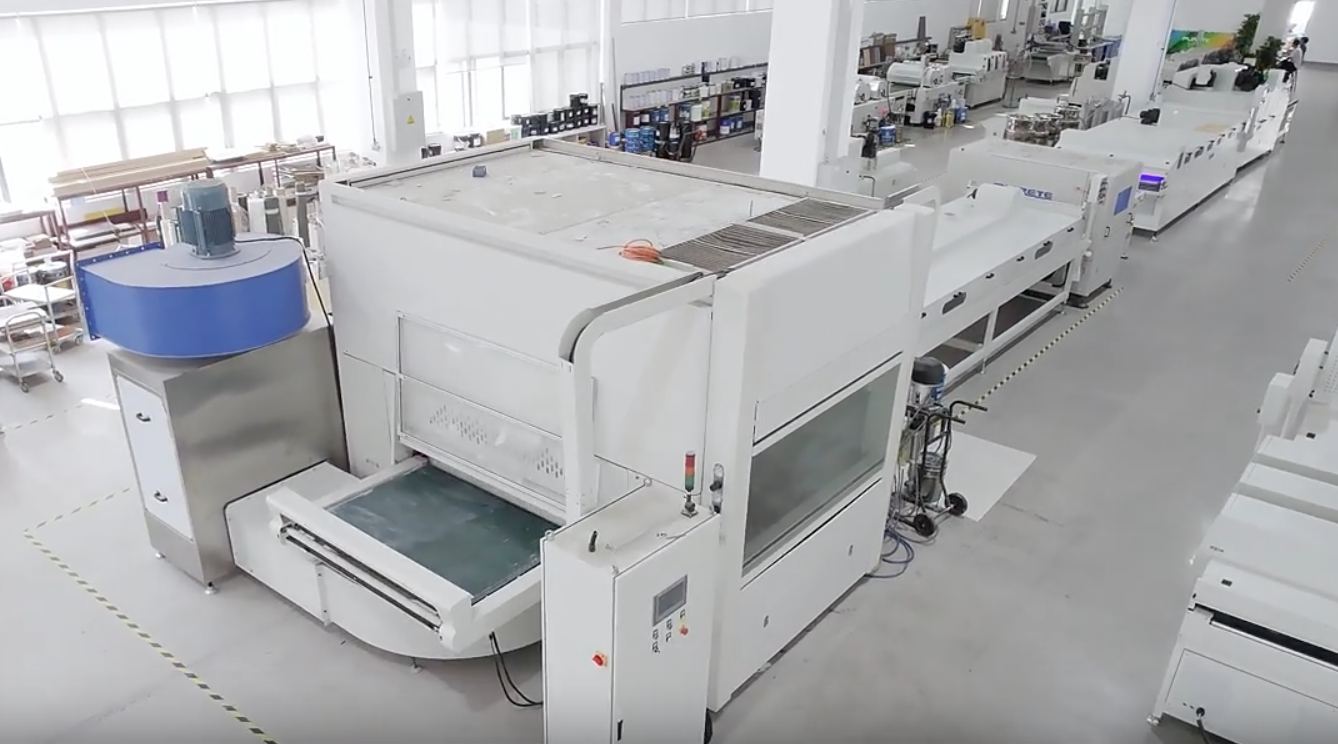
Ready to transform your finishing line?PURETE provides not just machines, but full process consultation. From sanding to dust removal, spraying, and drying—we design the entire ecosystem.
FAQ: Common Questions About Automated Spraying
Q1: Can automated spraying machines handle Water-Based paints?
A: Yes. In fact, automation is better for water-based paints. Water-based coatings require very specific humidity and drying controls (like microwave or IR drying) which are difficult to manage manually but easy to control in an automated PURETE line. We use stainless steel fluid passages to prevent corrosion.
Q2: How difficult is it to clean the machine when changing colors?
A: Modern PURETE machines are designed for "Quick Change." They feature automated flushing cycles that clean the guns and hoses. For the belt, if you use the paper system, you simply roll it forward. If you use the belt cleaning system, a scraper automatically cleans it during operation. A full color change can often be done in 10-15 minutes (depending on the number of circuits).
Q3: Do I need a Reciprocating or a Rotary machine for cabinet doors?
A: For most "Whole House Custom" manufacturers producing flat or shaker-style doors, a Reciprocating Machine is the best balance of cost and performance. A Rotary machine is only necessary if you have very deep, complex carvings or require extremely high throughput speeds.
Q4: What is the maintenance requirement for these machines?
A: Routine maintenance involves cleaning the spray gun nozzles (daily), checking the belt tension, and cleaning the filters. PURETE machines are built with "Predictive Maintenance" in mind, using robust components that require minimal downtime. We provide a detailed maintenance schedule with every installation.
Q5: Can I see a test run with my own paint and wood?
A: Absolutely. PURETE operates a full-scale testing lab in Shunde, China. We invite clients to send their raw boards and preferred coating materials. We will run the production, record the data (speed, grammage, quality), and send the finished samples back to you for inspection before you purchase.
What Is the Principle of Auto Coating Machine?

Advantages of Short-Cycle Presses in Panel Processing
Application of Soft-Touch (Excimer) Coating in Furniture and Decorative Materials
Which Industries Benefit Most from PUR Laminating?
What Is the Principle of Roller Coating Machine?
How Does PUR Laminating Compare to Solvent-Based Lamination in Terms of Cost?
Global Surface Finishing Market Analysis and Development Trends


