

Battery Enclosure Coating: When to Use a Reciprocating Roller Coater
 September 30, 2026
 Hits:19second
Battery enclosures, trays, and liquid-cooling plates are often discussed as one “battery coating” application. In practice, they can involve different materials, coating zones, and downstream processes. An aluminum lower enclosure may need to withstand vibration, temperature cycling from −40°C to 85°C, electrolyte-leakage corrosion risk, and high-voltage insulation considerations. A liquid-cooling plate may need controlled flux application before brazing. An energy-storage Pack enclosure may need a corrosion-protection route.
That distinction matters when selecting a roller coating machine. A reciprocating single-roller coater is a controlled contact-coating station for defined, accessible areas on a part. It can then be integrated with the required downstream process instead of being asked to replace every insulation, corrosion-protection, or welding-related step.
Begin With the Job the Material Must Do
The first question is not which machine to buy. It is what the material must do, where it must be applied, and what happens to that area next.
Insulation or sealing on selected enclosure and tray areas
For battery trays and enclosures, insulation or sealing requirements may apply only to specified areas rather than to every surface. The stated aluminum-alloy route uses alkaline degreasing, chrome-free zirconium/titanium passivation, multi-stage pure-water rinsing with conductivity below 30 μS/cm, cathodic epoxy e-coating, and subsequent curing. Its e-coat process window includes a 20–25 μm film, 150–250 V, a 28–32°C bath, pH 5.8–6.5, and curing at a 160–170°C part temperature for 20–25 minutes.
In this route, place a reciprocating roller station before or after e-coating when a defined functional area needs material application—for example, a welding zone, assembly contact area, or a sealing-related location. The application material and the downstream process determine the station's role in the route.
Flux application before liquid-cooling-plate brazing
Liquid-cooling plates require a different process logic. Before brazing, flux is applied at the brazing area. Its role is to remove oxides from the parent material and filler metal surfaces, protect the joint area, and improve wetting. Insufficient flux can leave oxides inadequately removed; excessive flux can leave residues that create a corrosion concern in the flow path.
Here, a reciprocating single-roller coater serves as a dedicated pre-brazing station. Controlled roller contact applies flux to a defined area, while reciprocating travel covers the plate surface. Roller settings, platform movement, and servo control work together to manage application quantity, coating boundaries, and repeatability before the plate enters brazing.
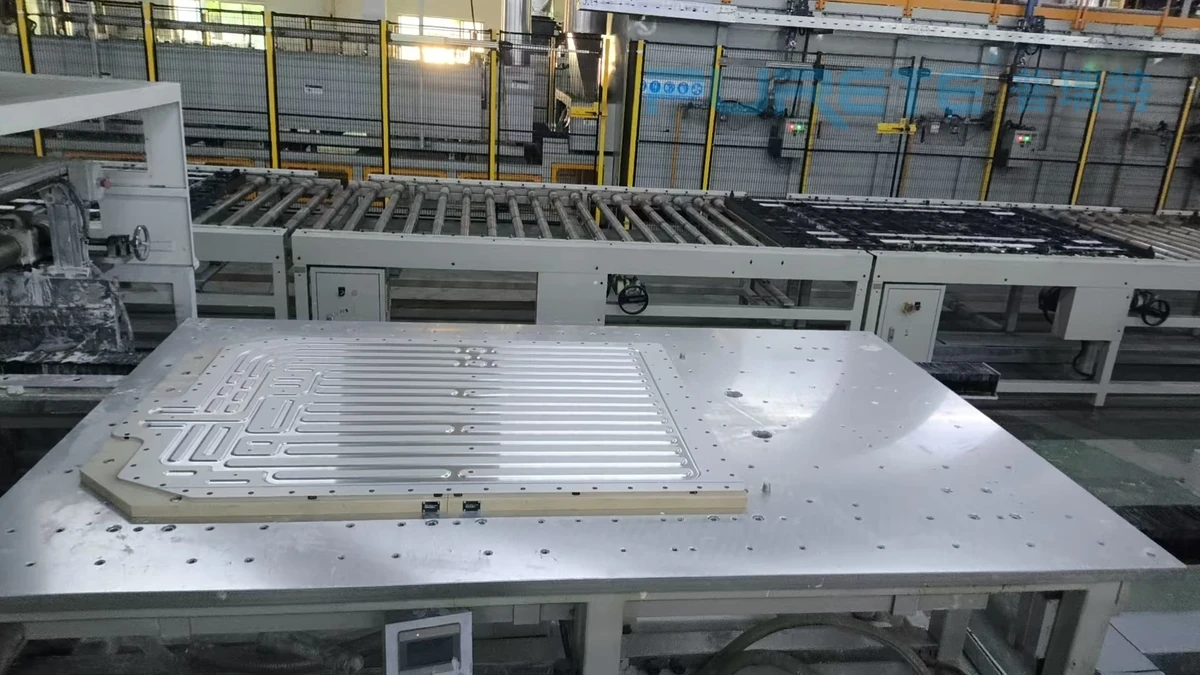
Liquid-cooling plate on the transfer line before brazing.
Corrosion-protection primer as part of a wider finishing route
Energy-storage Pack enclosures may operate outdoors or in enclosed environments where vibration and electrochemical-corrosion conditions are part of the design context. One aluminum-alloy Pack enclosure route uses a fluorocarbon-resin coating and a 2,000-hour neutral salt-spray requirement.
Here, roller coating can be used for a corrosion-protection primer where the part geometry and coating zone are suitable. The primer can then provide an adhesion basis for a later powder topcoat or fluorocarbon coating. The primer, topcoat, and durability requirements remain separate elements of the wider finishing route.
Why Use a Reciprocating Single-Roller Coater for Battery Components?
Battery-component projects can combine large lower panels—up to 1500 × 2300 mm in the PURETE configuration described here—with welds, cavities, blind holes, and several functional coating needs. That mix makes an all-purpose method difficult to define. The useful question is whether a specific zone can be coated by direct, controlled roller contact.
For large, relatively flat, clearly bounded areas, a roller station can transfer material through a contact process that is stable and repeatable from part to part. It can also sit within a larger route: flux application can lead to brazing, an insulation or primer layer can lead to curing, and other coating stages can be added where the part requires them.
The station works as one controlled sequence rather than as an isolated roller head. The coating head meters and transfers material, the reciprocating platform carries the workpiece through the target zone, and the locating and handling system keeps the part stable during that pass. This arrangement is especially useful when the coating map contains functional zones that must remain separate from no-coat areas, or when the next operation needs a consistently prepared surface. The required production pace then determines how the station connects to loading, unloading, curing, brazing, or the next finishing stage.
Battery-pack validation must align with the current applicable safety requirements for the target market. Where crush, drop, and vibration form part of a project's validation plan, insulation and corrosion-protection requirements belong in the same part- and material-specific process definition—not in one generic battery-enclosure specification.
When a Reciprocating Roller Coater Fits the Part
The value of roller coating lies in matching its contact method to the part and process. The following table is a selection guide, not a default specification.
| Part and process condition | Why it matters | What it means for roller coating |
|---|---|---|
| Accessible flat or shallow surface | The application roller needs stable contact with the target area. | A defined panel, plate, or shallow recessed zone may be suitable for evaluation. |
| Clear coating and no-coat boundaries | Functional material may be needed only at selected locations. | Boundary control can be specified around the intended application zone. |
| Material compatible with roller transfer | Flux, primer, sealant, and other materials do not behave identically at the roller. | Match the material's application window and transfer behavior to the selected process. |
| Stable part support and repeatable datum | Part movement can change pressure, position, and application coverage. | Build locating, lifting, vacuum support, and loading references into the station design. |
| Defined downstream interface | Coating is often only one step in the route. | Define whether the next operation is curing, brazing, spray coating, powder coating, or another process. |
Where Roller Coating Needs Another Process or a Different Method
Direct roller contact is not intended to solve every geometry. Enclosure cavities, deep holes, complex weld areas, enclosed sections, sharp features, and other three-dimensional structures need their own process review. In these situations, e-coating or spray coating may form part of the wider route.
The comparison is not simply “roller versus spray.” Roller coating is suited to defined contact areas, while spray can address contours, edges, grooves, and surfaces that are difficult to reach by contact. For a closer comparison of those process roles, see roller coater vs spray coating machine.
Performance Requirements Depend on the Coating Function
The requirements below apply to different coating contexts and should not be combined into one universal requirement for every battery component.
| Performance item | Requirement | Test reference | Coating context |
|---|---|---|---|
| Insulation resistance | ≥50 GΩ | DC 1000V, 5s | Insulating powder coating |
| Dielectric strength | 30–70 kV/mm | IEC 60243-1 | Insulating coating |
| Salt-spray resistance | ≥800 h, no rust | ISO 9227 | Corrosion-protection / insulating coating |
| Thermal-shock resistance | −40°C to 85°C, 100 cycles, no cracking | Project requirement | Insulating coating |
| Electrolyte-corrosion resistance | 50 days of continuous corrosion, no electrical breakdown | Project requirement | Battery-enclosure coating |
| Flame rating | V-0 | UL 94 | Battery-enclosure coating |
| Adhesion | Cross-cut class 0 | ISO 2409 | All coating types |
| MEK rub resistance | ≥50 rubs, no substrate exposure | Project requirement | Cured e-coat |
Inside a Reciprocating Single-Roller Coating Station
A reciprocating single-roller station combines the coating head with the part-transfer platform. In the PURETE configuration described here, the coating unit uses servo-controlled vertical movement, a lifting function, roller drive, and metering adjustment to support material transfer. The platform uses servo-driven horizontal travel with rack-and-pinion transmission and linear guides; its design line speed is 30 m/min.
Part handling is also part of the coating result. This station uses pneumatic lifting and corrugated vacuum cups to lift and stabilize the workpiece during transfer. Its material and boundary-control functions include an electrically stirred material container, no-material detection, a pneumatic material-stop plate, and position sensors for vertical and horizontal movement.
The PURETE configuration described here has a coating range of 1500 × 2300 × 50 mm, overall machine dimensions of 6000 × 4500 × 1800 mm, total power of 6.3 kW, and a total machine weight of approximately 3.9 t. These figures describe this station rather than every roller coating production line or every battery-component project.
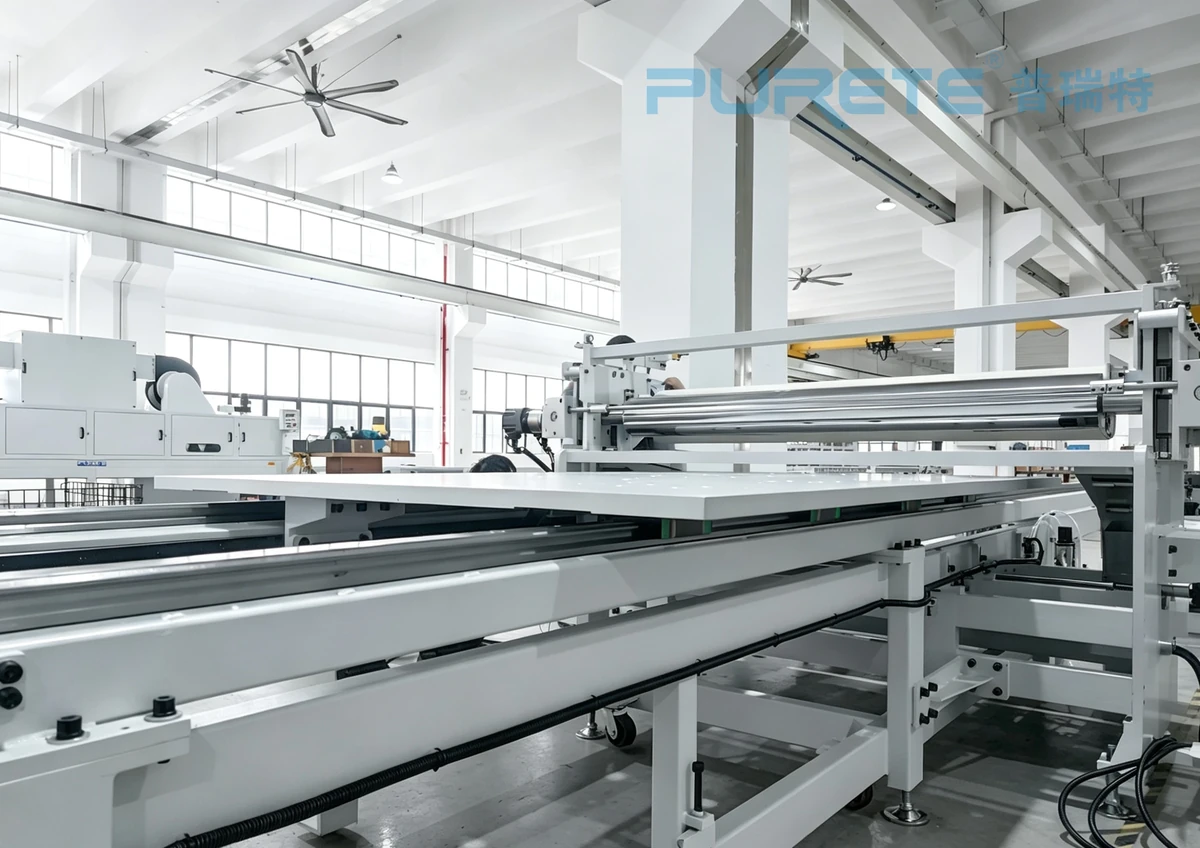
PURETE reciprocating single-roller coating station — roller coating production line.
Build the Station Around the Part and Production Route
Build the station from three groups of production information: the part drawing, dimensions, and coating/no-coat map; the substrate, coating material or flux, and downstream curing or brazing route; and the target cycle time, handling method, traceability, and safety requirements.
Match part size to the specified coating range. This station covers 1500 × 2300 mm. The stated typical battery lower-enclosure sizes range from approximately 1200 × 2000 mm to 1600 × 2400 mm, while liquid-cooling plates range from approximately 800 × 1200 mm to 1500 × 2000 mm. Parts at the upper end of the lower-enclosure range require a customized, longer and wider platform.
Choose Roller Coating for the Zones It Can Control
A reciprocating roller coater fits battery components with a defined, accessible, relatively flat zone that needs controlled material transfer. Build the final station around the actual part, material, handling method, and downstream process rather than treating it as a universal solution for every battery enclosure.
Discuss Your Battery-Component Coating Layout With PURETE
To discuss a roller-coating station or combined process route, send PURETE the part drawing and coating/no-coat map, the material or flux and downstream process details, plus the required production pace and handling method.
Frequently Asked Questions
What battery-enclosure and liquid-cooling-plate sizes can the station handle?
This station has a coating range of 1500 × 2300 mm. Typical battery lower-enclosure sizes are approximately 1200 × 2000 mm to 1600 × 2400 mm, and liquid-cooling-plate sizes are approximately 800 × 1200 mm to 1500 × 2000 mm. The upper end of the stated lower-enclosure range requires a customized, longer and wider platform. A 50 mm coating depth is intended for parts with shallow grooves or reinforcing ribs.
Can a roller coater cover enclosure cavities and weld areas?
Single-roller coating is intended for flat and shallow recessed surfaces. For cavities, deep holes, weld areas, and other complex three-dimensional structures, e-coating or spray coating may form part of the wider process route.
How is coating thickness controlled?
Three control parameters are used: the gap between the coating and metering rollers, roller-to-platform pressure, and roller-speed ratio. Under the stated process conditions, film-thickness variation can be controlled within ±5 μm.
Can the station be integrated with robotic loading and unloading?
In the PURETE configuration described here, a robot places the workpiece on the transfer platform, lifting cups secure it during coating, and the robot removes it after coating.
What happens after roller coating?
The downstream route follows the material function. Flux coating proceeds to brazing. Insulation or corrosion-protection primer proceeds to drying and curing. A subsequent topcoat may be applied by spray or powder coating. For the stated insulation/corrosion-primer route, curing is specified at a 160–170°C part temperature for 20–25 minutes.
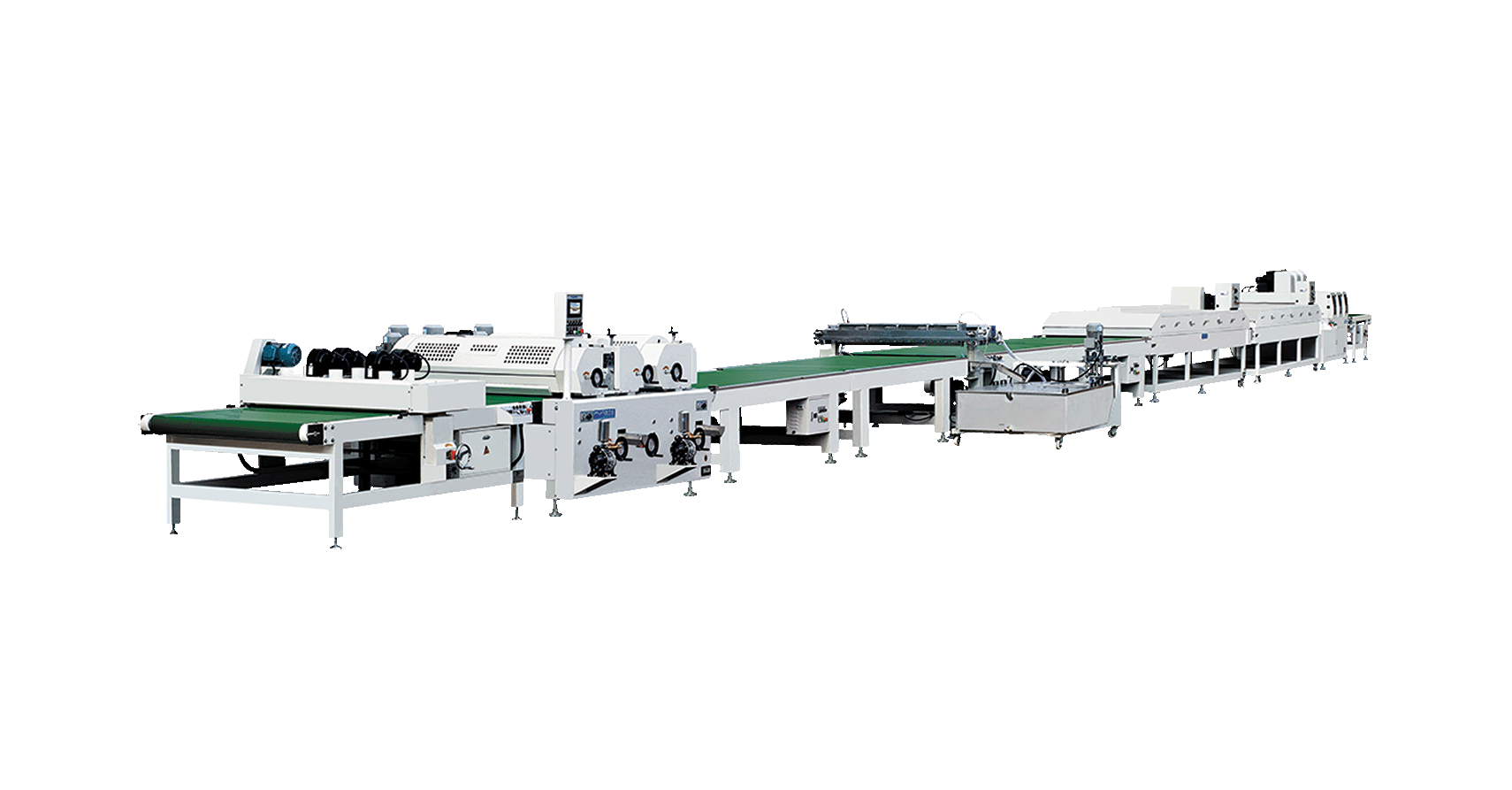
What Is the Principle of Auto Coating Machine?

Advantages of Short-Cycle Presses in Panel Processing
Application of Soft-Touch (Excimer) Coating in Furniture and Decorative Materials
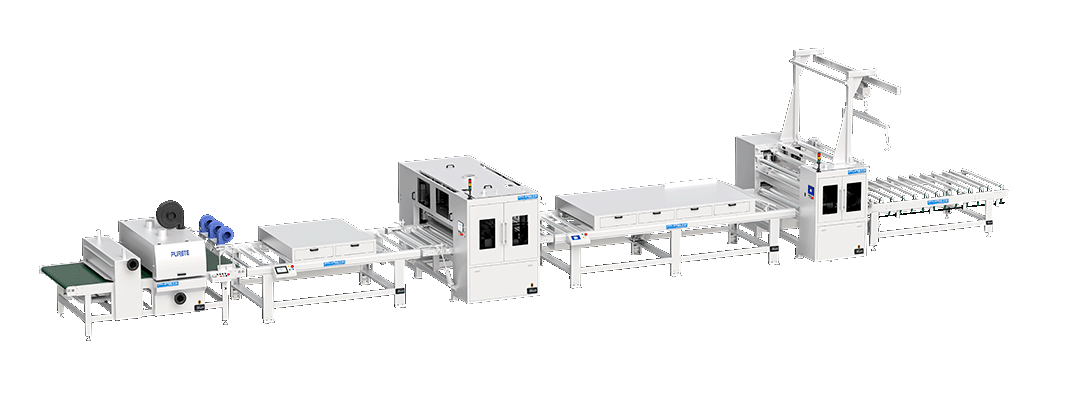
Which Industries Benefit Most from PUR Laminating?
What Is the Principle of Roller Coating Machine?
How Does PUR Laminating Compare to Solvent-Based Lamination in Terms of Cost?
Global Surface Finishing Market Analysis and Development Trends


