

Industrial Spray Coating Process: A Step-by-Step Guide
 June 30, 2026
 Hits:2424second
Introduction
The industrial spray coating process is a widely used finishing method for achieving uniform surface quality, durability, and appearance in modern manufacturing. It is commonly applied in furniture production, engineering components, and specialty materials, where consistency and efficiency are critical. As production demands increase, many manufacturers are shifting from manual spraying to automated spray coating machine systems integrated with conveyor lines and curing equipment, including solutions provided by PURETE.
Quick Answer
The spray painting process in industrial manufacturing involves five key stages: surface preparation, spray application, flow leveling, drying and curing, and inspection. Each step is tightly controlled and typically integrated into an automated spray coating equipment line to ensure consistent film thickness, surface quality, and production efficiency. In industrial applications, PURETE provides automated spray coating production line solutions for different manufacturing requirements.
What Is Industrial Spray Coating?
Industrial spray coating typically refers to liquid coating systems (such as paint, PU, UV, and water-based materials) that are atomized through a spray system and applied to a substrate surface. The goal is to form a uniform coating layer with controlled thickness, adhesion, and curing performance.
In modern production systems, spray coating is rarely a standalone operation. Instead, it is part of a continuous line that includes a conveyor system, drying oven, and sometimes UV curing modules depending on the coating type. This integration ensures controlled process conditions and repeatable quality across batches.
Step 1: Surface Preparation
Surface preparation is the foundation of any reliable coating process. Without proper preparation, even advanced spray coating equipment cannot prevent defects such as peeling, pinholes, or uneven adhesion.
This stage typically includes:
Dust and particulate removal using ionized air or vacuum systems
Degreasing with solvent or aqueous cleaning methods
Mechanical abrasion for surface energy improvement
Moisture control and environmental conditioning
The goal is to ensure the substrate is chemically and physically ready for coating adhesion. In high-precision industries such as engineering components and specialty materials, even microscopic contamination can lead to coating failure.
Step 2: Spray Application
The spray application stage is where the core spray painting process occurs. A spray machine atomizes coating material into fine droplets and applies it onto the moving workpiece.
Key system components include:
Spray coating machine (robotic, reciprocating, or multi-axis spray systems)
Nozzles and atomization control systems
Conveyor system synchronization
Paint supply and viscosity control units
Different automation configurations are used depending on product complexity. For example, flat panels in furniture production often use reciprocating systems, while complex geometries may require robotic arms or multi-axis systems.
PURETE systems such as the P4 PU/UV + Water-Based Reciprocating Spray Production Line are designed for stable, high-throughput flat panel coating, while Robotic Automatic Spraying systems handle irregular shapes. Some PURETE production line configurations also support automatic loading and unloading as part of the integrated system design.
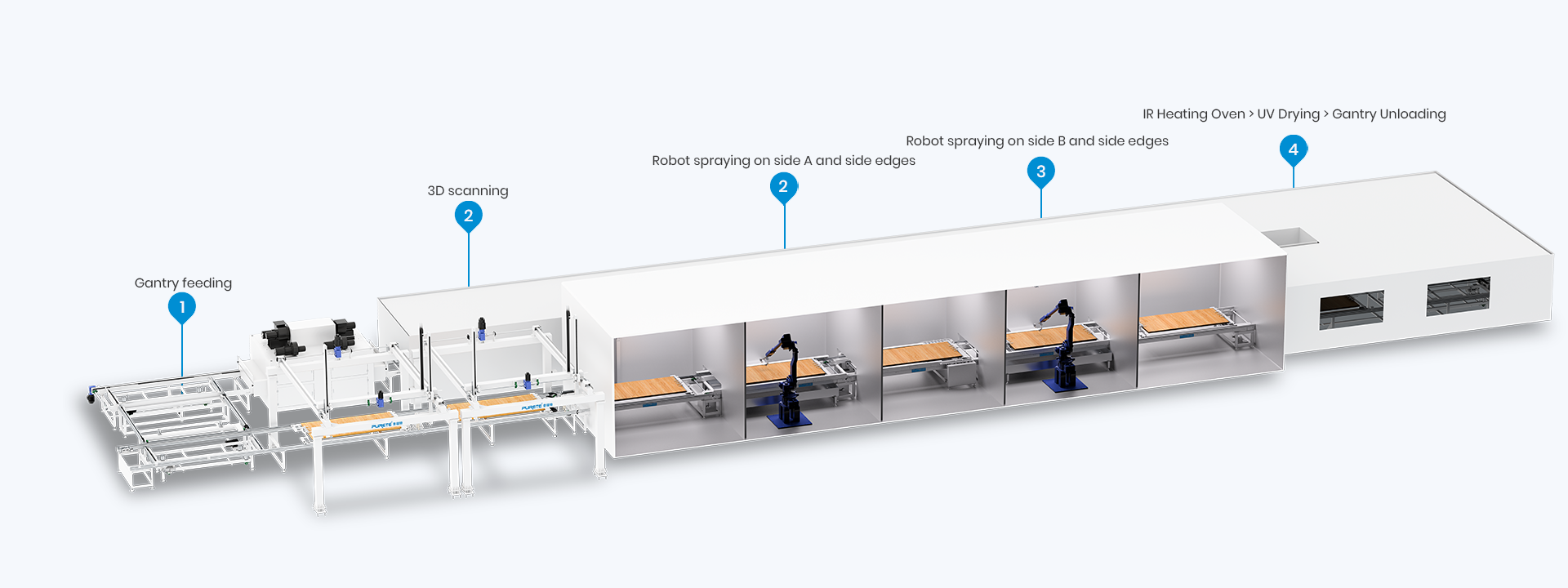 PURETE Robotic Automatic Spraying Production Line
Step 3: Flow Leveling
After spraying, the coating film undergoes a natural leveling phase known as flow leveling. This stage is critical for achieving a smooth, defect-free surface.
During flow leveling, the wet coating redistributes due to surface tension, gravity, and viscosity behavior. If controlled correctly, it eliminates:
Spray overlap marks
Orange peel texture
Uneven film thickness
Environmental conditions such as temperature, airflow, and humidity strongly influence this phase. In automated spray coating equipment lines, leveling zones are often isolated to ensure stable conditions before curing begins.
Step 4: Drying and Curing
Drying and curing transform the liquid coating into a solid, durable film. This is typically achieved using a drying oven or UV curing system, depending on coating type.
There are three common curing methods:
Thermal curing (hot air drying oven)
UV curing (instant polymerization under UV light)
Hybrid systems (thermal + UV for layered coatings)
In automated production lines, curing is synchronized with conveyor speed to ensure consistent dwell time. If curing is too fast or too slow, defects such as cracking, under-curing, or surface tackiness may occur.
Industries like new energy components and engineered materials often require precise curing control due to strict performance requirements.
Step 5: Inspection and Quality Control
After curing, each coated product enters the inspection stage, where quality is evaluated based on predefined standards. This step ensures consistency before packaging or assembly.
Typical inspection checks include:
Coating thickness measurement
Surface gloss uniformity
Adhesion testing
Visual defect detection
Modern systems increasingly integrate automated optical inspection systems, reducing reliance on manual judgment. In advanced spray coating equipment lines, data from inspection can be fed back into the spray machine to adjust parameters in real time.
inspection is therefore not just a final step but part of a closed-loop production system.
Common Challenges in the Spray Coating Process
Even in well-designed systems, several challenges can impact production stability:
1. Coating Defects
Orange peel texture
Sagging or dripping
Pinholes or bubbles
2. Equipment Instability
Spray machine nozzle clogging
Inconsistent atomization pressure
Conveyor speed mismatch
3. Environmental Variations
Temperature fluctuations affecting viscosity
Humidity impacting curing performance
Dust contamination in open systems
4. Material Variability
Inconsistent paint viscosity
Batch-to-batch formulation differences
Poor compatibility between coating layers
These challenges highlight why integrated spray coating equipment systems are preferred over standalone manual processes.
How Automated Spray Painting Lines Improve Process Consistency
Automation fundamentally changes how the spray painting process is controlled. Instead of relying on operator skill, parameters are standardized and digitally managed across the entire line. These requirements have led to the development of different spray coating production line solutions for various manufacturing scenarios.
Key improvements include:
1. Process Stability
Automated spray machines maintain consistent spray patterns, pressure, and distance, reducing variation in coating thickness.
2. Integrated Line Control
Systems such as conveyor system synchronization ensure every workpiece receives identical exposure time in each stage.
3. Reduced Human Error
Automation minimizes inconsistencies caused by fatigue, manual handling, or subjective judgment.
4. Closed-Loop Feedback
Modern spray coating equipment can integrate inspection data and automatically adjust spray parameters.
PURETE systems include examples such as the Belt-Type Numerical Control Intelligent Spray Coating Line and the P1 Reciprocating Spray Painting Production Line for Special-Shaped Workpieces. These systems are designed to improve coating consistency and process stability. As an industrial spray coating equipment provider, PURETE supports manufacturers across furniture, construction, and specialty materials industries.
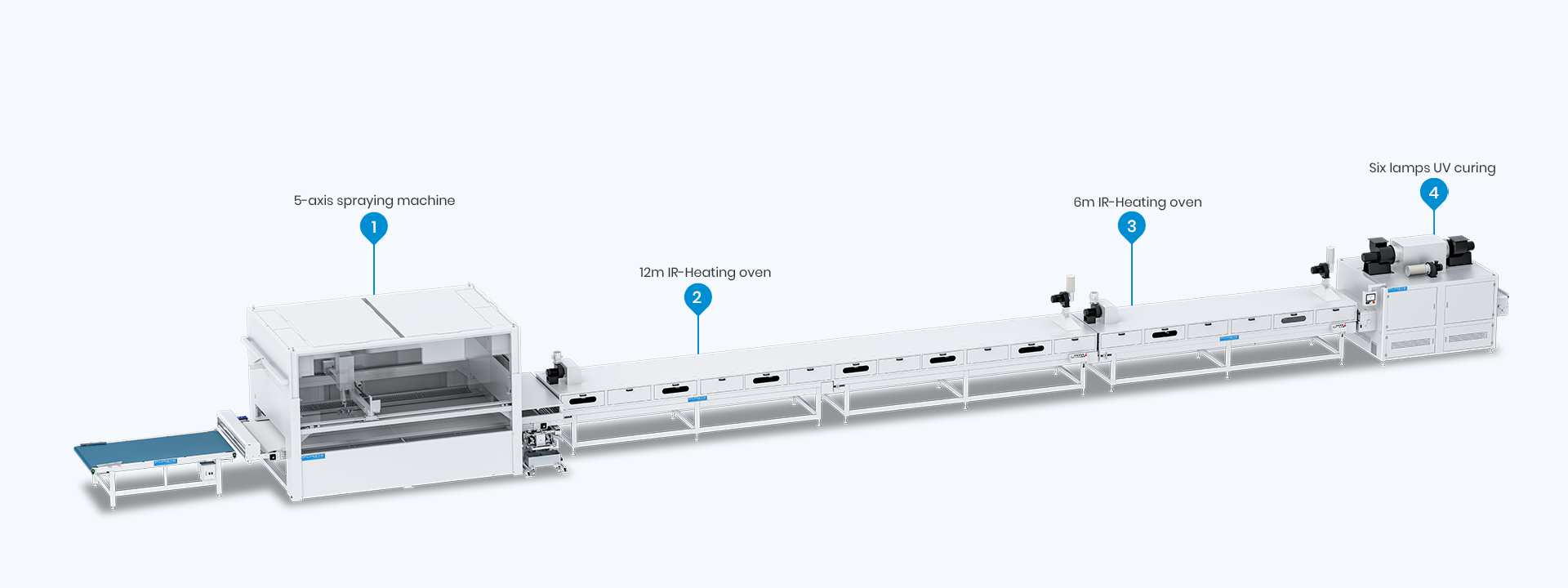 Belt-Type Numerical Control Intelligent Spray Coating Line
Conclusion
The industrial spray painting process plays a critical role in ensuring consistent surface quality and production efficiency in modern manufacturing. As requirements for automation and process stability continue to increase, manufacturers are placing greater emphasis on process control and system integration. This shift is driving wider adoption of integrated spray coating machine systems that connect each stage of production into a continuous and more stable workflow.
FAQ
How long does a typical spray coating process take?
The total cycle time depends on the coating system, film thickness, and curing mechanism. Spraying itself usually takes only seconds to minutes per workpiece, while the overall process is mainly determined by the curing stage. UV coatings can achieve near-instant surface curing in seconds, whereas water-based, PU, or solvent-based coatings typically require thermal or chemical curing, ranging from several minutes to longer cycles depending on process conditions.
What factors affect coating thickness?
Key factors include spray pressure, nozzle type, viscosity, conveyor speed, and spray distance. In automated spray coating equipment, thickness consistency is less about individual parameters and more about how well these variables are synchronized across the entire production line, especially in high-speed continuous operations.
How does paint viscosity influence spray quality?
Higher viscosity generally reduces atomization efficiency, which can lead to uneven coverage, while too low viscosity may cause sagging or insufficient film build. In industrial practice, viscosity is not treated as a fixed parameter but is continuously adjusted based on temperature and application conditions to maintain stable spray performance.
Can spray coating be fully automated?
Yes. Modern spray coating systems can automate spraying, material handling, curing, and inspection with minimal manual intervention. However, full automation performance depends heavily on system integration quality. For example, PURETE designs integrated spray coating production lines that combine automatic spray painting systems with conveyor synchronization and curing units to improve process stability and reduce human-dependent variability.
What industries benefit most from automated spray coating lines?
Furniture manufacturing, office and hospitality interiors, engineering components, construction materials, and new energy applications benefit significantly from automation. Among these, furniture and panel-based industries typically see the highest efficiency gains because standardized geometries allow full utilization of continuous spray coating line systems.
What Is the Principle of Auto Coating Machine?

Advantages of Short-Cycle Presses in Panel Processing
Application of Soft-Touch (Excimer) Coating in Furniture and Decorative Materials
Which Industries Benefit Most from PUR Laminating?
What Is the Principle of Roller Coating Machine?
How Does PUR Laminating Compare to Solvent-Based Lamination in Terms of Cost?
Global Surface Finishing Market Analysis and Development Trends


