

Roller Coating Metal and Glass Panels: Process Differences
 July 31, 2026
 Hits:266second
Introduction
Roller coating is widely used for continuous finishing of flat panels, but metal sheets and glass panels do not present the same process conditions. Surface chemistry, contamination sensitivity, appearance standards, handling, and curing requirements can differ substantially. A stable line therefore cannot be selected by panel size alone. Manufacturers must match the substrate, coating, roller system, transfer settings, and downstream curing equipment as one process.
Quick Answer
Metal and glass panels can both be roller coated when they are flat and can be conveyed steadily, but they should not automatically use the same settings or line. Metal projects often focus on adhesion over oily, oxidized, printed, or previously coated surfaces, plus color and protection. Glass projects place greater emphasis on cleanliness, scratch prevention, visual uniformity, and transparent or back-coated appearance. Roller material, hardness, gap, speed, pretreatment, leveling, and curing must match the actual substrate and coating system.
How Roller Coating Works on Flat Panels
Coating Transfer to the Panel
In roller coating, liquid coating is metered and transferred continuously from the coating roller to the moving panel. The wet film is influenced by coating condition, roller material and hardness, gap, pressure, roller and conveyor speed, and the doctor blade or metering roller.
PURETE's internal training material gives 5–50 g/m² as a reference range for roller coating flat workpieces. This should not be treated as a universal specification. A workable application rate must be established from the coating formulation, target film, substrate condition, roller arrangement, and curing capacity.
Why It Suits Flat Workpieces
The process depends on stable contact between the coating roller and the panel. It is therefore best suited to flat or nearly flat workpieces moving in a consistent direction. Deep grooves, pronounced relief, complex edges, and three-dimensional shapes are more difficult to cover and can also create abnormal roller loading. These parts are normally better evaluated for spray coating.
Position in the Production Line
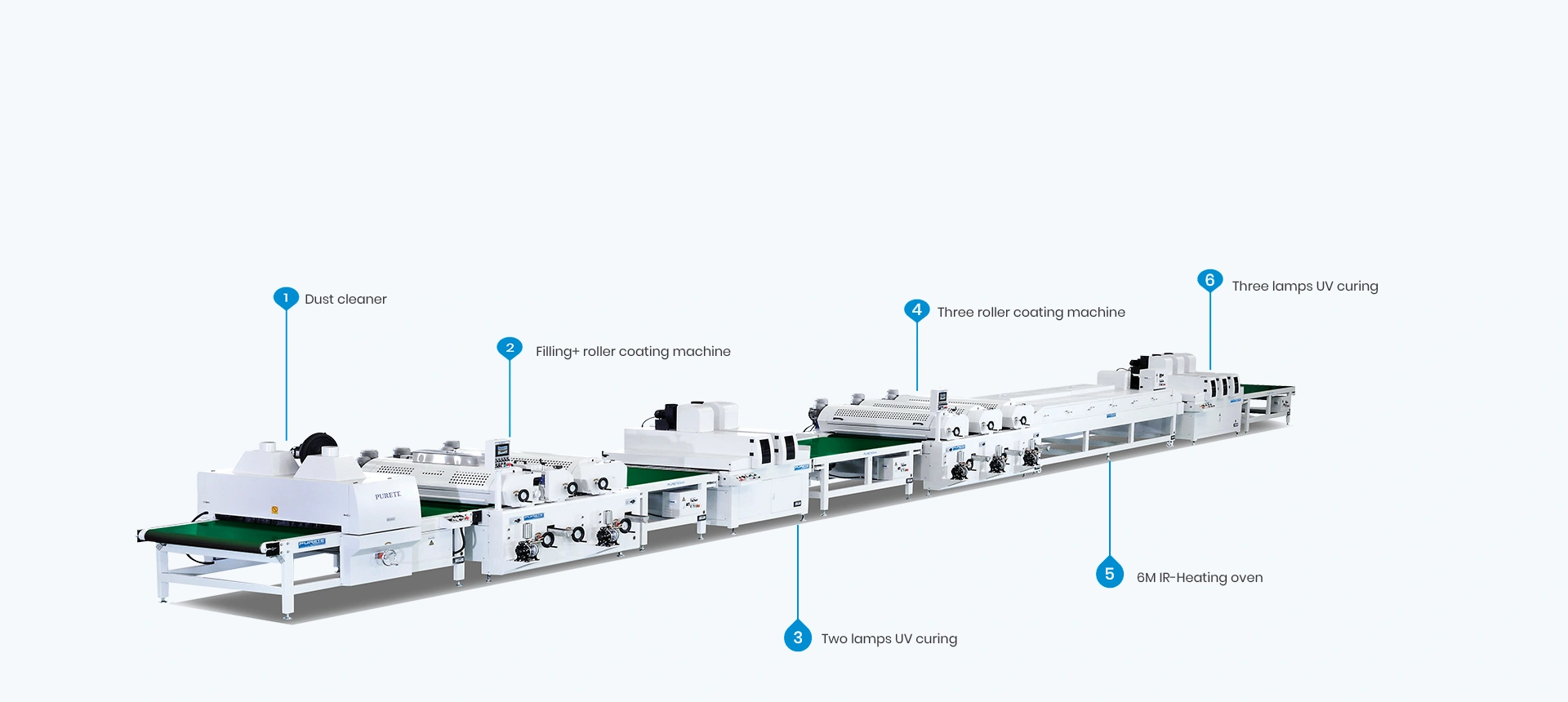
A typical sequence is surface cleaning or pretreatment, roller coating, leveling, drying or UV curing, inspection, and downstream processing. A complete roller coating production line may combine dust removal, one or more coating stations, IR heating, UV curing, and automated handling, but the exact modules must follow the coating system rather than a fixed template.
Roller Coating Applications for Metal Panels
Aluminum Ceiling Panels
Metal roller coating can be used on flat products such as aluminum ceiling panels. Before the coating unit is selected, the project should define the alloy or metal type, surface finish, existing treatment, panel flatness, and whether the coating is decorative, protective, or both.
Metal surfaces may carry rolling oil, residue, oxide, printing ink, primer, or an existing coating. Because these conditions affect wetting and adhesion, cleaning and pretreatment must match the actual surface and coating requirements.
UV Varnish on Printed Metal Sheets
One documented process applies UV varnish after a pattern has already been printed on sheet metal. The sheet passes through the roller coater, the varnish is UV cured, and the finished sheet is then formed into products such as drums or cans.
This differs from applying an opaque basecoat to bare metal. Settings must preserve the printed layer, form a uniform clear film, and avoid streaks, leading-edge buildup, or insufficient cure. The printed surface and later forming process must both be included in line planning.
Decorative and Protective Finishes
Metal projects may involve clear varnish, colored coatings, primers, topcoats, or protective films. Applications within New Energy & Specialty Materials may also involve aluminum-magnesium alloy, galvanized sheet, stainless steel, or other specialty materials. Each substrate still requires its own adhesion and curing assessment; the material category alone does not confirm compatibility.
Roller Coating Applications for Glass Panels
Glass Products and Surface Finishes
Roller coating for glass is generally applied to flat panels, often as a back-coating process. Existing PURETE applications include decorative, architectural, bathroom, energy-saving, photovoltaic, and electronic glass. These products differ in size, appearance, coating function, and acceptable defect level.
For building-related products, the line may form part of a broader Engineering & Construction finishing solution. However, the specific glass type and coating side must be confirmed before the equipment layout is defined.
Transparent, Colored, and Functional Coatings
Glass coating may be clear, tinted, colored, decorative, or functional. A UV-curable system is one possible route, but not every glass roller coating project uses UV. The coating chemistry determines whether the line needs UV lamps, IR or hot-air drying, staged leveling, or another curing method.
The key question is whether the coating wets the prepared glass, forms the required appearance, bonds after curing, and remains compatible with later processing.
Handling and Surface Protection
Glass places strict demands on surface cleanliness and handling. Dust, fingerprints, oil, cleaning residue, and particles can remain visible beneath transparent or translucent coatings. Conveyor contact, guides, and roller pressure must also avoid scratches, chips, unstable movement, or local stress.
A glass roller coating machine should therefore be evaluated together with cleaning, alignment, transport support, inspection, and protective handling. No single pressure, coating weight, or adhesion value suits every glass product.
Metal vs. Glass Roller Coating
Surface Condition and Adhesion
Metal preparation may address oil, oxidation, printing ink, primer, or an existing coating. Glass is non-porous and sensitive to contamination that interferes with wetting or remains visible. The substrates may therefore require different cleaning, pretreatment, or adhesion-promoting systems.
Appearance Requirements
Metal panels may prioritize hiding power, color consistency, gloss, corrosion protection, or resistance to later forming and handling. Glass panels often place more attention on transparency, back-coated color uniformity, optical appearance, and visible defects such as particles, pinholes, roller marks, or streaks.
A setting that produces an acceptable protective layer on metal may still be unsuitable for a visually critical glass panel.
Contact Pressure and Handling
Their handling risks also differ. Thin metal may flex or carry edge deformation, while glass requires stable support and protection against scratches, chipping, and concentrated loading. Pressure and conveyor support should follow panel thickness, flatness, transfer needs, and handling limits.
Drying and Curing
UV varnish on printed metal sheets is a supported metal application. Glass may also use UV coatings, but its curing route depends on the selected formulation and product function. In both cases, curing must be matched to the wet film and line speed. A uniform coating that is under-cured can still produce blocking, poor surface performance, unstable adhesion, or damage during stacking and processing.
How to Select the Coating Roller
EPDM, Silicone, and PU Rollers
Common coating roller materials in PURETE's roller coating systems include EPDM rubber, silicone, and PU. Selection depends on coating compatibility, transfer behavior, required film, surface finish, and cleaning method. A roller should not be assigned solely because the substrate is metal or glass.
Roller Hardness and Coating Transfer
A harder roller generally transfers less coating, while a softer roller transfers more. Softer is not always better: excess deformation can reduce film control, while an overly hard roller may not follow panel variation or transfer enough coating.
The final hardness must be established together with coating viscosity, panel flatness, target application weight, pressure, and speed.
Laser-Engraved or Textured Rollers
Laser-engraved rollers can increase coating transfer and influence leveling or fullness, while finer line counts generally produce a finer surface with lower transfer. They also demand suitable coating quality, clean panels, accurate setup, and experienced operation. Their suitability for a metal or glass project should be confirmed through material trials rather than assumed from the desired gloss alone.
Doctor Blade, Roller Gap, and Line Speed
Doctor Blade and Uniformity
A doctor blade can level coating on the roller, reduce application, improve colored-coating uniformity, and assist cleaning. It also increases roller wear, so blade material, contact, condition, and release during shutdown require control.
Roller-Gap Consistency
If the gap between the coating roller and the metering or steel roller is larger on one side than the other, the panel may show uneven film, roller patterns, or local coating accumulation. Mechanical leveling and repeatable gap adjustment are therefore basic requirements for both metal and glass applications.
Matching Speed to Transfer
Coating-roller speed and conveyor speed must work together. Poor synchronization can produce repeated transverse marks. Line speed must also be coordinated with coating supply, viscosity, roller hardness, gap, leveling time, and downstream curing. Increasing conveyor speed without confirming transfer and cure capacity does not create a stable high-output process.
Drying and Curing Metal and Glass Coatings
For printed metal sheets, the documented sequence is printing, UV varnish roller coating, UV curing, and later forming. For other metal coatings, the line may require hot air, IR, UV, or another method defined by the formulation.
Glass follows the same selection principle. UV curing may be suitable for a verified UV system, while water-based or other coatings may need a different drying arrangement. The line should provide enough leveling and energy for the applied wet film without overheating, under-curing, or disturbing the appearance.
The coater and curing section must be sized as one system. A production target is realistic only when the curing unit can process the transferred film at that speed.
Choosing a Line for Metal or Glass Panels
Line selection should begin with three groups of information.
First, define the substrate: metal or glass type, panel dimensions and thickness, surface condition, coating side, existing print or primer, flatness, and scratch sensitivity.
Second, define the finish: coating chemistry, transparent or colored appearance, primer, topcoat or varnish function, target application amount, gloss, visual standard, adhesion requirement, and curing method.
Third, define production needs: conveying direction, output target, changeover frequency, cleaning method, pretreatment, leveling and curing sections, automatic loading, unloading, and inspection.
These details determine the roller arrangement, forward or reverse coating, metering method, and drying system. An automated configuration such as the G1-1 roller coating line provides a structural reference, but one standard setup should not be assumed to switch directly between metal and glass. PURETE configures the line from the actual substrate and coating, with sample testing where required.
Conclusion
Metal and glass panels can both benefit from the efficiency and repeatability of roller coating, but they do not share one universal process. Metal applications are shaped by surface residue, oxidation, printed layers, protection, color, and later forming. Glass applications place greater emphasis on cleanliness, scratch-free handling, optical appearance, and coating-side control. Stable production comes from matching the substrate, coating, roller system, transfer settings, leveling, and curing capacity as a complete line rather than selecting the coater in isolation.
FAQ
Can the Same Roller Coater Process Metal and Glass Panels?
Potentially, but only when the roller materials, coating supply, gap control, handling, cleaning, pretreatment, and curing system are compatible with both processes. Direct switching should not be assumed.
Is UV Curing Required for Glass Roller Coating?
No. UV is one possible route. The correct curing method depends on the coating formulation, target film, panel temperature limits, and required production speed.
Which Roller Material Is Best for Metal or Glass?
There is no universal answer. EPDM, silicone, and PU rollers have different compatibility and transfer behavior. Selection must consider the coating, film target, surface condition, and cleaning method.
What Causes Uneven Coating Across the Panel Width?
Common causes include an uneven roller gap, inconsistent pressure, poor roller alignment, coating-supply variation, contamination, roller wear, or speed mismatch between the roller and conveyor.
What Information Is Needed Before Configuring the Line?
Provide the substrate type, dimensions, surface condition, coating product, target finish, application amount, curing method, output target, changeover needs, and handling requirements.
What Is the Principle of Auto Coating Machine?

Advantages of Short-Cycle Presses in Panel Processing
Application of Soft-Touch (Excimer) Coating in Furniture and Decorative Materials
Which Industries Benefit Most from PUR Laminating?
What Is the Principle of Roller Coating Machine?
How Does PUR Laminating Compare to Solvent-Based Lamination in Terms of Cost?
Global Surface Finishing Market Analysis and Development Trends


