

Spray Painting for Furniture: A Hospital Door and Casework Finishing Guide
 August 31, 2026
 Hits:195second
In healthcare environments, a door or cabinet is not finished simply because it looks uniform. Hospital doors are touched, cleaned, pushed by trolleys and exposed to moisture, disinfectants and installation damage. The same applies to casework around nursing stations, laboratories, patient rooms and treatment areas. A reliable factory process must connect surface preparation, spray application, drying, curing, inspection and packing.
This guide explains how to plan spray painting for furniture around the real requirements of hospital doors and casework.
What Makes Hospital Doors and Casework Different?
| Component | Production stress | Required finish performance | Planning focus |
|---|---|---|---|
| Hospital doors | Frequent contact, trolley impact and worn edges | Cleanability, impact resistance and edge coverage | Stable coating thickness on faces and edges |
| Door frames | Corners, joints and hardware areas | Adhesion and corner coverage | Controlled spray angle and masking |
| Casework cabinets | Spills, stains, drawer friction and repeated cleaning | Chemical resistance, abrasion resistance and easy cleaning | Consistent finish across doors, panels and profiles |
| Built-in casework | Multiple sizes, installation handling and visible joints | Dimensional consistency and protected packaging | Batch control and damage prevention |
The coating should be evaluated against the actual cleaning and disinfection products used in the facility. Antibacterial claims do not replace documented cleanability, chemical resistance or hygiene requirements. Fire rating, acoustic performance, door seals, hardware and structural strength must also be verified as part of the complete door or casework system.
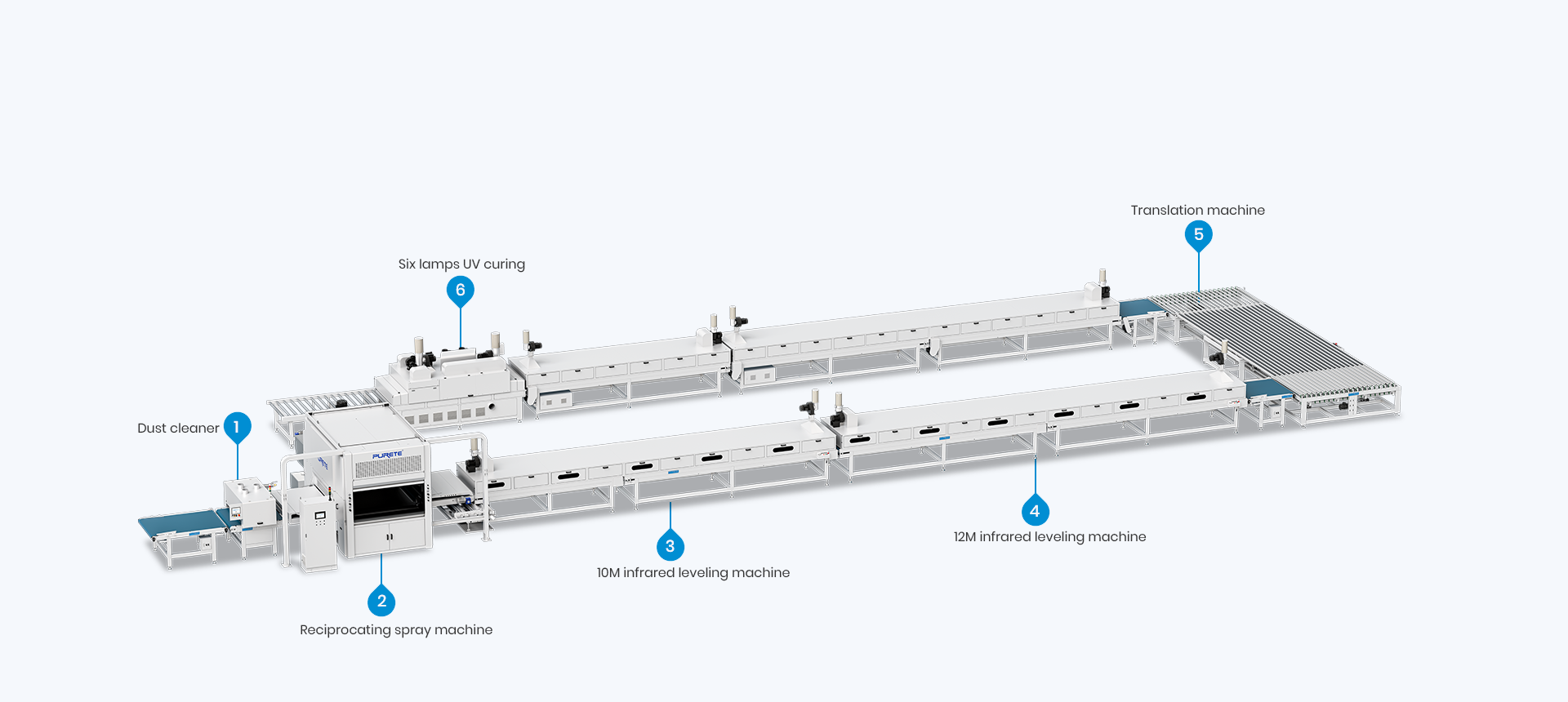
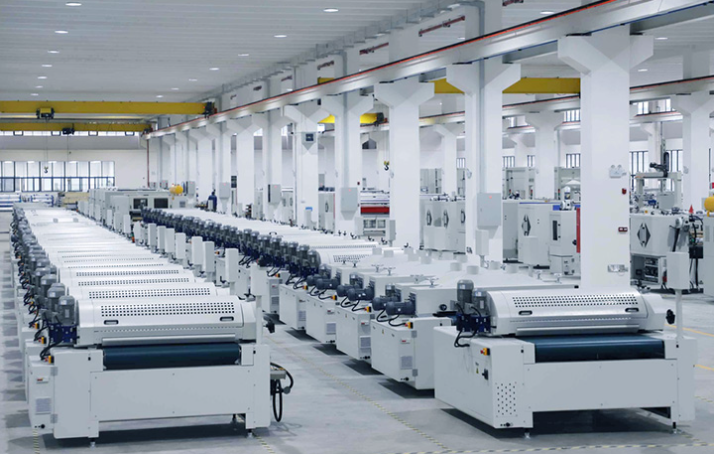
Automatic spray painting production line for furniture, doors and casework panels
Define the Finishing Specification Before Choosing a Sprayer
Equipment selection should follow the product specification, not the other way around. Before requesting a quotation, confirm:
Substrate type, moisture condition and surface preparation requirements
Part dimensions, weight, thickness and geometry
Coating chemistry, including water-based, PU, UV or other systems
Target dry film thickness, gloss level, color and appearance standard
Required resistance to disinfectants, stains, abrasion and moisture
Daily output, batch size, color changes and product variation
Dry-to-handle, dry-to-stack and full-cure requirements
Inspection method, sample approval and traceability procedure
A Hospital-Specific Factory Finishing Workflow
Material inspection
Edge preparation
Sanding
Dust removal
Primer spraying
Flash-off
Intermediate sanding
Topcoat spraying
Drying or curing
Cooling
Quality inspection
Packing
1. Prepare the Substrate
Confirm flatness, moisture, edge condition and contamination before coating. MDF, plywood, solid wood, metal components and pre-sealed boards may require different primers and preparation methods.
2. Control Dust and Edges
Hospital panels often have large visible surfaces and exposed edges. Poor edge preparation can cause uneven absorption, thin coverage and early coating failure. Sanding, cleaning and dust removal should be controlled before the workpiece reaches the spray area.
3. Match Spray Technology to Part Geometry
Flat doors and panels are suitable for automatic reciprocating spray systems. Curved, grooved or irregular components may require robotic or five-axis spray painting. For spray painting cabinet doors, the system should maintain consistent gun distance, spray angle and overlap across faces, edges and recessed areas.
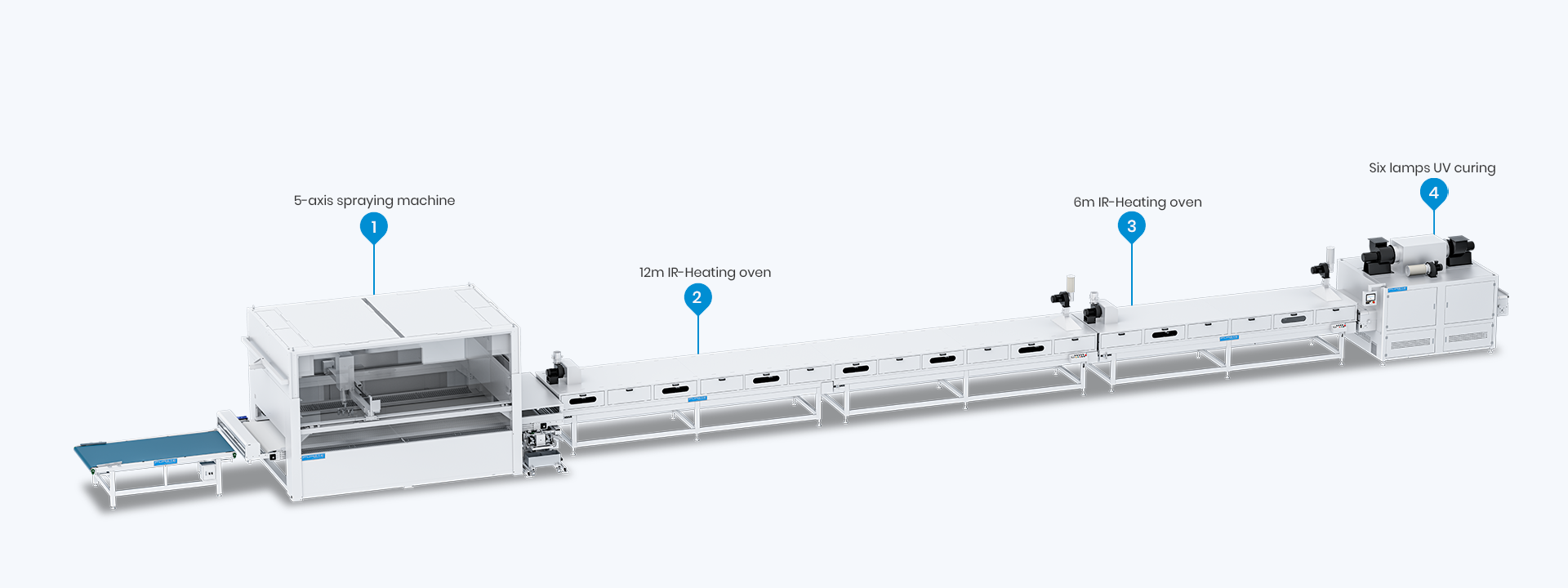
Five-axis spray painting system for irregular furniture and casework parts
4. Dry, Cure and Cool Before Packing
Drying is not the same as full curing. A panel may feel dry to the touch while still being vulnerable to blocking, imprinting or chemical damage. Define separate standards for dry-to-touch, dry-to-handle, dry-to-stack and full-cure conditions.
How to Choose an Industrial Paint Sprayer
| Production condition | Suitable solution | Main advantage |
|---|---|---|
| Low volume and high product variety | Manual HVLP spraying | Flexible for samples and frequent changes |
| Repeated flat doors and panels | Automatic reciprocating spray painting | Stable coverage and repeatable output |
| Grooved, curved or irregular parts | Robotic or five-axis spraying | Improved access to complex surfaces |
| High-speed UV production | Automatic spraying with UV curing | Shorter handling time when coating and curing are compatible |
| Water-based coating systems | Automatic spraying with controlled hot-air or infrared drying | Better moisture removal and process stability |
An industrial paint sprayer should be evaluated as part of a complete line that includes feeding, filtration, overspray collection, drying, curing, cooling and inspection. For mixed hospital orders, a modular line can be more practical than a system designed for only one door size or coating formula.
Drying and Curing Control the Real Production Schedule
Drying time depends on coating chemistry, film thickness, air movement, temperature, humidity, part spacing and conveyor speed. Water-based coatings require controlled air conditions to remove moisture. PU and solvent-based systems require suitable ventilation, filtration and fire-safety controls. UV coatings require compatible lamps, correct exposure and sufficient cooling.
Industrial examples may range from under two minutes to more than 45 minutes, but no single number applies to every project. A basic planning formula is:
Required drying time × conveyor speed = required drying length
For hospital projects, the line should be tested with the actual substrate, coating and target film thickness before final production approval.
Quality Control for Healthcare Projects
A practical inspection plan may include:
Dry film thickness
Color and gloss consistency
Adhesion
Edge and corner coverage
Scratch and abrasion resistance
Resistance to specified cleaning chemicals
Dry-to-stack and full-cure verification
Coating consumption and rework rate
Record coating batch, operator, line settings, inspection results and rework reasons. This traceability helps manufacturers respond quickly when a hospital project requires repeat production or replacement parts.
Mexico as a Regional Application Example
Official Mexican economic data recorded 32,545 business units in the furniture, mattress and blinds sector in 2026, with Estado de México, Michoacán and Jalisco among the states with the largest number of units. This reflects a broad manufacturing base that includes furniture, cabinetry, door panels and engineering-related components.
For manufacturers serving hospitals, contractors or commercial interiors, the key questions are similar in every market: Can the line handle the required parts? Is the coating process repeatable? Can the finished product withstand cleaning and installation? Are technical support, spare parts, Spanish-language documentation and safety requirements available locally?
September 2026: PURETE Exhibition Program in China
In September 2026, PURETE will present surface-treatment and finishing solutions at two major Chinese industry exhibitions. From September 5 to 8, visit PURETE at CIFF Shanghai and the WMF International Woodworking Fair at the National Exhibition and Convention Center in Shanghai, Booth 7.1F01. From September 20 to 22, PURETE will exhibit at Linyi Wood Expo, Booth 5A50.
PURETE will showcase profile wrapping, roller coating, laminating and CNC intelligent spray painting solutions for furniture, cabinets, door panels, wall panels and other components. Visitors are welcome to bring their product samples and production requirements to discuss suitable finishing solutions with the PURETE team. Read PURETE’s September 2026 exhibition preview.
Frequently Asked Questions
What is the best sprayer for hospital doors?
For repeated flat doors, an automatic reciprocating system is often suitable. Curved or detailed doors may require robotic or five-axis spraying. The final choice depends on coating chemistry, output and geometry.
Can automatic spray painting be used for hospital casework?
Yes. Automatic spray painting can provide consistent film thickness and repeatable coverage for cabinet doors, panels and other casework components when the feeding, spray and drying stages are properly matched.
How long should hospital doors dry before packing?
The correct time depends on the coating system and process conditions. Always verify dry-to-stack and full-cure performance with the actual coating and substrate rather than relying only on touch-dry results.
What information is needed for a finishing-line quotation?
Prepare product drawings, material details, part dimensions, coating data, daily output, quality requirements, available factory space and power conditions. Samples are also valuable for testing spray coverage and drying performance.
The right finishing line is selected around the complete product and project specification, not the sprayer alone. For hospital doors, casework and other demanding furniture components, Contact PURETE to discuss samples, coating requirements and a suitable factory finishing solution.
What Is the Principle of Auto Coating Machine?

Advantages of Short-Cycle Presses in Panel Processing
Application of Soft-Touch (Excimer) Coating in Furniture and Decorative Materials
Which Industries Benefit Most from PUR Laminating?
What Is the Principle of Roller Coating Machine?
How Does PUR Laminating Compare to Solvent-Based Lamination in Terms of Cost?
Global Surface Finishing Market Analysis and Development Trends


