

Types of Coating Machines for Industrial Finishing: Complete Guide
 June 30, 2026
 Hits:1071second
Introduction
Industrial finishing is not only about choosing one coating machine. In factory production, coating equipment usually works inside a complete line with conveying, cleaning, drying, curing, loading, unloading, and inspection. A spray coating machine or roller coating machine affects surface quality, but the final result depends on the full coating process. For manufacturers evaluating industrial coating equipment, PURETE represents a production-line approach, where each machine supports stable output, process control, and long-term factory operation.
Quick Answer
A coating machine is industrial equipment used to apply coating material onto a product surface. It may apply paint, primer, lacquer, UV coating, powder, adhesive, or other functional surface materials. In B2B manufacturing, however, the machine is usually selected as part of an industrial coating system rather than as an isolated unit.
Spray coating machines are suitable for shaped parts, edges, grooves, and multi-sided products. Curtain coaters are used for smooth coating on flat substrates. Roller coaters are efficient for flat panels, boards, and doors. UV coating machines support fast curing and surface hardening when UV-compatible materials are used. Powder coating systems and dip coating systems are also common in broader industrial finishing, especially for metal and protective applications.
The right choice depends on product shape, coating material, surface quality target, line speed, automation level, factory space, and ROI.
What Is a Coating Machine?
A coating machine is the equipment used to apply a controlled layer of coating material onto a substrate. The substrate may be wood, MDF, plywood, plastic, metal, glass, composite board, or other industrial material. The coating may be used for decoration, protection, gloss control, adhesion, wear resistance, corrosion resistance, or special surface texture.
In real production, a coating machine is only one part of the process. Before coating, the surface may need sanding, cleaning, dust removal, or pretreatment. After coating, the product may need leveling, drying, UV curing, cooling, inspection, or stacking. If these stages are not matched, even a well-built machine may produce unstable results.
For this reason, factories should not evaluate coating equipment only by machine type. A better question is which coating process fits the product, material, production volume, and quality requirement. This system view is important for furniture factories, board manufacturers, cabinet producers, door factories, plastic parts suppliers, and metal component manufacturers.
A coating machine can be manual, semi-automatic, or fully automatic. Manual systems depend heavily on operator skill. Semi-automatic systems improve feeding, movement, or application consistency. Fully automatic systems connect the coating machine with conveyors, dryers, UV curing units, loading machines, unloading machines, and control systems. The more continuous the production requirement, the more important system integration becomes.
Why Coating Machines Matter in Modern Manufacturing
Surface finishing often determines how customers judge product quality. In furniture, cabinet, door, panel, plastic, and metal manufacturing, visible coating defects can reduce product value immediately. Common problems include uneven gloss, poor adhesion, orange peel, pinholes, dust marks, color variation, edge defects, and unstable coating thickness.
A coating machine matters because it reduces process variation. Manual coating can work for small batches, but it is difficult to maintain the same speed, distance, overlap, coating amount, and drying condition across long shifts. Automated coating equipment creates a more repeatable process window and helps the factory reduce operator-dependent quality changes.
Material cost is another reason factories invest in coating technology. Paint, primer, lacquer, UV coating, adhesive, and solvent can represent a large part of finishing cost. Poor transfer efficiency, overspray, excessive film thickness, and rework all increase operating cost. A properly selected industrial coating system helps control coating consumption.
Labor structure also affects the decision. Many factories want to reduce dependence on skilled painters, improve workplace conditions, and make daily output more predictable. In an integrated production line, operators manage parameters, recipes, quality checks, and maintenance instead of manually controlling every coating result.
For factory owners and production managers, coating equipment should be evaluated by production stability, defect reduction, material use, labor savings, maintenance workload, and long-term ROI. Purchase price is only one part of the decision.
How Coating Machines Are Classified
Coating machines can be classified by application method, substrate type, coating material, automation level, and production purpose.
By application method, common types include spray coating, curtain coating, roller coating, UV coating, powder coating, and dip coating. Each method has a different process logic. Spray coating uses atomized material. Curtain coating uses a controlled falling film. Roller coating uses contact transfer. UV coating combines application or surface treatment with fast curing. Powder coating applies dry powder and cures it in an oven. Dip coating immerses the workpiece in a coating bath.
By substrate type, flat products usually fit roller coating, curtain coating, and UV coating lines. Shaped furniture parts, profiled doors, carved surfaces, and irregular components often require spray coating. Metal components may require powder coating, liquid spray coating, or dip coating depending on protection requirements.
By material, water-based coatings, solvent-based coatings, UV coatings, powder coatings, primers, stains, lacquers, adhesives, and functional coatings all require different process settings. Viscosity, drying behavior, curing method, surface absorption, film thickness target, and environmental conditions should be checked before machine selection.
By automation level, some machines operate as standalone units, while others are part of coating production lines that connect cleaning, conveying, coating, drying, curing, cooling, and unloading. For B2B buyers, this distinction matters because production output depends on the complete line, not only the coating unit.
Types of Coating Machines
Spray Coating Machines
A spray coating machine atomizes coating material through spray guns or nozzles and applies it to the product surface. It is widely used when products have complex shapes, grooves, edges, curves, or multi-sided surfaces that cannot be coated efficiently by roller or curtain methods.
Spray coating is common in furniture, cabinet doors, molded doors, plastic parts, metal components, and shaped wood products. It can apply primer, topcoat, stain, lacquer, water-based coating, solvent-based coating, and UV coating, depending on system configuration.
The main advantage of spray coating is flexibility. It can cover surfaces that contact coating methods cannot reach. This is important for factories producing mixed shapes, edge-heavy parts, or decorative products. A system such as a reciprocating paint production line is useful when controlled gun movement, conveyor transport, and repeatable coating coverage are required.
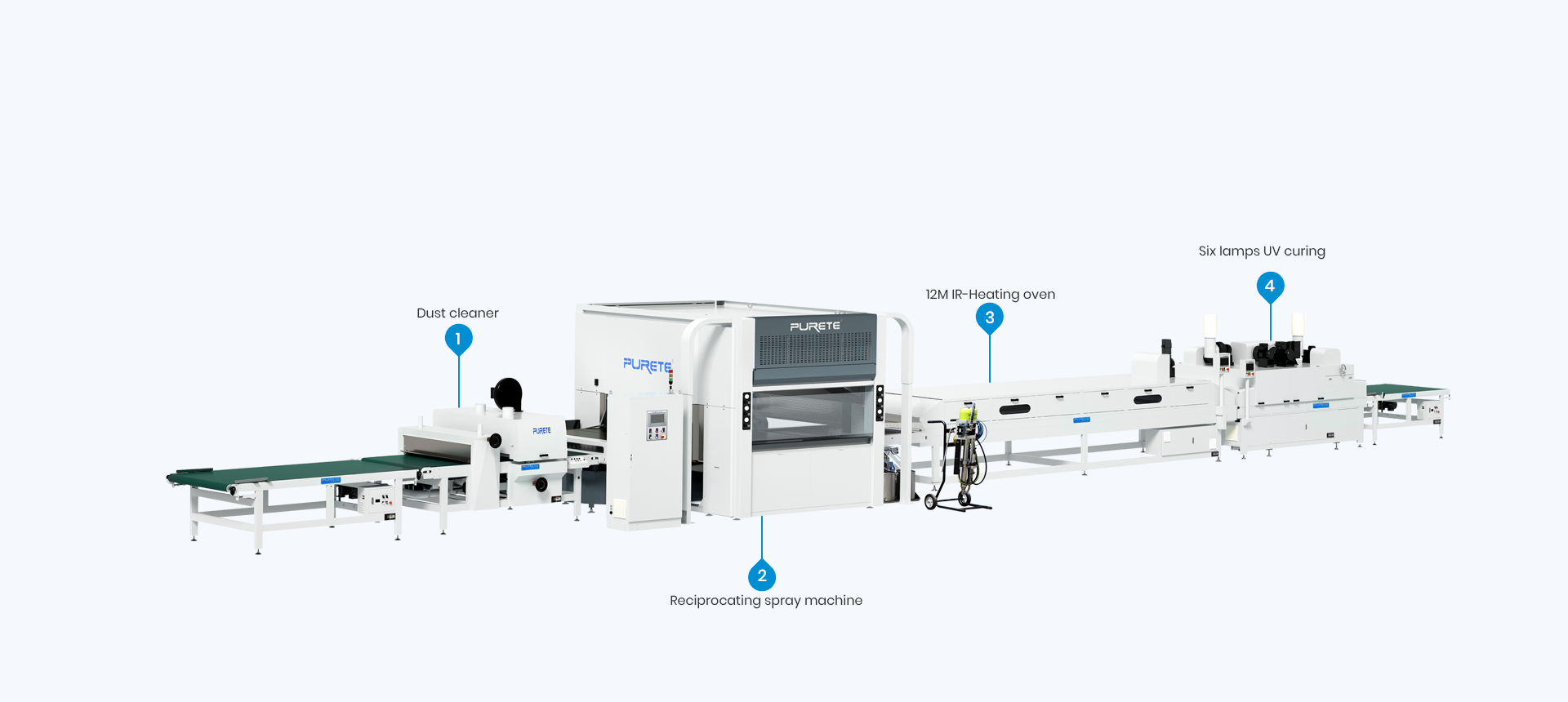 PURETE Spraying painting production line
The main limitation is overspray. Because coating material is sprayed through air, not all material reaches the workpiece. Airflow, gun distance, spray angle, pressure, viscosity, conveyor speed, filtration, and exhaust design all affect transfer efficiency and surface quality. Spray coating works best when it is designed as part of a full production line rather than as a simple spraying station.
Curtain Coaters
A curtain coater creates a continuous falling film of coating material. The substrate passes under this coating curtain and receives a uniform layer on the surface. This method is mainly used for flat products such as boards, panels, doors, flooring, and decorative surfaces.
Curtain coating is suitable for smooth surface application and high-speed production. Compared with spray coating, it usually creates less airborne waste because the material is applied in a controlled flow. It can also support consistent surface coverage when the substrate is flat and the material flow is stable.
The limitation is flexibility. Curtain coating requires stable coating viscosity, flow rate, substrate flatness, width, and conveyor speed. It is not suitable for deep profiles, complex edges, irregular surfaces, or products with large height differences.
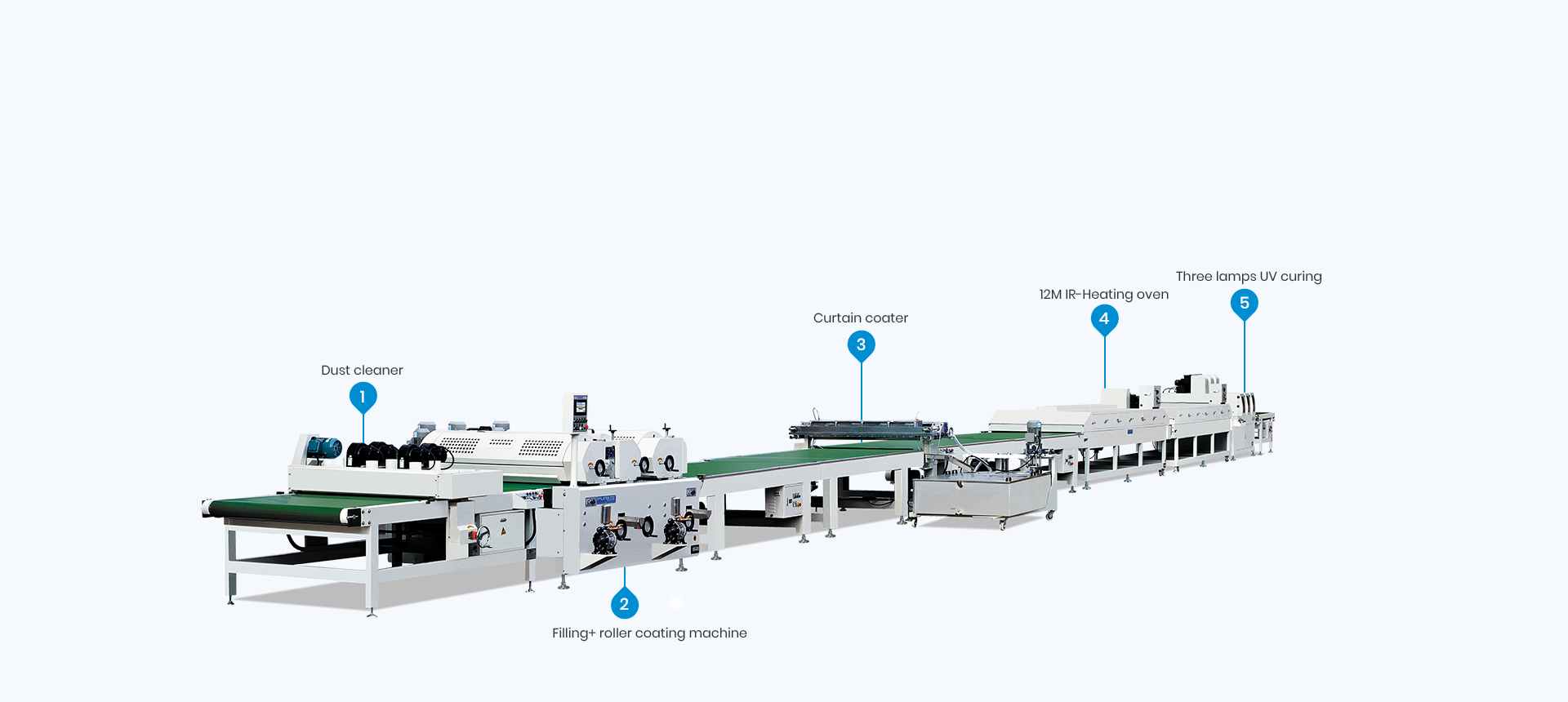 PURETE Curtain Coating Production Line
For factories producing large volumes of flat panels, curtain coating can be an efficient coating technology. For mixed production with many shapes, it is usually used together with other methods such as roller coating, spray coating, drying, and UV curing.
Roller Coaters
A roller coating machine transfers coating material from a roller to the surface of a flat or slightly profiled substrate. It is one of the most practical technologies for MDF, plywood, cabinet panels, doors, flooring, furniture boards, and decorative panels.
The main advantage is material control. Roller gap, roller hardness, pressure, coating viscosity, and conveyor speed can be adjusted to create stable coating thickness. Since the coating is transferred by contact, material waste is usually lower than in spray coating.
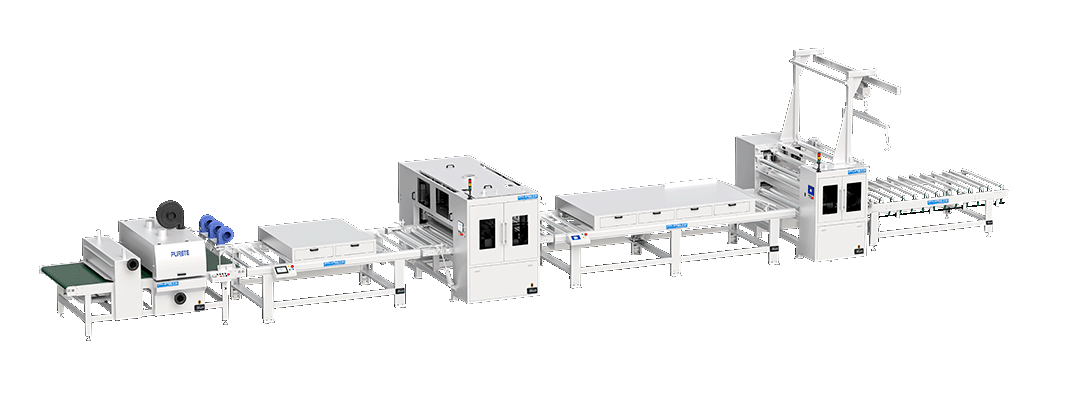
Roller coating is especially suitable for factories with continuous flat panel production. A system such as a large roller coating production line can support wide workpieces, stable application, and repeated coating processes in one line.
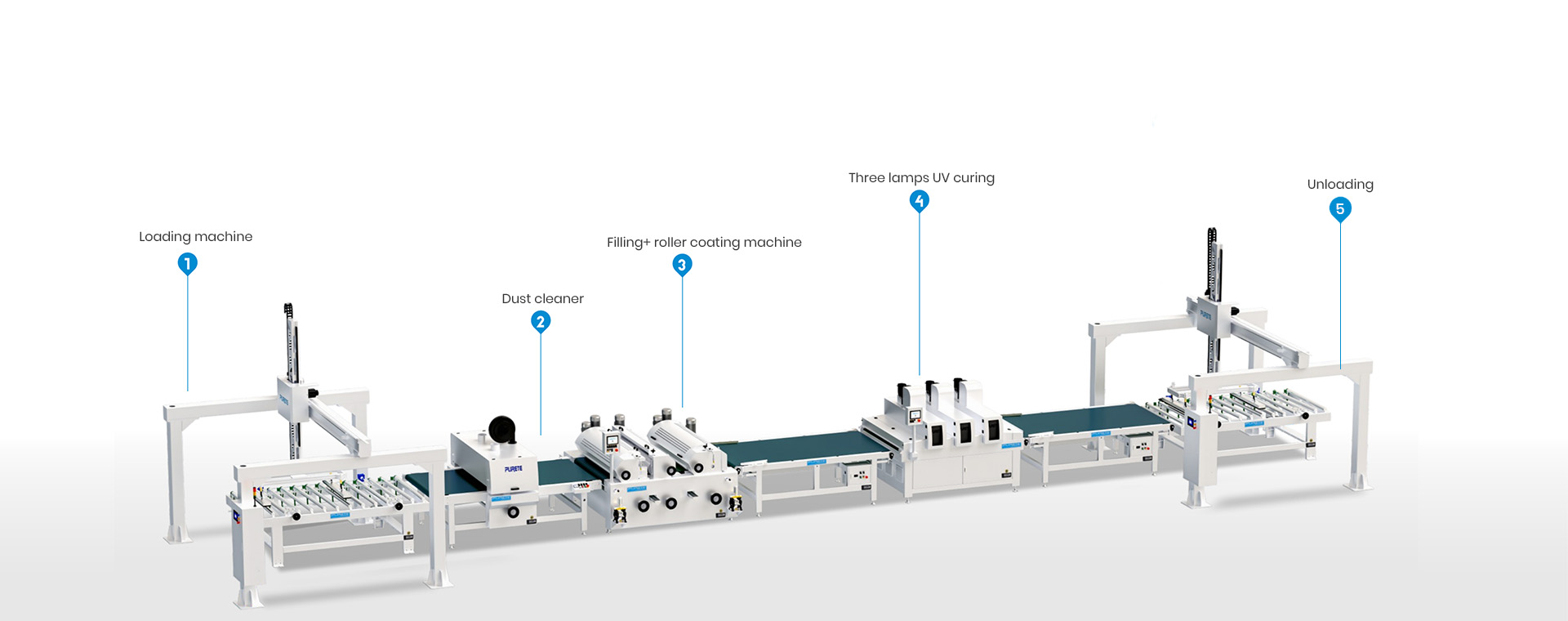 PURETE Roller coating production line
The limitation is product geometry. Roller coating cannot fully cover deep grooves, carved surfaces, complex profiles, or irregular edges. Roller marks, streaks, or uneven film can also appear if roller pressure, cleaning, coating viscosity, or substrate flatness is not controlled. This is why roller coating lines often work with sanding, dust cleaning, leveling, drying, and UV curing equipment.
UV Coating Machines
A UV coating machine applies or processes UV-curable coating and uses ultraviolet energy to cure the surface quickly. In many factories, UV equipment is not only a coating unit. It also works as a curing and surface hardening section inside a roller coating line, curtain coating line, or other finishing system.
UV coating technology is common in furniture panels, decorative boards, doors, flooring, cabinet panels, and high-gloss or matte surfaces. The main advantage is curing speed. When coating chemistry, lamp power, exposure time, and line speed are matched, UV coating can cure quickly and allow faster handling.
UV coating can improve surface hardness, gloss control, scratch resistance, and production efficiency. It also helps reduce waiting time and work-in-process storage compared with slower drying methods.
The limitation is material compatibility. UV coating machines are not suitable for every substrate or coating formula. Incomplete curing, poor adhesion, cracking, or heat-related defects may occur if UV energy, coating thickness, and substrate properties are not matched. For this reason, UV coating should be evaluated through process testing before full line design.
Powder Coating Systems
Powder coating systems apply dry powder to a product surface, usually by electrostatic spraying, and then cure the powder in an oven. This method is widely used for metal components, aluminum profiles, equipment housings, racks, shelves, appliance parts, and industrial hardware.
The main advantage is durable surface protection. Powder coating can provide corrosion resistance, wear resistance, and strong surface coverage. Many systems also allow powder recovery, which can improve material use.
Powder coating usually requires pretreatment, drying, powder application, curing, cooling, and inspection. Pretreatment is critical because oil, rust, moisture, or poor cleaning can cause adhesion and corrosion problems.
For this article, powder coating is included as a common industrial coating method, but it is less relevant to flat panel coating, furniture finishing, UV roller coating, curtain coating, and integrated wood-based surface finishing lines. Factories should include powder coating in their comparison only when metal protection is a major requirement.
Dip Coating Systems
Dip coating immerses the product in a coating bath and then removes it at a controlled speed. The coating layer forms as excess material drains from the surface. This method is useful when full coverage is required, including internal areas or difficult-to-reach surfaces.
Dip coating is often used for protective coatings, primers, small metal parts, hardware, and components where coverage is more important than decorative surface precision. The process depends on bath viscosity, withdrawal speed, drainage time, temperature, and curing conditions.
The advantage is complete coverage. The limitation is surface control. Runs, edge buildup, uneven drainage, and coating accumulation can occur. Dip coating is useful in specific protective applications, but it is usually not the first choice for high-quality decorative furniture, cabinet, door, or panel surfaces.
Advantages and Limitations of Each Coating Technology
Each coating technology fits a different production scenario. Spray coating is flexible and suitable for complex shapes, but overspray and airflow control must be managed. Roller coating is efficient for flat panels and offers strong material control, but it is limited by product geometry. Curtain coating supports smooth and fast application on flat substrates, but it requires stable material flow and product consistency.
UV coating improves curing speed and reduces waiting time, but it requires compatible material chemistry and controlled curing energy. Powder coating is strong for metal protection, but it depends on pretreatment and oven curing. Dip coating provides full coverage but is less precise for visible decorative surfaces.
A common mistake is choosing equipment only by machine name. A roller coating machine may have high efficiency, but it cannot replace spraying for shaped parts. A spray coating machine may be more flexible, but it may not be the best choice for high-volume flat board production. A curtain coater may produce smooth surfaces, but it needs stable substrates and coating flow.
The better approach is to compare the full coating process. Buyers should evaluate substrate shape, material cost, defect rate, line speed, drying or curing capacity, maintenance workload, labor structure, and ROI. In many cases, the best solution is not one machine, but a connected production line.
Coating Machines by Application
Furniture
Furniture production often includes both flat panels and shaped parts. Flat furniture components may use roller coating, curtain coating, and UV coating. Chairs, frames, carved parts, and assembled components often require spray coating.
For furniture factories, product classification should come before machine selection. A factory producing mainly flat panels may need a high-efficiency roller coating line. A factory producing complex furniture parts may need spray coating and flexible conveying. Many factories use combined systems to handle different components in the same finishing department.
Cabinets
Cabinet production includes doors, side panels, shelves, frames, and decorative parts. Flat cabinet panels are suitable for roller coating and UV coating. Routed doors, profiled edges, grooves, and molded surfaces often require spray coating.
Cabinet factories should pay attention to edge quality. A machine that performs well on the face surface may not coat edges or recesses properly. If the product requires multi-side coating, the line must include suitable turning, handling, and drying arrangements.
Doors
Door finishing depends on the surface structure. Flat doors can be processed efficiently with roller coating and UV curing. Molded doors, grooved doors, and decorative doors often need spray coating to reach recessed areas and edges.
Doors are large workpieces, so conveying and drying layout are important. Poor handling after coating can create scratches, stacking marks, or edge damage. For door manufacturers, coating should be planned as a production line process rather than a single machine purchase.
Wood Panels
Wood panels, MDF, plywood, flooring, and decorative boards are typical applications for roller coating, curtain coating, and UV coating. These products are usually flat, which supports continuous high-speed production.
Surface preparation is critical. Sanding quality, dust removal, panel flatness, moisture content, and surface absorption all affect the final coating result. A roller coating machine or curtain coater can only produce stable results if the incoming panel condition is controlled.
Metal Components
Metal components often require both appearance and protection. Powder coating, liquid spray coating, and dip coating are common options. The right choice depends on part shape, corrosion requirement, coating thickness, curing temperature, and production volume.
Pretreatment is especially important for metal finishing. Cleaning, degreasing, blasting, or chemical treatment may be required before coating. Without proper pretreatment, even a good coating machine cannot ensure long-term adhesion or corrosion resistance.
How to Choose the Right Coating Machine
The first step is to define the product family. Buyers should list substrate material, size range, surface shape, edge structure, coating target, and production volume. Flat boards, cabinet doors, furniture parts, plastic components, and metal parts should not be evaluated with the same criteria.
The second step is to define the coating material. Water-based coating, solvent-based coating, UV coating, powder coating, primer, lacquer, stain, and adhesive all have different process requirements. Viscosity, drying behavior, curing method, and surface compatibility must be confirmed.
The third step is to calculate real production capacity. Machine speed alone is not enough. Feeding, coating, drying, curing, cooling, unloading, changeover, and inspection all affect line output. A fast coating machine creates little value if drying or curing becomes the bottleneck.
The fourth step is to evaluate automation and ROI. Buyers should consider material savings, labor reduction, defect reduction, output increase, energy use, maintenance cost, downtime risk, and product value improvement. A reliable coating machine supplier or coating machine manufacturer should discuss the complete process, not only the machine specification.
Key Factors Affecting Equipment Selection
Substrate geometry is the first factor. Flat products favor roller, curtain, and UV coating systems. Complex products favor spray coating. Metal parts may favor powder coating or dip coating depending on protection needs.
Coating behavior is another factor. Some materials are suitable for rollers. Some flow better through curtain systems. Some require atomization through spray guns. Testing is important when the factory changes material, substrate, or finish target.
Production volume affects automation level. High-volume factories usually need automatic loading, conveying, coating, drying, curing, and unloading. Small-batch factories may need flexible semi-automatic systems with faster changeover.
Factory environment also affects finish quality. Dust, humidity, temperature, airflow, and ventilation can create defects. A coating system should be designed with the actual factory environment, not only with the machine footprint.
Maintenance capability should also be considered. Rollers, spray guns, UV lamps, filters, pumps, booths, ovens, and conveyors all require routine care. A system that is difficult to clean, adjust, or inspect may lose performance after installation.
Automation Trends in Coating Technology
Automation in coating technology is moving from single-machine operation to connected production line control. Instead of adjusting each machine separately, factories increasingly expect coating application, conveyor speed, drying temperature, UV energy, and workpiece spacing to work as one process.
Automatic loading and unloading reduce manual handling. This is important because coated surfaces are easy to damage before drying or curing is complete. Integrated conveying also improves line balance and reduces waiting time.
Recipe control is another practical development. A recipe may include conveyor speed, roller gap, spray gun movement, coating amount, drying temperature, and UV energy. Stored recipes help factories repeat previous settings and reduce operator-dependent variation.
Beyond standard coating machines, some finishing lines may also include inert coating, excimer surface treatment, PUR laminating, or wrapping equipment. These systems are not always classified as traditional coating machines, but they belong to the wider surface finishing process when factories need matte, soft-touch, laminated, or wrapped decorative surfaces.
Automation should still match real production needs. A factory with stable flat panel production may benefit from a highly automated line. A factory with frequent custom orders may need flexibility. The right automation level depends on product mix, labor cost, output target, and maintenance ability.
Industry 4.0 and Smart Finishing Lines
Industry 4.0 in finishing lines is mainly about process visibility, data connection, and controlled decision-making. A smart finishing line records useful production data such as line speed, coating consumption, curing energy, downtime, defect rate, recipe use, and maintenance alerts.
This data helps factories compare shifts, identify unstable settings, and reduce repeated defects. If a quality issue appears, managers can check the process conditions from that batch instead of guessing the cause.
Smart finishing also supports remote service and troubleshooting. For international buyers, EPC integrators, and distributors, machine data can help service teams diagnose faults faster and reduce downtime.
However, data alone does not improve production. The factory must know which data matters and how it will be used. A smart industrial coating system should support better uptime, material control, maintenance planning, and quality consistency.
Future of Industrial Coating Machines
The future of industrial coating machines will focus on material efficiency, process stability, flexible production, and environmental control. Factories need to reduce waste, improve quality, and handle smaller batches without losing efficiency.
Water-based coatings, UV coatings, low-emission materials, and faster curing systems will continue to influence equipment design. These materials often require better control of airflow, drying, curing, and surface preparation.
Hybrid coating lines will become more common. A factory may use roller coating for primer, curtain coating for a smooth top layer, spray coating for shaped parts, and UV curing for fast handling. In higher-end decorative surface production, inert coating, excimer finishing, laminating, and wrapping may also be combined with coating lines to meet different surface appearance and touch requirements.
The ability to combine several coating technologies in one turnkey coating system will be important for manufacturers with mixed product lines. The best equipment decisions will continue to come from process understanding. A coating machine should be selected according to product, material, quality target, factory layout, operating cost, and long-term production stability.
Conclusion
Coating machines are central to industrial finishing because they control surface quality at production scale. Spray coating machines are flexible for complex shapes. Curtain coaters support smooth coating on flat substrates. Roller coating machines are efficient for flat panels. UV coating machines reduce curing time when materials are compatible. Powder and dip coating systems serve important protective applications.
For factory buyers, the best choice depends on process fit, not only machine type. Substrate shape, coating material, production speed, drying or curing method, automation level, and ROI all need to be evaluated together. A well-designed coating system connects application, conveying, drying, curing, and handling into one stable production process.
FAQ
Which coating machine has the highest transfer efficiency?
For flat products, roller coating and curtain coating usually have high transfer efficiency because coating is applied directly or in a controlled flow. Spray coating can have lower transfer efficiency due to overspray, although automation can reduce waste. Powder coating may also recover unused powder in many systems.
What is the difference between curtain coating and spray coating?
Curtain coating uses a falling film of coating material to cover a flat moving substrate. Spray coating atomizes coating material through guns or nozzles. Curtain coating is better for flat, high-speed production. Spray coating is better for complex shapes, edges, grooves, and multi-sided parts.
Are UV coating machines suitable for all materials?
No. UV coating machines require UV-curable materials and substrates that can tolerate the curing process. Coating chemistry, lamp energy, line speed, and surface preparation must be matched before production.
How much automation is available in modern coating lines?
Modern coating lines can include automatic loading, cleaning, conveying, coating, drying, UV curing, cooling, turning, unloading, recipe control, and process monitoring. The required level depends on product mix and production volume.
What coating technology is best for furniture manufacturing?
Flat furniture panels often fit roller coating, curtain coating, and UV coating. Shaped furniture parts, carved surfaces, frames, and assembled components often require spray coating. Many furniture factories use combined systems.
How do manufacturers calculate coating line ROI?
ROI includes purchase cost, coating material savings, labor reduction, output increase, defect reduction, rework reduction, energy use, maintenance cost, and downtime risk. Long-term operating cost is usually more important than machine price alone.
What are the latest trends in industrial finishing?
Important directions include higher automation, lower coating waste, better process data, faster curing, water-based and UV-compatible systems, and hybrid lines that combine multiple coating methods.
Can multiple coating technologies be combined in one production line?
Yes. A factory may combine roller coating, spray coating, curtain coating, UV curing, drying, and conveying in one line. Related surface finishing systems such as inert coating, excimer finishing, PUR laminating, and wrapping can also be integrated when the product requires special surface appearance or composite finishing.
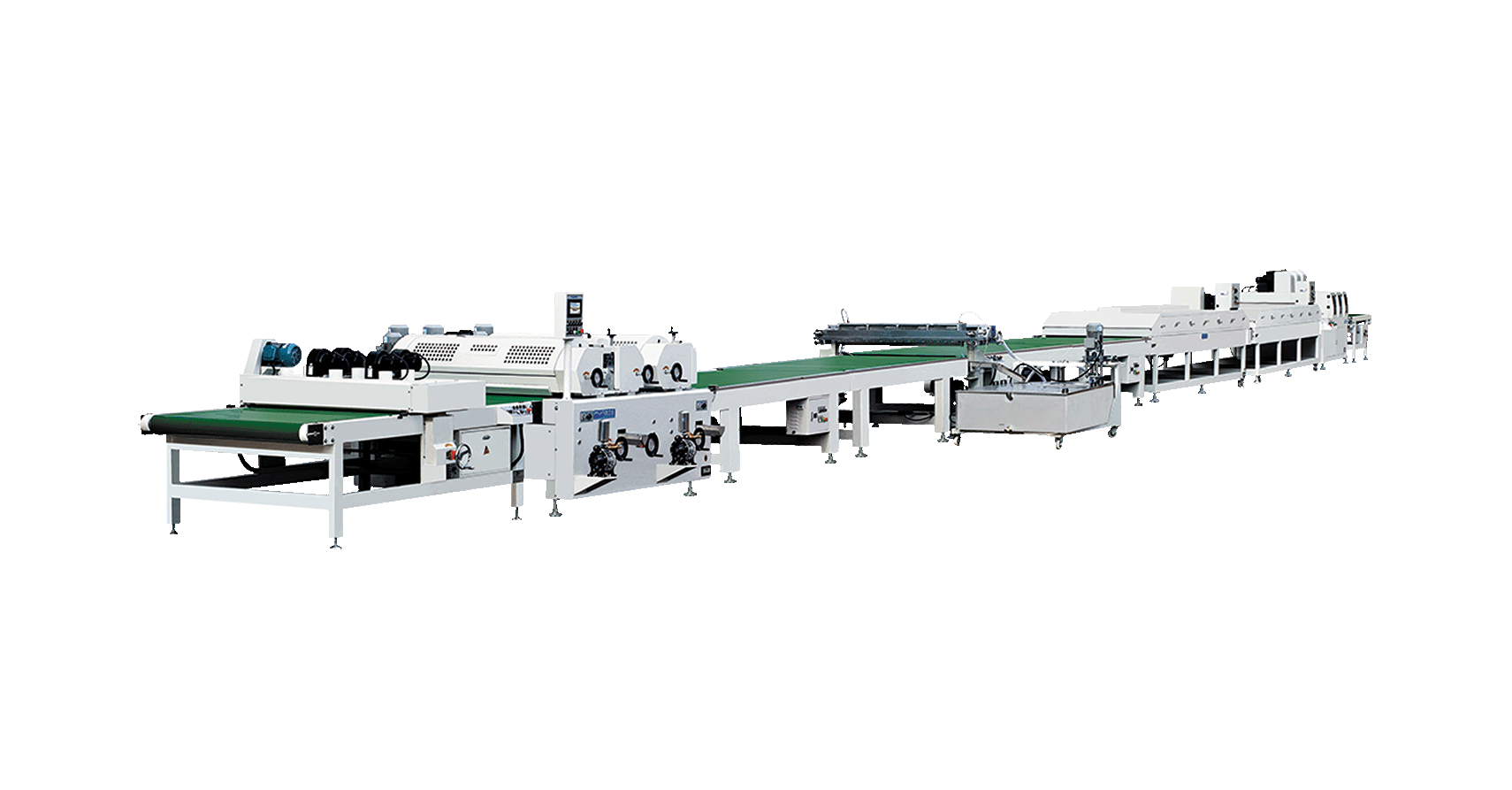
What Is the Principle of Auto Coating Machine?

Advantages of Short-Cycle Presses in Panel Processing
Application of Soft-Touch (Excimer) Coating in Furniture and Decorative Materials
Which Industries Benefit Most from PUR Laminating?
What Is the Principle of Roller Coating Machine?
How Does PUR Laminating Compare to Solvent-Based Lamination in Terms of Cost?
Global Surface Finishing Market Analysis and Development Trends


