

What Is an Automatic Surface Coating Machine and How Does It Work?
 March 25, 2026
 Hits:811second
For production managers and factory owners, figuring out the mechanics and the actual return on investment (ROI) of these systems is the first step toward scaling up.
Here is a practical, engineer-level breakdown of how these machines work, the technologies involved, and how to figure out if your production volume justifies the investment.
What Exactly Is an Automatic Surface Coating Machine?
At its most basic level, an automatic surface coating machine is an industrial system built to apply wet finishes (like UV paint or water-based varnish), adhesives, or protective films to raw materials without needing a human hand to guide the process.
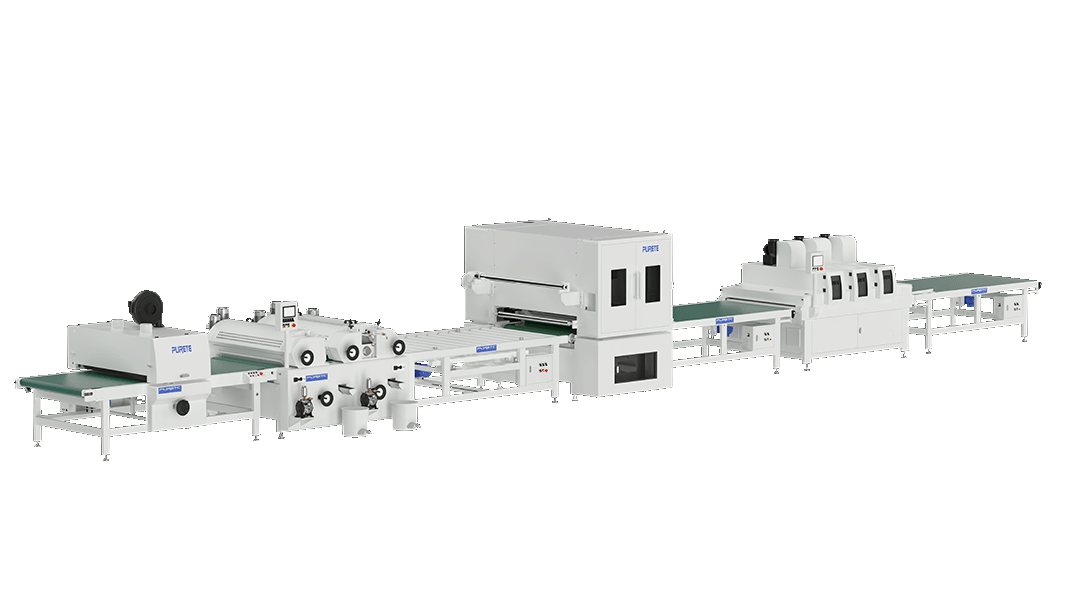
The True Meaning of Automated Equipment
When we say "automated" in a modern factory setting, we aren't just talking about a motorized conveyor belt. We are talking about machines driven by Programmable Logic Controllers (PLCs) and optical sensors. The equipment physically "reads" the board coming down the line, adjusts the application rollers or spray guns down to the micron, and applies the exact amount of coating required at speeds of 15 to 30 meters per minute.
Manual vs. Semi-Automatic vs. Fully Automatic
Moving from hand-spraying to a machine-driven process changes the math of your entire operation. Manual coating relies entirely on operator skill. Even your best painter gets tired by 3:00 PM, which leads to uneven film thickness and a lot of wasted paint floating in the air. Semi-automatic setups might use a mechanized spray gun, but you still have a crew manually loading boards and pushing drying racks around the floor.
A fully automatic machine—especially when linked into a continuous line—takes the raw board at one end and spits out a dry, perfectly finished, ready-to-pack product at the other.
| Production Method | Precision & Consistency | Material Waste | Labor Dependency |
| Manual / Semi-Auto | Inconsistent (relies on human skill) | High (up to 40-50% lost to overspray) | Heavy (requires multiple skilled painters) |
| Fully Automatic | Exacting (sensor & PLC controlled) | Minimal (up to 95-98% transfer efficiency) | Light (1-2 operators to monitor the screen) |
The Core Components of an Automatic Coating System
To understand how these machines hit such tight tolerances day in and day out, it helps to look under the hood. A standard automated setup is usually broken down into five distinct zones.
- 1. The Feeding and Preparation Unit: You can't put a perfect finish on a dusty board. Before any paint is applied, the material runs through automated feeding rollers and heavy-duty dust cleaners. These use specialized brush rollers and strong vacuums to pull microscopic debris off the surface.
- 2. The Coating Unit (The Heart of the Machine): This is where the magic happens. Depending on what you are making, this section houses precision dosing rollers, robotic spray arms, or glue applicators. Engineers use the control panel to dial in exactly how many grams of liquid should be applied per square meter.
- 3. Drying and Curing Tunnels: Putting the paint on is easy; drying it fast enough to keep the line moving is the real engineering challenge. Automatic machines feed the wet boards directly into UV (Ultraviolet) curing tunnels, IR (Infrared) heaters, or hot air systems. The finish hardens in seconds rather than hours.
- 4. Transfer and Control System: Heavy-duty, solvent-resistant belts or rollers move the product through the machine. Everything is tied back to a central touch-screen interface. Once you find the perfect speed and thickness for a specific product, you save it as a "recipe" in the PLC for the next time you run that batch.
- 5. Inspection and Output: At the tail end, automated stackers gently catch and stack the finished boards. Many high-end lines now include optical scanners that check for tiny surface defects before the board is cleared for shipping.
How Does an Automatic Surface Coating Machine Work in Practice?
The real appeal of automated surface treatment is the continuous, hands-free workflow. Let’s walk through what actually happens when a flat MDF panel goes through a standard UV roller coating line:
- Detection: The raw MDF board drops onto the infeed conveyor. Sensors instantly measure its thickness and width, feeding that data to the machine's brain.
- Prep: The board runs through the dust cleaner to ensure the surface is completely bare and clean.
- The Primer Coat: It enters the first roller coater. A perfectly metered dose of UV primer is pressed into the wood grain.
- Flash Curing: The board zips under a set of UV lamps. The primer is instantly semi-cured so the next layer won't bleed into it.
- Sanding: An automated sanding unit lightly scuffs the primer. This gives the topcoat something to grip onto.
- The Topcoat: The board passes through the final coating machine, getting its designated finish (maybe a tough, anti-scratch clear coat).
- Final Cure: A trip through a high-power UV or Excimer curing tunnel completely hardens the surface. The board comes out the other side cool to the touch and ready to be boxed up.
Because the machine constantly monitors itself, if the ambient temperature drops and the paint gets slightly thicker, the system can automatically adjust roller pressure to keep the film thickness exactly where you want it.
Which Products and Applications Need Automated Surface Treatment?
If you are manufacturing building materials or furniture at scale, automated coating is essentially a requirement to stay competitive.
Flat Panels and Flooring
This is the bread and butter of automated coating. Raw materials like MDF, plywood, and SPC/LVT flooring need tough base coats and durable topcoats. Roller coating lines handle these perfectly flat surfaces at blistering speeds.
Premium Decorative Boards
The high-end cabinetry and wall-panel markets are incredibly picky about aesthetics. Factories use automated machines to churn out flawless high-gloss acrylic panels, ultra-matte soft-touch (PET) finishes, and realistic wood-grain laminates.
Furniture Components and Profiles
Not everything is flat. For items like routed cabinet doors, window frames, or chair legs, factories use automatic 3D spray machines and vacuum coaters. These ensure that every single groove and complex edge gets an even coat without the paint pooling in the corners.
Common Types of Automatic Coating Technologies Explained
You don't just buy a "coating machine"—you buy the specific technology that fits your product's geometry and your buyer's finish requirements.
1. Roller Coating

If your product is flat, this is what you want. It uses rubber and steel rollers to literally press the paint onto the board. It is famous for having up to 95-98% paint transfer efficiency, meaning almost zero paint is wasted. It’s the undisputed king of flooring and flat-pack furniture.
2. Spray Coating
When you have 3D profiles, shaker-style doors, or complex shapes, rollers won't work. Automatic spray machines use robotic arms or reciprocating guns to spray a fine mist over the product, ensuring the paint wraps around uneven surfaces evenly.
3. Curtain Coating vs. Advanced Film & Excimer Technologies
Curtain coaters drop a continuous "waterfall" of paint that the board passes through, which used to be the go-to for thick, high-gloss finishes. However, the industry is rapidly shifting toward two advanced alternatives for premium panels: Inert Film Coating and Excimer Technology.
Instead of a waterfall, Inert Film Coating applies the paint, covers the wet board with a perfectly smooth transparent film, and cures it with UV light. Because the film itself blocks out oxygen, it doesn't need a special gas chamber. When the film is peeled away, it reveals a zero-bubble, ultra-flat mirror finish.
For ultra-matte, anti-fingerprint finishes, factories use Excimer curing, which cures the paint in an oxygen-free, nitrogen-filled chamber without any film. Both methods use a fraction of the paint required by a traditional curtain coater.
4. Vacuum Coating
This is built specifically for linear profiles like door frames and skirting boards. The wood passes through a small application chamber, and a powerful vacuum instantly sucks away the excess paint. This leaves a perfectly uniform finish on complicated, multi-angled edges without any drips.
The Real-World Advantages of Automated Coating Equipment
Putting capital into industrial machinery changes how your factory operates on a fundamental level.
- Predictable, Repeatable Quality: You eliminate the "Monday morning" or "Friday afternoon" quality drops. The 10,000th panel looks identical to the first one off the line.
- Reclaiming Floor Space: Because UV and Excimer systems cure paint in seconds, you no longer need hundreds of square feet dedicated to drying racks.
- Drastic Labor Reductions: Replacing manual spray booths with an automated line usually cuts the required finishing staff by 70% to 80%. In a tight labor market, this is a massive relief.
- Smart Factory Integration: Modern PLCs talk directly to your factory's ERP software. You can sit in your office and see exactly how much paint was used and how many meters were coated on the night shift.
Investment Considerations: Is an Automatic Coating Machine Worth It?
Let's be honest: upgrading to heavy industrial machinery is a serious financial commitment. B2B buyers have to look at the big picture.
CapEx vs. OpEx (The Long-Term Math)
The initial Capital Expenditure (CapEx) for an automated line is high. But the Operational Expenditure (OpEx) plummets immediately. When you stop wasting 40% of your paint to overspray, stop paying for rework due to human error, and run the line with two people instead of ten, the math shifts quickly. For factories with steady, medium-to-high volume orders, the ROI is typically realized within 12 to 18 months.
It Demands Good Production Planning
These machines like to run. If your factory only processes a handful of custom, one-off boards a day, an automated line is going to sit idle and waste its potential. It thrives on standardized, continuous batch production.
Maintenance Cannot Be Ignored
You are trading manual labor for machine maintenance. Cleaning precision rollers, swapping out UV lamps on schedule, and keeping the optical sensors dust-free have to become strict daily habits to avoid costly downtime.
How to Tell if Your Factory is Ready for an Automatic Coating Line
If you are debating whether it's time to pull the trigger on an upgrade, run through this quick checklist:
- The Volume Problem: Are you turning down lucrative contracts because your finishing room simply can't paint and dry boards fast enough?
- The Consistency Issue: Are clients rejecting batches because the gloss levels don't match or there is dust trapped in the finish?
- The Market Demand: Are your buyers asking for premium finishes (like anti-fingerprint or high-scratch resistance) that your manual team just can't pull off reliably?
- The Labor Headache: Are you constantly struggling to hire, train, and keep reliable spray painters?
If you are nodding your head at two or more of those points, your production floor has likely outgrown manual finishing.
Contact our engineering team for a free throughput analysis and discover which automated line fits your production goals.
FAQs
1. Can a small factory benefit from an automatic coating machine?
Yes, but you have to scale it right. A small custom shop doesn't need a 100-meter fully automated line. Investing in a single, compact standalone machine (like a small roller coater for flat parts) is usually the best starting point to boost efficiency without overspending.
2. What kinds of materials can these machines actually handle?
They are incredibly adaptable. Depending on the primer and the machine setup, you can coat MDF, solid wood, plywood, plastics (like PVC or PET), metal, glass, and even fiber-cement boards.
3. Is it difficult to integrate a new machine into my existing production line?
Not at all. Modern coating equipment is modular. You can easily link a new roller coater or curing tunnel with your existing automated loaders, sanding machines, and conveyors to create a seamless loop.
4. How much downtime is there when switching paint colors?
Equipment builders know that downtime kills margins. Features like quick-release rollers, automated solvent cleaning cycles, and swap-and-go paint pumps mean a trained operator can often change colors on a roller coater in about 10 to 15 minutes. Complex spray systems with multiple lines and guns will take slightly longer (around 15 to 30 minutes), but it is still a massive improvement over manual teardowns.
5. Why do these lines use UV paint instead of traditional PU or NC paints?
Traditional Polyurethane (PU) or Nitrocellulose (NC) paints rely on solvents evaporating into the air to dry, which takes hours and creates harmful VOC emissions. UV paints are 100% solid. They don't air-dry; they cure instantly when hit with UV light inside the machine, giving you a harder finish, zero emissions, and the ability to pack the product immediately.
What Is the Principle of Auto Coating Machine?

Advantages of Short-Cycle Presses in Panel Processing
Application of Soft-Touch (Excimer) Coating in Furniture and Decorative Materials
Which Industries Benefit Most from PUR Laminating?
What Is the Principle of Roller Coating Machine?
How Does PUR Laminating Compare to Solvent-Based Lamination in Terms of Cost?
Global Surface Finishing Market Analysis and Development Trends


