

7 × 12 ft Vertical Short-Cycle Press Line: A Case Study in Large-Format Panel Production
 September 20, 2026
 Hits:18second
Large-format decorative panels change more than the size of the press. They change how boards enter the line, how decorative paper is laid, how press plates are managed, how finished panels are cooled, and how packing keeps pace with the press.
This case examines a 7 × 12 ft vertical short-cycle press line for large-format panel production. Its working board format is 2135 × 3660 mm. The useful question is not whether a larger press is always the right answer. It is whether the panel format, surface requirement, order mix, and material flow justify organizing the production line around a larger longitudinal format.
When a 7 × 12 ft Vertical Line Becomes Relevant
A standard panel format can be efficient when the product mix is stable and downstream cutting produces the required finished parts. But a factory that repeatedly receives long-panel orders may need to start planning from the largest practical board, rather than from the most familiar press format.
For decorative panels, a 7 × 12 ft format can be relevant when the factory needs to manage a combination of long finished parts, large decorative surfaces, double-sided pressing, or a cutting plan that begins with a larger panel. The board format affects more than press coverage. It also affects loading direction, paper positioning, edge handling, cooling, inspection, and the layout of the packing area.
That is why the decision should begin with the production task. Define the substrate, board size range, decorative paper or film, pressing side, surface texture, target product families, and expected batch pattern. A large press may be part of the answer, but it cannot solve an upstream paper-laying problem or a downstream packing bottleneck on its own.
The Case Configuration: From Board Infeed to Packed Panels
The case line is organized as a continuous production flow rather than as a stand-alone press. Its modules can be understood in seven linked stages.
1. Loading and Surface Preparation
The line begins with board transfer, lifting, and loading. The purpose is to introduce the substrate in a controlled orientation before it reaches the paper-laying and pressing stages. Dust removal is placed before pressing because surface contamination can affect the appearance of the finished panel and can interrupt a stable production sequence.
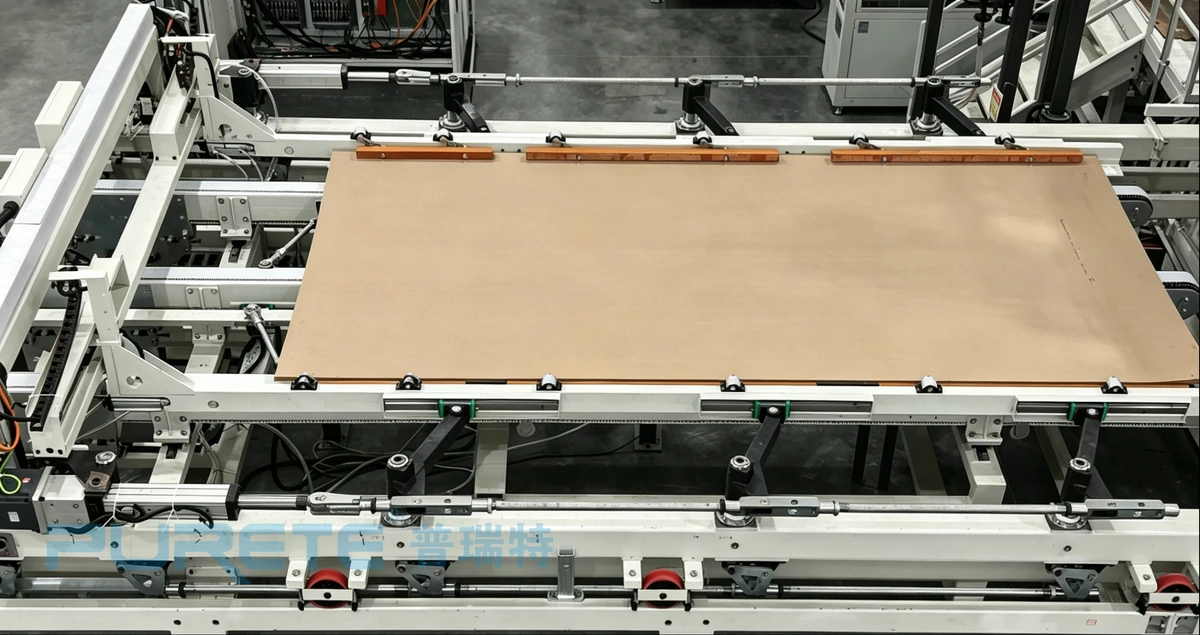
For a large board, the loading stage must be considered together with the board's stiffness, handling method, and position at the next machine. A line designed around a large format should not assume that a manual loading practice suitable for smaller boards will transfer unchanged.
2. Double-Sided Paper Laying
The case includes paper-laying modules, paper-feed conveyors, lifting paper racks, and automatic double-sided paper laying. This stage prepares the decorative material before the board enters the press.
Double-sided production adds a synchronization task: the paper, board, press plate, and intended surface effect need to meet the press in the correct sequence. The paper-laying section is therefore not just an accessory to the press. It is part of the production rhythm that determines whether the line can operate continuously.
3. Pressing and Plate Management
The central stage is the vertical short-cycle press, with infeed and outfeed equipment. In a large-format application, press selection must match the required board coverage, product construction, surface effect, and the operating sequence of the full line.
Steel press plates are also part of the production plan. The case includes handling and storage support for plate replacement. This matters when a factory changes textures, finishes, or product families. A faster press cycle does not remove the need to organize plate changes, cleaning, and safe transport between product runs.
In a large-format line, a press such as PURETE's 4700T Vertical Short-Cycle Press Production Line can be combined with longitudinal feeding, automatic double-sided paper laying, plate-change support, inspection, and synchronized infeed and outfeed. In this case, these functions should be considered as one coordinated response to the panel format and production sequence, rather than as a fixed package for every project.
4. Edge Treatment and Inspection
After pressing, the case flow uses separate edge-treatment steps, transition conveyors, dust removal, and panel inspection. Long-edge and short-edge treatment can be planned as separate responsibilities when the board format and handling direction make that useful.
Inspection should be positioned as a process decision, not as a single machine label. The inspection method must suit the surface requirement, product family, and acceptance process. Visual inspection systems can be considered where they fit the project's quality-control plan, but they should not be described as a standard result of every vertical press line.
5. Cooling, Discharge, and Packing
The downstream flow in this case includes lifting, cooling conveyors, discharge conveyors, packing, and wrapping. Cooling and packing are often treated as secondary modules in an equipment discussion. In continuous large-format production, however, they determine whether completed boards can leave the press area without creating a queue.
The connection between discharge and packing can be designed around the factory's handling method. Conveyors, transfer systems, and automated logistics may be selected where they support the actual layout and product flow. They are not automatic substitutes for a layout review.
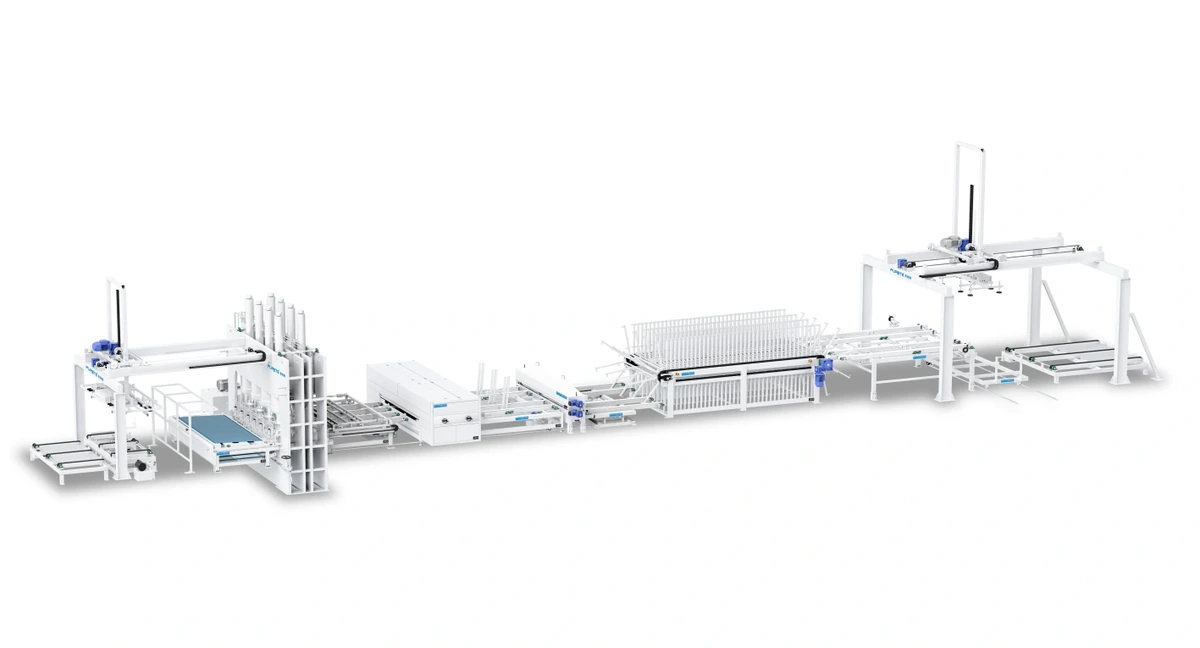
Short-cycle press prodution line
How to Read the Case Figures Correctly
The most useful figures in a press-line case are not interchangeable specifications. Board size, press coverage, cycle time, line footprint, clear height, and finished output each answer a different question.
Press Size and Press-Platen Coverage Are Different Questions
The board format in this case is 2135 × 3660 mm. The press and hot-platen arrangement must cover the required board area while allowing for the edge conditions required by the pressing process. The correct allowance is a configuration decision, not a number that should be copied into another factory's quotation.
Likewise, a press-force figure should be stated only after the machine model and unit are confirmed. Press force, effective pressing area, panel construction, and surface requirement must be read together. A larger number alone is not a complete selection rule.
Why a 24-Second Cycle Is Not a Finished-Output Promise
The supplied case uses a 24-second total cycle as a reference value. Mathematically, 3,600 seconds divided by 24 seconds equals 150 cycles per hour. If one qualified board is released per complete cycle, this is the theoretical maximum of 150 boards per hour.
That calculation is useful because it makes the press rhythm visible. It is not the same as planned factory output. Paper positioning, board loading, plate changes, cleaning, inspection, minor stoppages, rejected boards, and product changeovers all affect the number of finished panels a factory can actually ship.
For production planning, keep two values separate:
- Theoretical press cycles per hour.
- Planned finished output after utilization, changeovers, inspection, and yield are included.
This distinction helps a production team avoid building a delivery plan around the fastest possible press rhythm.
What Must Be Confirmed Before Applying This Case Elsewhere
This case can guide the conversation, but it is not a copy-and-paste line design. A similar project should first confirm:
- Required board sizes and thickness range.
- Substrate and decorative-paper or film combination.
- Single-sided or double-sided pressing requirement.
- Surface texture, press-plate requirement, and product-change pattern.
- Target production plan, including the difference between theoretical cycles and finished output.
- Available factory length, width, clear height, utilities, and transfer route.
- Inspection, cooling, storage, and packing interfaces.
These inputs establish whether a longitudinal large-format configuration is appropriate and which modules should be included. For a broader method that starts with the panel matrix and product family, see PURETE's short cycle press line planning guide.
Conclusion: Large-Format Pressing Is a Line-Integration Decision
A 7 × 12 ft vertical short-cycle press line is not defined by press size alone. Its value comes from whether the loading, paper laying, pressing, plate handling, edge treatment, inspection, cooling, and packing stages can support the same large-format production task.
The case shows why a large board should be planned as a line-flow decision. When the panel matrix, decorative requirement, material movement, and output plan are considered together, a factory can determine whether the larger format is appropriate and what supporting modules it needs.
Discuss a 7 × 12 ft Short-Cycle Press Line with PURETE
Send PURETE the intended panel sizes, substrate, decorative material, pressing sides, surface requirements, product mix, and production plan. The short-cycle press production line category provides a starting point for discussing a configuration that fits the required panel flow.
FAQs About 7 × 12 ft Vertical Short-Cycle Press Lines
Is a larger press always the right choice for decorative panels?
No. A larger format is relevant when the required board sizes, long-panel products, pressing sides, cutting plan, and material flow justify it. The press should be selected as part of the complete line, not independently from paper laying, inspection, cooling, and packing.
Why can the press-platen area be larger than the board?
The pressing arrangement must provide coverage for the required board format and edge conditions. The exact margin depends on the machine configuration and the pressing process, so it should be confirmed from the relevant equipment drawing and product requirement.
Does a 24-second cycle guarantee 150 boards per hour?
No. It produces a theoretical cycle calculation only. Actual finished output depends on the full process, including paper laying, loading, product changes, inspection, downtime, and yield.
Can a vertical short-cycle press line include vision inspection or automated transfer?
It can be designed with inspection and logistics modules when they suit the product and factory layout. The chosen solution should be defined as part of the project configuration rather than assumed as a standard feature.
How many steel press plates can a storage system hold?
Storage capacity depends on the selected storage equipment, plate size, handling method, and line layout. Confirm the capacity against the specific equipment model and project plan.
What Is the Principle of Auto Coating Machine?

Advantages of Short-Cycle Presses in Panel Processing
Application of Soft-Touch (Excimer) Coating in Furniture and Decorative Materials
Which Industries Benefit Most from PUR Laminating?
What Is the Principle of Roller Coating Machine?
How Does PUR Laminating Compare to Solvent-Based Lamination in Terms of Cost?
Global Surface Finishing Market Analysis and Development Trends


