

Automating Industrial Panel Finishing Lines: Coordinating Material Handling, Process Stages, and Changeovers
 August 31, 2026
 Hits:249second
When a panel finishing line fails to meet its production target, the problem is not always the coating machine itself. In many factories, the real losses occur between machines: panels enter the line out of position, sanding cannot keep up with coating, curing capacity limits the conveyor speed, or a color change stops several stations at the same time.
This is why coating line equipment should be planned as one coordinated production system. Feeding, conveying, surface preparation, coating, drying, curing, inspection, stacking, and changeover control must work to the same production rhythm.
For industrial panel manufacturers, the goal is not simply to install an automatic spray painting line or a faster roller coating line. The goal is to produce the required finish repeatedly, at the required output, with controlled material movement and predictable changeover time.
This guide explains how to coordinate an automated panel finishing line from the first panel entering the system to the final approved panel leaving it.
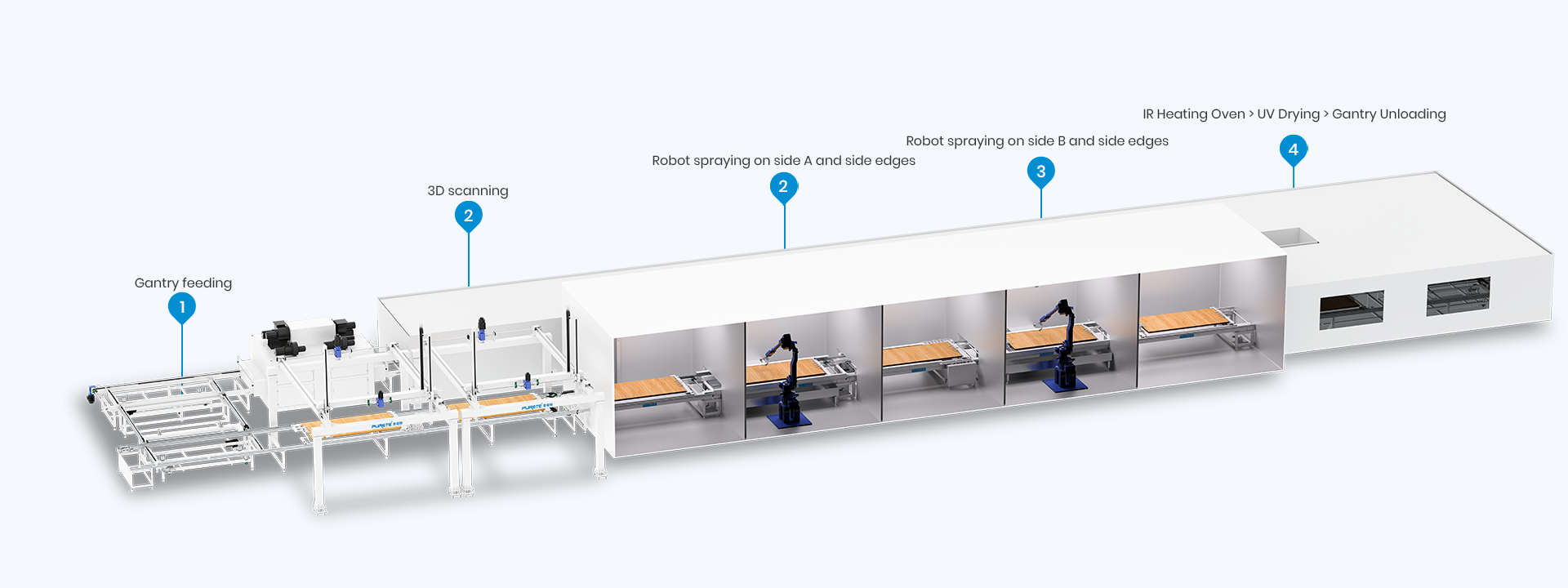
PURETE Robotic Automatic Spraying Production Line for Industrial Panels
What Does Coating Line Equipment Include?
A complete coating equipment production line normally combines several functional sections:
Panel loading and feeding
Alignment and positioning
Sanding and dust removal
Roller, spray, curtain or other coating equipment
Leveling, drying or curing
Inspection and defect handling
Unloading and stacking
Conveyors, buffers and transfer units
PLC, HMI, sensors and recipe management
Ventilation, filtration and safety systems
The exact configuration depends on the substrate, panel geometry, surface effect, coating chemistry, product mix and target capacity.
A flat MDF panel for a high-volume furniture program may require stable loading, sanding, dust removal, roller coating and UV curing. A shaped cabinet door may require 3D scanning, automatic spray programming, a multi-axis spray unit and controlled drying. A high-mix factory may need flexible positioning, recipe control and quick-cleaning systems more than maximum conveyor speed.
The key distinction is simple:
A machine performs one process. A production line coordinates many processes around the movement and quality of the panel.
That distinction should guide both new-line design and automation upgrades.
Start With Material Handling, Not the Coating Machine
Many line-planning projects begin with the coating method. A better approach is to begin with the panel and its movement through the factory.
Before selecting equipment, define:
The minimum and maximum panel dimensions
Panel thickness and weight
Flat, profiled or irregular geometry
MDF, plywood, particleboard, HDF, metal sheet or other substrate
Required surface effect and coating type
Daily and shift output
Number of product families
Number of colors or coating systems
Expected changeover frequency
Available factory length, width and height
These details determine how the panel must be loaded, supported, aligned, transferred and inspected.
Panel Staging and Identification
The line should not begin at the first conveyor. It begins in the staging area.
Panels should be grouped by production order, substrate, finish and coating recipe before they reach the loading station. If different products are mixed without clear identification, the automation system may run the wrong recipe even when the equipment itself is functioning correctly.
Useful identification methods include:
Product or work-order numbers
Barcode or QR-code scanning
Batch and coating-lot records
Visual labels for panel direction
Recipe numbers linked to the production schedule
A simple rule is useful: the system should identify the panel at the point where the decision is made, not several stations earlier from memory or paperwork.
Loading and Alignment
Automatic loading must account for more than panel presence. It must control:
Panel spacing
Leading-edge position
Orientation
Side alignment
Surface contact
Double-sheet prevention
Transfer stability
Poor alignment at the entrance can create problems throughout the line. A panel entering a spray zone at an angle may receive uneven coverage. A misaligned panel entering a roller coater may create edge variation or contact the wrong part of the roller. A panel that shifts during transfer may also create an inspection failure even when the coating parameters are correct.
The loading system, conveyor and coating equipment therefore need a shared reference position.
Conveyors and Transfer Points
Conveyors are not passive transport devices. They establish the distance between panels, control process time and determine how one station communicates with another.
A well-designed transfer point should answer four questions:
Where is the panel positioned?
At what speed does it enter?
What confirms that the panel has transferred successfully?
What happens if the next station is not ready?
Depending on the line, transfer equipment may include belt conveyors, roller conveyors, alignment devices, lifting units, turning systems, buffer conveyors or accumulation zones.
For large panels, the conveyor must also prevent sagging, vibration and surface contamination. The support method should be selected according to panel size, weight, coating condition and whether the back side can touch the transport surface.
Buffers and Accumulation Zones
A buffer is useful when two process stages have different short-term operating speeds. It can absorb a brief stop, support inspection, or separate product batches during a planned changeover.
However, a buffer should not be used to hide a permanent bottleneck. If the curing oven is consistently slower than the coating station, adding more accumulation only moves the problem downstream.
The best buffer locations are usually:
Before a known bottleneck
Before inspection
Before a planned changeover point
Between process sections with different operating speeds
Before unloading and stacking
Each buffer should have a defined maximum quantity. When the buffer reaches that limit, the upstream station should receive a controlled stop signal rather than continuing to produce material that cannot move forward.
Coordinate Process Stages Around One Production Rhythm
Surface Preparation
Surface preparation may include sanding, brushing, dust removal, cleaning or other treatment. Its purpose is not only to improve appearance. It also determines whether the coating can be applied consistently.
For panel finishing, the surface preparation stage should control:
Surface flatness
Dust level
Oil or contamination
Edge condition
Moisture or temperature where relevant
Panel orientation
Surface readiness for the selected coating
If sanding and coating operate at different capacities, the factory may experience either an empty coater or an accumulating queue of prepared panels.
Coating Application
The coating stage must be selected according to the panel geometry and finish requirement.
A roller coating line is generally suitable for flat, stable surfaces. Its performance depends on the relationship between:
Conveyor speed
Coating roller speed
Metering or applicator roller speed
Roller pressure
Coating viscosity
Coating temperature
Substrate thickness and flatness
If the coating roller and conveyor are not synchronized, visible horizontal marks or uneven transfer may occur.
An automatic spray painting line provides more flexibility for shaped surfaces, edges and complex workpieces. It requires coordination between:
Panel recognition
Spray trajectory
Gun distance
Gun angle
Pump pressure
Nozzle selection
Panel speed
Exhaust and filtration
A curtain coating system has a different control logic. Pump speed, curtain stability, knife gap and conveyor speed influence the coating layer. It is generally used for specific flat-panel finish requirements and must be evaluated together with the coating material.
Drying, Leveling and Curing
The coating station cannot be separated from the drying or curing section.
For liquid coatings, the line may require leveling time before curing. For UV coatings, lamp power, distance, line speed and coating thickness influence curing performance. For water-based systems, evaporation and drying capacity become especially important.
If a line is designed around the maximum speed of the coater but not the actual curing requirement, the result may be:
Incomplete curing
Surface defects
Poor adhesion
Blocking during stacking
Rework after inspection
Reduced usable output
The curing section should therefore be treated as a capacity-setting process, not merely an accessory after the coating machine.
Inspection and Stacking
Inspection must be connected to production control. A panel that fails inspection should not simply continue to stacking and be discovered later.
The line should define:
What defects are detected automatically
What requires operator inspection
Where rejected panels are diverted
How the defect reason is recorded
Whether the previous panels need to be quarantined
Who can release the line after an adjustment
Stacking also affects quality. Panels that are not sufficiently dry or cured may stick together, receive pressure marks or become contaminated during handling.
How to Calculate Takt Time and Practical Capacity
Line speed should be calculated from the required output and the available production time.
The basic formula is:
Takt time = Net available production time ÷ Required good panels
For example, if a factory has 420 minutes of effective production time and needs 300 good panels per shift:
Takt time = 420 minutes ÷ 300 panels
= 1.4 minutes per panel
= 84 seconds per panel
If the panel pitch is 1.4 meters, the initial conveyor speed would be approximately:
1.4 meters ÷ 84 seconds × 60
= 1.0 meter per minute
This is a planning value, not a final operating setting.
The line must also account for:
Loading and unloading time
Cleaning
Changeovers
Inspection
Short stoppages
Panel rejection
Maintenance
Product variation
Curing or drying constraints
A more realistic model is:
Good output =
Theoretical output × Availability × Yield
Theoretical capacity may look attractive on a machine specification sheet, but good output is what the factory can actually sell.
For reference, PURETE equipment data indicates that standard roller and spray systems can operate at very different speeds depending on the process. Roller coating lines may run in the 10–12 m/min range in standard configurations, while reciprocating spray lines for shaped panels are commonly designed around a lower speed range. These figures should never be treated as universal guarantees. The final speed must be verified against the actual panel, coating material, finish target and curing process.
A PURETE reciprocating spray line example lists a line speed of 3–6 m/min, a capacity of 800 m² per 8-hour shift, a total power of 109 kW, an installation area of approximately 50 × 7 m and staffing of 3–5 people. These figures describe a specific project configuration, not a general benchmark for every panel finishing line.
Choosing the Right Finishing Route
| Process route | Suitable applications | Main coordination issues | Changeover considerations |
|---|---|---|---|
| Roller coating line | Flat MDF, furniture panels, flooring substrates | Roller speed, pressure, viscosity, panel flatness and conveyor synchronization | Roller cleaning, coating residue and color changes |
| Automatic spray painting line | Shaped doors, profiled panels and complex surfaces | 3D recognition, spray trajectory, nozzle, pressure and exhaust | Gun, pump, hose and spray-booth cleaning |
| Automatic spray painting system with conveyor | Continuous panel production and multi-station spraying | Panel spacing, transport stability and spray-zone timing | Cleaning must include the conveyor, spray path and material supply |
| Curtain coating | Flat panels requiring specific high-build or high-gloss finishes | Pump speed, curtain stability, knife gap and conveyor speed | Residual coating, filtration and circulation cleaning |
| Hybrid finishing line | Products using different surface routes | Recipe control, transfer logic and process compatibility | More complex scheduling and stronger recipe management |
A factory should ask three questions before choosing the route:
Is the panel flat or geometrically complex?
Is the production mix high-volume or high-variety?
Is the finish mainly controlled by coating transfer, spraying, curing or a combination?
The best line is not necessarily the fastest line. It is the line that can maintain the required quality while handling the real product mix.
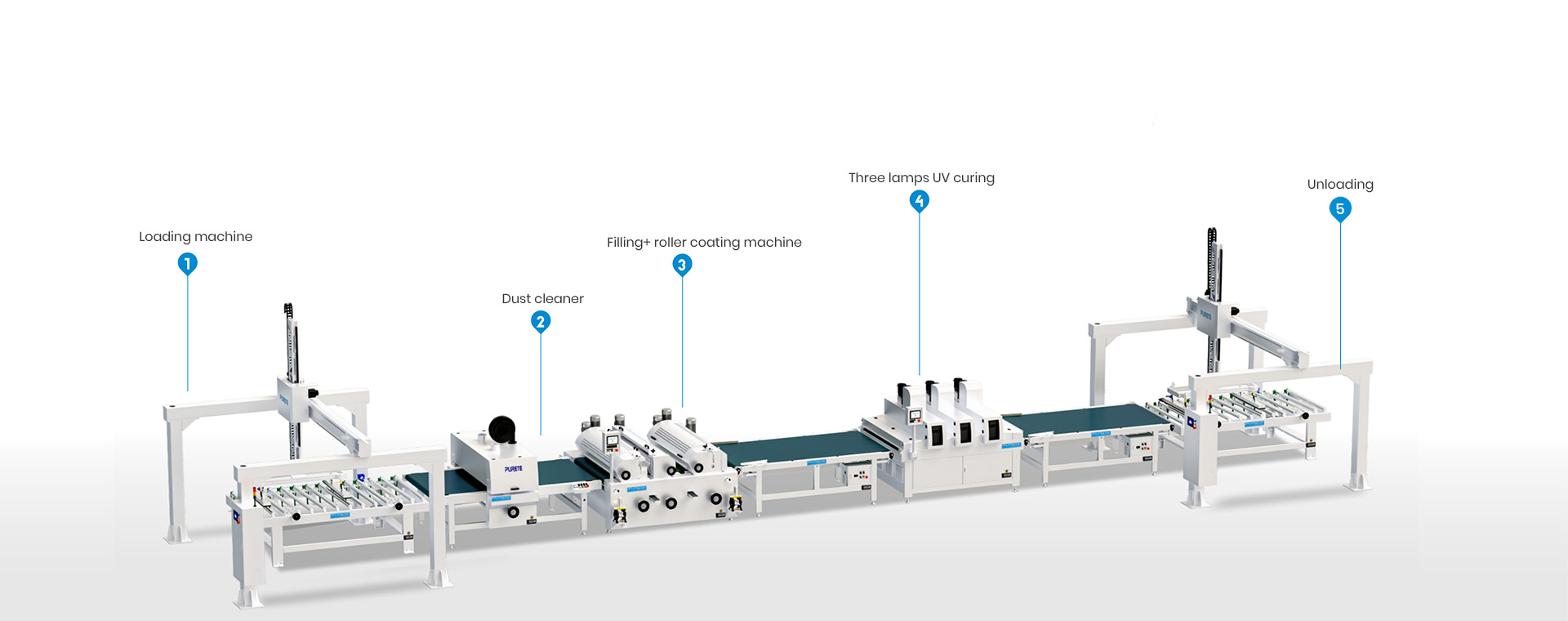
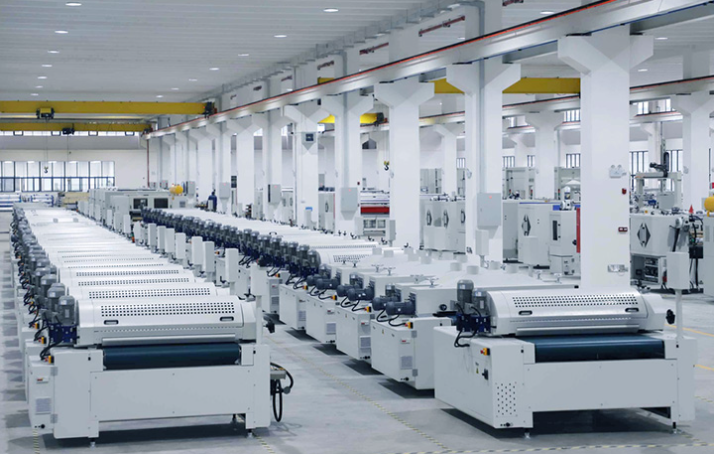
PURETE Fully Automatic Roller Coating Production Line for Flat Panels
Plan Changeovers as a Line-Wide Process
Changeovers are often underestimated because factories measure only the time required to change the coating head. In reality, a changeover affects the entire line.
A changeover may be triggered by:
Product size
Panel thickness
Substrate type
Color
Gloss level
Coating chemistry
Spray program
Roller arrangement
Fixture or support method
Curing recipe
A Practical Changeover Sequence
Complete and identify the last approved panel
Stop new panels from entering the line
Remove or isolate unfinished panels
Drain, purge or clean the coating path
Clean rollers, pumps, hoses, spray guns or curtain components as required
Load the new product and coating recipe
Adjust guides, supports, applicators and conveyor settings
Confirm drying or curing parameters
Run a dry cycle or controlled test cycle
Produce the first panel
Inspect and approve the first panel
Release the line for normal production
Separate External and Internal Setup
External preparation may include:
Preparing the next coating material
Confirming the next recipe
Preparing labels and inspection forms
Preparing rollers, guns or fixtures
Checking substrate and color information
Sequencing products into logical families
Internal setup includes:
Stopping the line
Cleaning and purging
Replacing or adjusting components
Calling the new recipe
Performing dry runs
Producing the first panel
This distinction is especially important for small-batch production. A line that can change recipes quickly but still requires long manual cleaning may not deliver a short total changeover.
Measure Changeover Quality
Track more than elapsed time:
Planned changeover time
Actual changeover time
Material consumed during cleaning
Number of trial panels
First-piece pass rate
Rework during the first production batch
Time required to return to a previous setup
Unplanned downtime after changeover
The best changeover is not the one that ends fastest. It is the one that returns the line to stable, approved production with minimal waste.
First-Piece Validation: The Release Gate
The first panel after a changeover is not just a sample. It is the decision point between setup and production.
The line should not be released until the first piece has been checked against the approved requirements.
What Should Be Recorded?
Record the following information:
Product code
Panel dimensions and substrate
Material or batch number
Coating name, color and batch
Recipe version
Conveyor speed
Roller, pump or spray settings
Curing temperature, time or UV condition
Coating thickness
Gloss or color result
Adhesion or performance checks where required
Appearance photographs
Adjustment history
Production and quality approval
The purpose of this record is traceability. If a defect appears later, the factory should be able to determine whether the problem began with the material, recipe, equipment setting, cleaning condition or curing process.
Appearance Is Not Always Enough
Visual appearance is important, but it may not be the only acceptance criterion.
Depending on the product, first-piece validation may also include:
Coating thickness
Gloss consistency
Color difference
Adhesion
Scratch or abrasion resistance
Surface hardness
Cure condition
Edge coverage
Smoothness or texture
Bond strength for laminated surfaces
The acceptance criteria should be agreed before production begins. Otherwise, operators may make different decisions about the same panel.
Use a Hold Point
First panel → Inspection → Adjustment or approval → Line release → Normal production
If the first panel fails, the line should return to adjustment rather than continue producing panels for later sorting.
For larger production batches, factories should also define routine checks at the beginning, middle and end of the run. This helps identify process drift caused by coating viscosity, roller wear, lamp aging, temperature variation, dust or conveyor instability.
Three Common Factory Scenarios
High-Volume Flat Panels
For high-volume MDF or furniture panels, the main priorities are:
Stable loading
Accurate alignment
Continuous sanding and dust removal
Synchronized roller and conveyor speed
Reliable curing capacity
Low defect rate
Minimal unplanned stoppage
In this case, the factory should focus on line balance and repeatability rather than adding unnecessary flexibility.
Complex or Profiled Panels
For shaped cabinet doors, decorative profiles or irregular panels, the priorities change:
3D scanning or shape recognition
Automatic program generation
Edge and side coverage
Stable fixtures
Flexible spray trajectories
Controlled panel rotation or transfer
Reliable inspection
PURETE intelligent spray systems can use 3D vision to recognize different workpiece shapes and automatically generate spraying programs. One equipment configuration supports workpieces up to approximately 2,800 × 1,200 × 100 mm, subject to the final system design and application requirements.
Small-Batch, High-Variety Production
High-variety factories need a different definition of efficiency.
Their main concerns are often:
Quick product recognition
Recipe accuracy
Short cleaning cycles
Flexible positioning
Easy access to guns, rollers and pumps
Low trial-panel waste
Fast first-piece approval
For this type of factory, a line that runs slightly slower but changes products reliably may produce more saleable output over the full shift.
Common Mistakes to Avoid
Mistake 1: Selecting Equipment by Maximum Speed
Maximum speed does not represent practical capacity. The slowest process, often curing, inspection or handling, controls the real output.
Mistake 2: Treating the Conveyor as an Accessory
The conveyor determines panel spacing, alignment, transfer timing, process dwell time and accumulation behavior.
Mistake 3: Ignoring the Product Mix
A line designed for one product may perform poorly when asked to process many sizes, colors or coating systems.
Mistake 4: Planning Changeovers Only Around the Coater
Cleaning, recipe control, guides, fixtures, curing and inspection must all be included.
Mistake 5: Releasing Production Without a First-Piece Hold Point
A small setup error can affect an entire batch if the first panel is not formally approved.
Mistake 6: Using Unsupported Performance Claims
Line speed, capacity, coating consumption and labor requirements should always be tied to a specific material, configuration and operating condition.
A Pre-Project Checklist for Buyers
Before requesting a coating line proposal, prepare the following information:
Panel dimensions and thickness range
Panel weight and surface condition
Substrate types
Required coating or finish
Coating chemistry
Target production per shift
Product and color mix
Expected changeover frequency
Available factory space
Required utilities
Existing equipment to be integrated
Inspection and acceptance requirements
Desired future expansion
Photos, drawings or sample panels
The supplier should then provide more than a machine list. A useful proposal should include:
Process flow
Layout drawing
Equipment list
Expected operating speed
Capacity assumptions
Buffer locations
Changeover method
Cleaning requirements
Recipe and control strategy
FAT and SAT criteria
Training and after-sales plan
Conclusion: Automate the Flow, Not Just the Machines
An automated panel finishing line is successful when the entire process behaves predictably.
Panels must enter in the correct position. Surface preparation must keep pace with coating. Conveyors must maintain the production rhythm. Drying and curing must support the target speed. Inspection must be connected to release decisions. Changeovers must be planned across the full line. Most importantly, the first approved panel must become the reference for the production run.
The right coating line equipment is therefore not simply the machine with the highest speed or the longest equipment list. It is the coordinated system that matches the factory’s panels, finishes, product mix, production target and operating capability.
FAQs
What is coating line equipment?
Coating line equipment is the connected group of machines used to load, transport, prepare, coat, dry, cure, inspect and stack panels in one controlled production flow.
What equipment is included in a complete panel finishing line?
A complete line may include loading equipment, conveyors, alignment units, sanding and cleaning machines, roller or spray coaters, drying or curing systems, inspection equipment, stacking units and PLC-based controls.
How do I calculate the required line speed?
Start with the required good output and the net available production time. Calculate takt time, then compare the required panel pitch and conveyor speed with coating, drying, curing and inspection capacity.
Is a faster conveyor always better?
No. A higher conveyor speed may reduce coating coverage, leveling time, curing performance or inspection stability. The correct speed is the highest speed that still produces acceptable, repeatable quality.
Should I choose roller coating or automatic spray painting?
Roller coating is generally suited to flat, stable panels. Automatic spray painting is more flexible for shaped, profiled or complex surfaces. The final decision should consider panel geometry, finish target, production mix and cleaning requirements.
How can I reduce changeover time?
Prepare the next material and recipe before stopping the line, standardize cleaning, use saved setup parameters, group similar products and make first-piece approval part of the planned changeover sequence.
What should be checked on the first panel?
Check the panel identity, coating material, recipe, appearance, thickness, gloss, color, adhesion, curing condition, edge coverage and any customer-specific performance requirement.
Can one line process different panel materials?
It may be possible, but the different substrates must be evaluated for flatness, absorption, surface energy, coating compatibility, drying behavior and finish tolerance. Testing with the real materials is strongly recommended.
What information should I provide to a coating line supplier?
Provide panel dimensions, substrate, finish target, coating type, production target, product mix, changeover frequency, factory constraints, utilities and existing equipment. Sample panels and drawings make the proposal more accurate.
If you are planning a new line or upgrading an existing one, send PURETE your panel dimensions, substrate information, finish requirements and target output. Our engineering team can help evaluate the material flow, process route, line balance, changeover method and first-piece validation requirements before the final configuration is confirmed.
Request an Automated Panel Finishing Line Review
What Is the Principle of Auto Coating Machine?

Advantages of Short-Cycle Presses in Panel Processing
Application of Soft-Touch (Excimer) Coating in Furniture and Decorative Materials
Which Industries Benefit Most from PUR Laminating?
What Is the Principle of Roller Coating Machine?
How Does PUR Laminating Compare to Solvent-Based Lamination in Terms of Cost?
Global Surface Finishing Market Analysis and Development Trends


