

How to Choose a Coating Line for Decorative Panel Production
 March 30, 2026
 Hits:714second
Choosing a coating line for decorative panel production is not just about selecting a coater, a dryer, or the fastest machine in a catalog. For manufacturers, the more reliable decision comes from understanding how substrate condition, finish target, coating system, production volume, and line integration work together. A line that performs well in one factory may not perform well in another if the panel type, surface requirements, or production logic are different.
This guide is especially relevant for manufacturers of MDF decorative panels, furniture boards, wall panels, laminated composite boards, and other engineered decorative surfaces. In these applications, the right line must support not only surface appearance, but also stable throughput, repeatability, and practical operating control.
That is why experienced buyers rarely start with the question, “What is the best coating line?” A more useful question is: What kind of coating or finishing line best matches our decorative panel products, finish targets, coating system, and factory conditions? That question leads to better equipment decisions because decorative panel production depends on the performance of the full process, not just the name of one machine.
What Are the Core Requirements of a Decorative Panel Coating Line?
A decorative panel coating line should be judged by the result it helps the factory achieve, not only by what equipment it includes. In most projects, four requirements define whether a line is commercially successful: surface quality, effective output, consistency, and total operating cost.
Surface quality comes first because decorative panels are evaluated visually as well as functionally. Depending on the product, the line may need to support gloss uniformity, matte consistency, texture development, color stability, or wear-related performance. A line that runs smoothly but cannot produce the required finish quality is not the right solution.
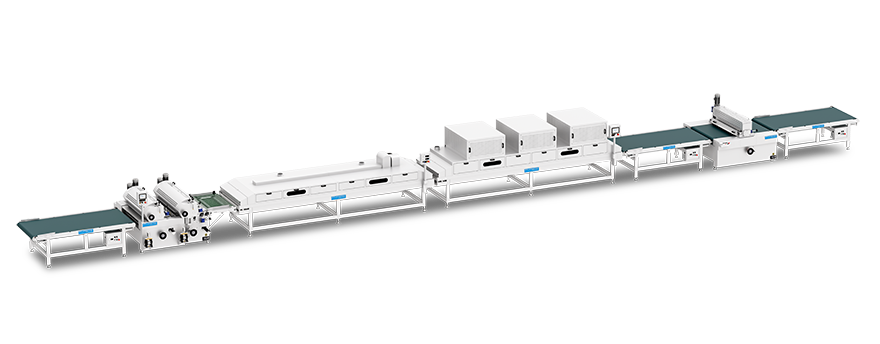
Effective output is also important, but it should not be confused with nominal machine speed. Decorative panel producers need stable feeding, balanced drying, manageable changeovers, and a process rhythm that holds up over real production time. In practice, a slightly slower but better-balanced line often delivers more usable output than a faster but unstable one.
Consistency is where many investment decisions are tested. A trial panel may look excellent, but production success depends on whether the same surface result can be repeated across shifts, batches, and product runs. This depends on substrate preparation, coating transfer, drying or curing, and overall line control working together.
Total operating cost should also be evaluated carefully. In decorative panel production, cost is shaped not only by machine price, but also by labor, coating consumption, energy use, maintenance needs, downtime risk, and defect loss. That is why a coating line should be selected as a long-term production system rather than as a short-term equipment purchase.
How Should You Choose a Coating Line Based on Decorative Panel Substrates?
Substrate category is an important starting point in decorative panel line selection, but it is not the only factor. A suitable line depends not only on whether the board is MDF, plywood, or particleboard, but also on surface density, flatness, sanding condition, moisture behavior, pre-treatment status, and the coating system planned for production.

MDF Decorative Panel Coating Line Requirements
MDF is widely used in decorative panel manufacturing because of its relatively uniform structure and suitability for furniture and interior products. Even so, MDF should not be treated as one standardized material in all projects. Surface density, edge absorption, and sanding quality can all affect finish quality.
For MDF decorative panels, the line usually needs strong support in surface preparation. This becomes even more important when the target is high gloss, super matte, or another premium decorative finish. In these cases, sanding quality, dust removal, and stable coating transfer may have as much impact on the final result as the coating equipment itself.
Plywood Decorative Panel Coating Line Requirements
Plywood introduces a different set of challenges. Because of its layered structure and veneer-related variation, it may show greater differences in smoothness, porosity, and visual consistency. A line that performs well for one plywood specification may not produce the same finish quality on another.
This means manufacturers should look beyond the plywood category itself and evaluate the actual surface condition and decorative target. If the goal is to preserve the natural veneer character, the line priorities may differ from those of a project aiming for a more engineered and uniform surface appearance.
Particleboard Decorative Panel Coating Line Requirements
Particleboard can also be used in decorative surface production, but its behavior in a coating or finishing line often depends heavily on the quality of the surface layer and the condition of pre-treatment. In some cases, a line may need to work together with sealing, pre-lamination, or more controlled preparation in order to achieve stable decorative quality.
The practical lesson is simple: substrate type matters, but substrate condition matters more than broad material labels alone. Buyers should define what kind of board condition the line must process repeatedly, not just what the board is called.
How Does the Required Surface Finish Affect Coating Line Design?
The finish requirement is one of the strongest drivers of coating line design. A line built for high gloss decorative boards may not be suitable for super matte panels, and a route developed for wear resistance may differ from one focused mainly on appearance. This is why finish target should always be evaluated together with the coating system.
High Gloss Decorative Panel Production
High gloss finishes require strong control over substrate preparation, surface cleanliness, coating leveling, and curing stability. Gloss surfaces reveal defects easily, so any weakness in sanding, dust removal, coating application, or line balance may become visible in the final panel. In these applications, the line must support a stable process from board preparation to final curing.
Matte Decorative Panel Production
Matte finishes are sometimes assumed to be easier, but they require their own kind of control. Uneven sheen, local texture variation, or inconsistent curing can make matte boards look unstable from batch to batch. A suitable matte line should therefore support consistent application and finish development rather than simply aiming for lower gloss.
Super Matte or Skin-Feel Decorative Panels
Super matte and skin-feel surfaces often involve more advanced curing strategies, including excimer-related technology in some applications. However, this should not be treated as a universal route. Whether excimer technology is suitable depends on the coating system, target effect, substrate condition, and the manufacturer’s process control capability. Buyers should therefore evaluate this route as a specialized finish solution rather than as a default upgrade from a standard matte line.
Wear-Resistant Decorative Surface Production
Wear-resistant decorative surfaces are judged by both appearance and performance. In these projects, coating build, curing conditions, and surface treatment need to work together. The process route may vary depending on whether the wear resistance mainly comes from the coating formulation, an added functional layer, or a combined finishing structure.
Decorative Surface Treatments and Composite Finishing
Some decorative panel manufacturers are not only coating boards, but also creating surfaces through decorative film bonding or functional layer lamination. In these cases, laminating may become part of the full finishing route. But this point should be defined clearly: laminating is relevant in some decorative panel production lines, not in every coating line.
Here is a quick comparison of how finish targets can influence line priorities:
| Finish Type | Main Process Focus | Typical Line Priority |
|---|---|---|
| High Gloss | Surface smoothness and leveling | Sanding quality, dust removal, curing stability |
| Matte | Sheen consistency | Controlled coating and repeatable finish development |
| Super Matte / Skin Feel | Surface effect plus curing compatibility | Coating system matching and specialized curing route |
| Wear-Resistant | Durability and appearance balance | Coating build, curing balance, functional finishing |
This kind of comparison matters because the finish requirement does not only describe how the panel should look. It also affects process routing, equipment integration, and production risk.
What Equipment and Process Sections Are Usually Included in a Decorative Panel Coating Line?
A decorative panel line should be viewed as a connected process system rather than a series of isolated machines. Although the exact configuration depends on the product and finish route, most projects involve several key sections that must work in balance.
The process usually begins with feeding and conveying. Stable handling is important because panel misalignment or inconsistent transfer at the front end of the line can create downstream quality and efficiency problems.
Surface preparation often includes sanding, especially in MDF and other engineered board applications where final finish quality depends heavily on substrate smoothness. Dust removal follows as a critical quality-control stage because decorative surfaces are highly sensitive to residual contamination.
The coating section is the core application stage, but it should not be evaluated separately from the rest of the line. Whether the line uses roller coating, spray coating, curtain coating, or another application method depends on the finish target, coating system, substrate behavior, and required process stability. Manufacturers comparing different routes often also review specific solutions such as a roller coating line, a UV coating line, or a broader decorative panel production line, depending on the project scope.
Drying or curing is equally important. This stage must be matched carefully to coating chemistry, line speed, and finish requirement. UV, water-based, solvent-based, and specialty systems do not behave the same way in production, which is why curing design should be discussed early rather than treated as a secondary detail.
In some decorative panel routes, laminating is also included. This becomes especially relevant where the target surface is created through PET films, decorative layers, aluminum-based structures, or other composite finishing methods. In those cases, manufacturers may compare a dedicated PUR laminating line or a broader panel laminating machine solution as part of the overall project.
Inspection is the final control point. In decorative production, inspection is not just about rejecting defective panels. It is also part of maintaining process stability and protecting finish consistency over time.
Which Technical Parameters Matter Most When Choosing a Decorative Panel Coating Line?
When buyers compare line proposals, the most useful parameters are those that affect actual production capability rather than just catalog presentation. Several technical points are especially important, but each should be interpreted in the context of the whole process.
Working width is one of the first practical filters because it determines what panel formats the line can support. For manufacturers producing large decorative boards, width can become a strategic market decision rather than a simple machine specification. In one Purete project example, a customized line was built with 1920 mm working width for large-format panel processing, showing how width can be linked directly to product positioning.
Line speed is also important, but only when sanding, coating, drying, conveying, and inspection can operate in balance. A high-speed coater does not guarantee high usable output if the rest of the line cannot maintain the same pace.
Drying or curing method should always be evaluated together with coating chemistry. UV, water-based, solvent-based, and specialty coatings can require very different curing designs, temperature controls, and finish development conditions. This is one reason why paint system compatibility should be defined early in the equipment planning stage.
Coating thickness matters because both appearance and performance may depend on repeatable film build. But thickness should not be treated as an isolated number. The more practical question is whether the line can maintain the required coating build consistently across the substrate and across production time.
Energy consumption is another important factor, especially in a full finishing line where drying, conveying, ventilation, and environmental control can shape long-term cost. A line that looks attractive at the purchase stage may become less competitive if energy demand is not aligned with real production needs.
Automation level should be selected according to output target, product variation, labor strategy, and maintenance capacity. Higher automation can improve repeatability, but only if the factory can support the system operationally.
What Common Configuration Mistakes Should Decorative Panel Buyers Avoid?
Many line problems begin during planning rather than during operation. One common mistake is focusing too much on individual machines while neglecting line integration. Decorative panel quality depends on the full route, so a good coater alone cannot compensate for poor sanding, unstable feeding, or inadequate curing.
Another common mistake is defining substrate categories too broadly. It is not enough to say that a line will process MDF or plywood. Buyers should clarify the actual board grade, thickness range, surface condition, and pre-treatment status that the line must handle. Without this detail, even a technically acceptable proposal may perform poorly in real production.
A third mistake is overlooking future maintenance and expansion. Decorative surface production changes over time as market expectations, product styles, and finish trends evolve. A line that is difficult to service, modify, or upgrade may become restrictive much sooner than expected.
A fourth mistake is ignoring compatibility between equipment and coating system. Whether the project uses UV, water-based, solvent-based, or specialty coatings will affect application behavior, drying strategy, finish development, and line stability. Equipment planning and coating planning should therefore move together.
These mistakes are common because they often come from understandable purchasing shortcuts. In decorative panel manufacturing, however, shortcuts taken during project definition tend to become expensive later.
How Can Manufacturers Choose the Right Decorative Panel Coating Line More Reliably?
The most reliable way to choose a coating line for decorative panel production is to begin with production reality. Manufacturers should first define the actual substrate condition, required surface effect, performance expectation, coating system, output target, and plant constraints before comparing equipment layouts.
This approach improves both technical accuracy and commercial decision-making. It reduces the chance of choosing a line that looks strong on paper but performs weakly in the factory. It also leads to more productive discussions with suppliers because the conversation can focus on process matching rather than on general equipment labels.
For decorative panel manufacturers, the right line is not simply the most advanced, fastest, or most automated one. It is the system that can deliver the required decorative finish consistently, at the target output level, under operating conditions the factory can sustain over time.
FAQ: Common Questions About Decorative Panel Coating Lines
Q:What coating line is suitable for MDF decorative boards?
A:There is no single standard answer for all MDF decorative boards. A suitable line depends on MDF surface condition, finish target, coating system, production volume, and whether the product is positioned for standard or premium decorative use.
Q:Can one coating line process MDF and plywood?
A:In some cases, yes, but only if the substrate differences can be managed within the same process window. The greater the variation in surface behavior, the more important it becomes to evaluate preparation, coating compatibility, and finish tolerance carefully.
Q:Is laminating necessary in decorative panel production?
A:Not always. Laminating is important in some decorative panel routes, especially where the target surface is formed by bonded decorative or functional layers, but it is not a mandatory stage in every coating line.
Q:How do I choose between coating and laminating for decorative boards?
A:The answer depends on how the target surface is created. If the decorative effect is mainly formed by liquid coating transfer and curing, a coating-focused route may be more appropriate. If the surface is built through bonded films or composite layers, laminating may play a more central role.
Q:What affects throughput in a decorative panel coating line?
A:Throughput is influenced by the balance between substrate preparation, coating method, curing capacity, conveying stability, changeover efficiency, and automation level. In decorative panel production, speed only creates value when acceptable finish quality can still be maintained.
What Is the Principle of Auto Coating Machine?

Advantages of Short-Cycle Presses in Panel Processing
Application of Soft-Touch (Excimer) Coating in Furniture and Decorative Materials
Which Industries Benefit Most from PUR Laminating?
What Is the Principle of Roller Coating Machine?
How Does PUR Laminating Compare to Solvent-Based Lamination in Terms of Cost?
Global Surface Finishing Market Analysis and Development Trends


