

How to Plan a Roller Coating Line for AR-Coated Photovoltaic Glass
 September 30, 2026
 Hits:17second
Planning a roller coating line for AR-coated photovoltaic glass starts with the process window, not a generic equipment list. The line has to transfer a very thin, uniform wet coating to clean glass, preserve that coating through drying and handling, and connect reliably with the project’s downstream thermal process. A workable proposal therefore begins with the glass, coating formulation, target optical requirements, production rhythm, and acceptance method that the project has already defined.
This article takes the next step after process selection: it helps a process team prepare the inputs and decisions needed to plan, commission, and accept a production line.
Start with the Process Window, Not the Equipment List
An AR coating line is not selected only by glass width or a desired output rate. The coating must wet and transfer consistently, the glass must move steadily without creating defects, and each downstream step must suit the coating system and the agreed manufacturing route. If these requirements are not defined first, a line may look complete on a layout drawing while leaving critical process interfaces unresolved.
The process window should state what the project is trying to achieve, how that result will be checked, and which operating conditions have already been validated. It should distinguish a coating supplier’s material requirements from an equipment supplier’s control and handling responsibilities. It should also identify which variables may change between products, because a line intended for one stable glass/coating combination is planned differently from a line that must handle frequent product changes.
The practical question is not “Which roller coater should we buy?” It is “What combination of glass condition, coating behavior, roller transfer, line speed, drying route, and inspection method must remain under control?” Once that question is answered, equipment modules can be specified with a clearer purpose.
If the team first needs the underlying process sequence rather than a line-planning framework, it can review how AR coating is applied to photovoltaic glass before returning to the project inputs below.
Define the Inputs for Glass, Coating, and Downstream Processing
Before a line layout is finalized, the project team should assemble one shared input package. This avoids treating coating, handling, and thermal processing as separate purchases.
| Input area | Questions to settle before configuration | Why it affects the line |
|---|---|---|
| Glass | What glass size range, thickness range, surface condition, flatness, and edge condition will be processed? | These factors affect conveying stability, support layout, coating contact, and handling protection. |
| Coating system | What material documentation, storage rules, mixing or circulation requirements, viscosity-control method, and approved application window apply? | The roller arrangement and liquid-management design must follow the actual coating system. |
| Quality target | Which optical, appearance, adhesion, and defect criteria will be used for this product? Who owns each measurement? | The line needs appropriate inspection points and records; a visual check alone may not answer every quality question. |
| Production plan | What shift pattern, batch size, product-change frequency, and required throughput are expected? | These inputs determine conveyor logic, change-control needs, maintenance access, and buffer planning. |
| Downstream route | How will pre-drying, cooling, pre-curing where applicable, and subsequent thermal processing connect to coating? | The downstream route determines the required line interface and the allowable time between steps. |
The coating supplier, glass producer, process engineer, and line supplier do not need to own the same decisions. They do need to use the same project inputs. For example, a material supplier can define the required coating behavior and validation method, while the equipment team translates that requirement into controllable transfer, conveying, and handling functions.
Build the Line Around Four Connected Functions
A planning-level layout can be organized around four connected functions rather than around individual machine names.
1. Surface readiness and controlled infeed
The glass should arrive at the coating station in a condition that the agreed process can accept. The infeed section must support stable transport and protect the surface from avoidable contact, contamination, or handling damage. The project should define where surface readiness is verified and how nonconforming glass is prevented from entering the coating sequence.
This is also where the line establishes a consistent reference for orientation, spacing, and product identification. If multiple sizes are planned, the infeed and conveyor design should show how the line will maintain stable positioning without relying on ad hoc operator adjustments.
2. Metered wet-film transfer
The roller coating station is where a liquid coating is metered and transferred to the moving glass. The design discussion should cover the roles of the applicator roller, metering surface, liquid supply, containment, adjustment mechanisms, and controls. Roller geometry, roller surface specification, relative speed, and conveyor speed affect wet-film transfer together; no single setting should be presented as a universal answer for every coating system.
For this reason, process-change control matters as much as the hardware. A line should have a practical way to record the approved setup for a given glass and coating combination, return to it after maintenance, and distinguish an authorized product change from an uncontrolled drift. The project’s own validated process card should be the reference for operating values.
3. Drying, cooling, and downstream interface
After coating, the wet layer has to move through the agreed downstream route without being disturbed. Depending on the validated process, that route may include pre-drying, cooling, pre-curing, and connection to a later thermal step. The line plan should show the physical handoff between these functions and the information handoff between the teams that own them.
The key planning point is compatibility. Drying capacity, air management, conveyor stability, residence time, and downstream handling must match the coating system and the planned production rhythm. A dryer or cooling section should not be selected as an isolated module simply because it fits the available floor space.
4. Inspection, traceability, and controlled outfeed
Inspection should be planned as part of the process rather than added only at the end. The project needs to decide which checks occur in line, which occur off line, how samples are identified, and how process records connect to a product or batch. If a quality deviation occurs, the team should be able to determine the material, product condition, line setup, and downstream route associated with it.
The outfeed must also protect the finished surface and preserve the sequence needed for later processing. Conveying and accumulation choices should be reviewed against the actual glass dimensions, surface sensitivity, and production schedule.
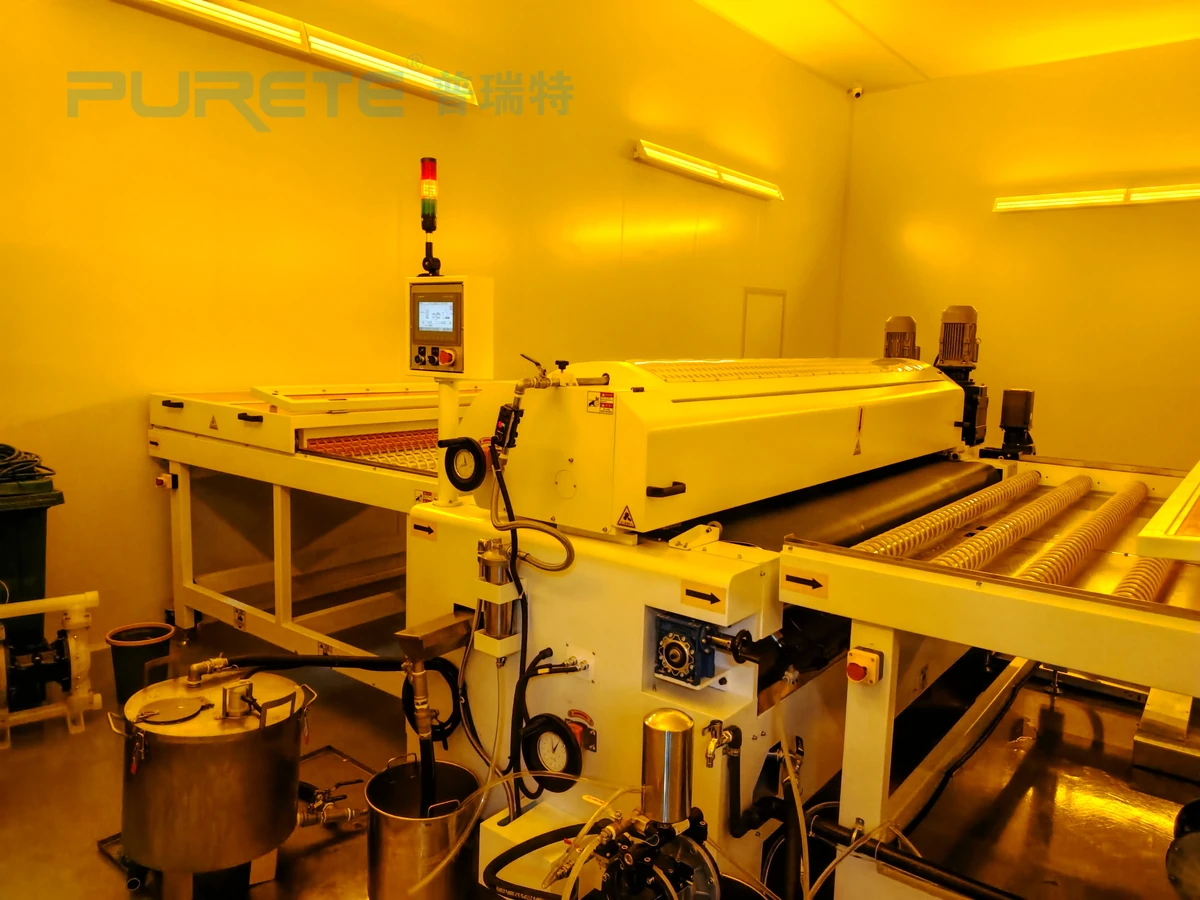
Explore PURETE roller coating production lines.
Plan Wet-Film Transfer and Change Control Together
Stable coating begins with stable transfer, but transfer stability cannot be maintained by equipment adjustment alone. It depends on a controlled relationship between the coating material, the glass condition, the roller system, and the motion of the line.
The project should identify which controls are fixed by hardware and which are adjusted as part of an approved process setup. Roller surface selection is typically a hardware decision. Relative roller settings, conveyor speed, and liquid-management conditions may be operating decisions, but they should be changed only through a defined process-control procedure.
That distinction helps during commissioning. The first goal is not to find one impressive demonstration setting. The goal is to establish a repeatable, documented process window for the intended product. When a new coating batch, glass type, or product specification is introduced, the team should know whether the change stays within that window or requires fresh validation.
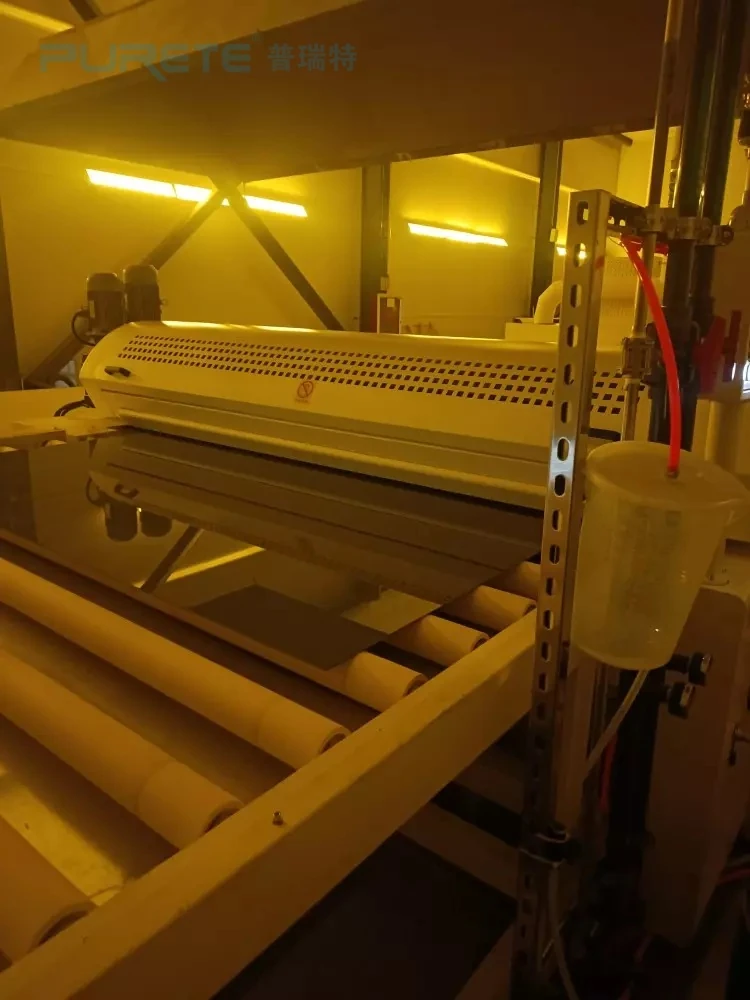
Review the AR coating process overview.
Design the Handling, Cleanliness, and Maintenance Interfaces
Glass coating projects need a maintenance plan that supports process stability. Liquid residue, dust, carryover, and avoidable contact can affect coating appearance and downstream yield. The line layout should therefore provide practical access for cleaning, inspection, roller servicing, and recovery after a planned stop.
Automatic cleaning functions can be evaluated where they support the actual maintenance plan. Their value is not that they eliminate process responsibility; it is that they can make a defined cleaning routine more repeatable and reduce unnecessary manual disassembly. The selected design still needs to match the conveyor construction, coating system, plant practices, and service access available for the project.
The same approach applies to cleanliness. Instead of stating one universal room classification, the project should define the contamination controls required by its own coating and quality criteria: where particles are most damaging, how material and operators enter the area, how surfaces are cleaned, and how the effectiveness of those controls is checked.
Turn the Reference Configuration into a Project-Specific Module List
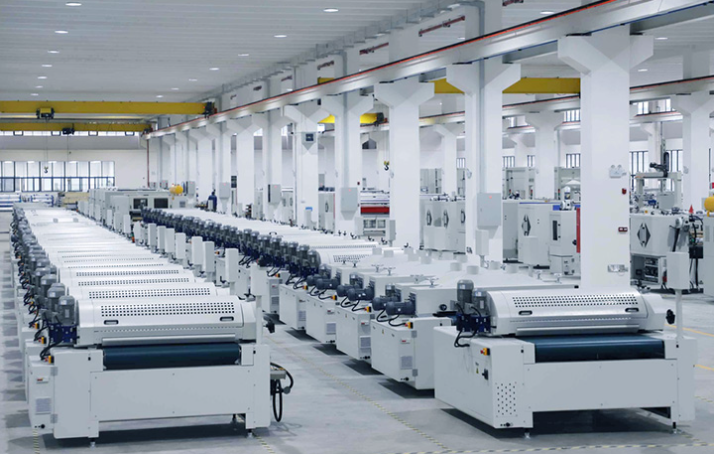
A reference PV glass AR coating configuration may include roller conveyors, a precision single-roller coating unit, pre-drying, cooling or pre-curing functions, and controlled outfeed. This sequence is useful because it illustrates the connected functions a project must cover. It is not a universal bill of materials.
For the new project, each module should be reviewed against the shared input package. The final list should state the purpose of each station, its interface with the previous and next station, the data or condition that must be controlled there, and the acceptance evidence expected during commissioning. That approach prevents a reference configuration from being copied without considering different glass sizes, coating systems, layouts, or downstream thermal routes.
After the project has defined its required modules and interfaces, it can use roller coating production line options to begin an equipment-category discussion. The final solution should still be built around the validated AR process window rather than a standard product description.
Prepare a Commissioning and Acceptance Plan Before Installation
Commissioning is more effective when its questions are agreed before the line is installed. A planning package should define the materials and samples to be used, the functions to be demonstrated, the records to be collected, and the parties responsible for each decision.
Useful pre-commissioning questions include:
- Which glass and coating materials represent the initial production scope?
- Which product conditions and appearance criteria will be checked during trials?
- Which line settings and material conditions must be recorded for each trial?
- What changes require a new trial or approval before production resumes?
- How will coating, equipment, glass, and downstream-processing teams resolve a deviation?
- Which handoff conditions must be met before glass enters the next thermal or handling stage?
This is where engineering value becomes visible. A good line plan does not promise that every material will run at one fixed setting. It creates a controlled route for proving the intended product, documenting the approved condition, and managing later change.
Conclusion: Specify the Interfaces Before You Specify the Machine
An AR roller coating line for photovoltaic glass should be planned as a connected production system. Begin with the validated glass, coating, quality, and downstream requirements. Use those inputs to define controlled wet-film transfer, stable handling, suitable drying and thermal interfaces, practical maintenance, and traceable acceptance checks. The resulting equipment list is then a consequence of the process—not a substitute for it.
Discuss a PV Glass AR Roller-Coating Line with PURETE
To begin a line-planning discussion, prepare three groups of information: the glass formats and surface condition to be processed; the AR coating system and target quality requirements; and the current or planned drying, thermal-processing, and production-rhythm interfaces. You can review PURETE for brand and solution context, then use Contact Us to start a project-matched station-path discussion rather than a generic machine-list inquiry.
FAQ
What information should be available before a roller coating line is quoted?
At minimum, the project should identify the glass range, coating-system requirements, production plan, downstream route, and the quality criteria that will be used to accept the product. Early clarity on these points makes the equipment discussion more useful and reduces late changes to the layout.
Can one approved setup be used for every PV glass AR product?
Not automatically. A setup must remain within the validated process window for the actual glass, coating, and quality requirement. Product or material changes should be assessed through the project’s change-control and validation process rather than assumed to be interchangeable.
How should reference-line data be used during planning?
Reference configurations help identify functions that a project may need, such as coating, drying, cooling, conveying, and cleaning. They should be treated as a discussion baseline. Final specifications, operating conditions, and acceptance criteria must be confirmed for the specific project.
What Is the Principle of Auto Coating Machine?

Advantages of Short-Cycle Presses in Panel Processing
Application of Soft-Touch (Excimer) Coating in Furniture and Decorative Materials
Which Industries Benefit Most from PUR Laminating?
What Is the Principle of Roller Coating Machine?
How Does PUR Laminating Compare to Solvent-Based Lamination in Terms of Cost?
Global Surface Finishing Market Analysis and Development Trends


